Final Goal Is Integration with Patriot Interceptor Missiles
US Military Mobilizes All Pacific Region Missile Defense Units for Training
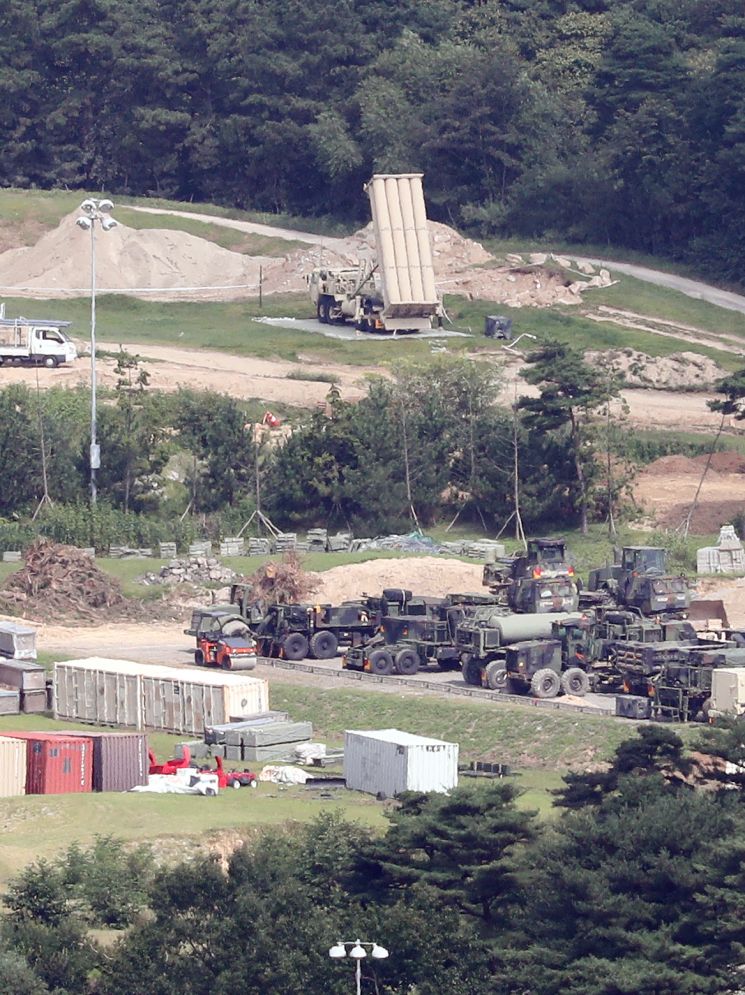
[Asia Economy Yang Nak-gyu, Military Specialist Reporter] The US Forces Korea is hastening the performance upgrade of the Terminal High Altitude Area Defense (THAAD) system deployed in Seongju, Gyeongbuk. With North Korea launching ballistic missiles consecutively, the plan is to complete the customized missile interception system by the end of this month.
According to military officials on the 6th, the US Forces Korea recently brought in radar, electronic equipment (EEU), and missile transport vehicles to Osan Air Base. Once the third phase of the US Forces Korea's performance upgrade is completed, the interception altitudes of THAAD (40?150 km), responsible for upper and lower layer defense, and Patriot (below 40 km) will be integrated and operated together, eliminating blind spots and enabling customized missile interception.
The US Forces Korea is also promoting the third phase of the THAAD system performance upgrade program (Joint Emergency Operational Need, JEON), with the ultimate goal of integrating and operating THAAD and Patriot missiles as one system.
The first phase involves separating and deploying the launchers, which were previously connected by wired connections at the THAAD battery in Seongju, Gyeongbuk, to enable remote control and command. The second phase equips the system with the capability to launch PAC-3 MSE using THAAD radar information before the Patriot radar detects the target. The final third phase integrates the Patriot launchers and PAC-3 MSE into the THAAD system to realize remote launching of the Patriot.
Prior to the THAAD performance upgrade, the US military conducted its first joint ballistic missile defense exercise in March last year with the US missile defense units. It is known to be the first joint exercise involving all US missile defense units in the Pacific region. The participating units included the 38th Air Defense Artillery Brigade, the 94th Army Air and Missile Defense Command (94th AAMDC) in Hawaii, the 35th Air Defense Artillery Brigade (35th ADA) in Osan, Gyeonggi, and the Guam E-3 THAAD battery, totaling four missile units.
The exercise was conducted using computer simulation methods applying various scenarios, and given the nature of the participating units, it assumed North Korea’s ballistic missile launches. It was assumed that North Korean ballistic missiles were flying toward Japan, and missile information detected by US Forces Korea and US Forces Japan was shared, while situation information such as tracking and interception was also transmitted.
Meanwhile, under the current administration, efforts to normalize THAAD operations appear to be gaining momentum. Since June, the frequency of material imports has increased, and an evaluation council for the general environmental impact assessment has been formed. Once the general environmental impact assessment is completed, reinforcement and expansion construction will also be carried out.
© The Asia Business Daily(www.asiae.co.kr). All rights reserved.
![Clutching a Stolen Dior Bag, Saying "I Hate Being Poor but Real"... The Grotesque Con of a "Human Knockoff" [Slate]](https://cwcontent.asiae.co.kr/asiaresize/183/2026021902243444107_1771435474.jpg)
















