[Our Fourth on Unknown Korean Meanings]
Private Education Stirred by Declining Literacy
Literacy Essential for Improving Grades
Up to 500,000 KRW Including Tutoring
Lifelong Learning Centers Also Strengthen Related Education
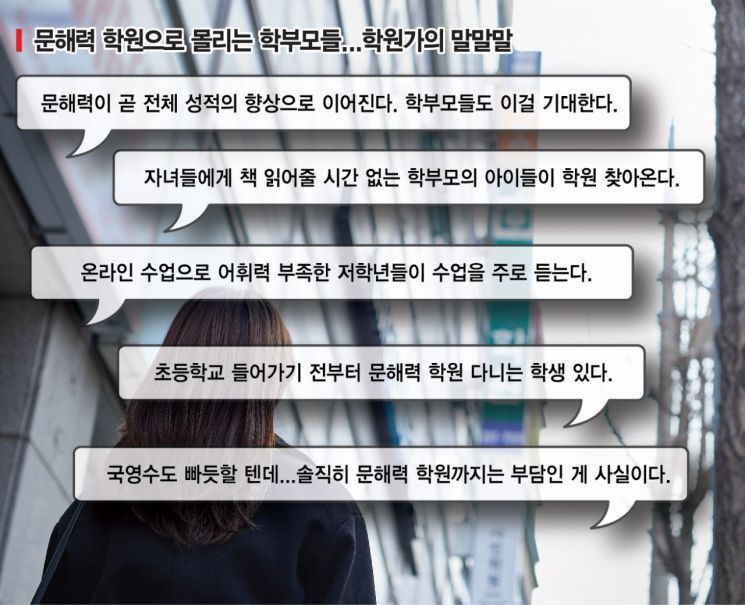 Parents are heading to literacy academies. In the academy district, it was hinted that even children who have not yet entered elementary school are visiting these academies.
[Asia Economy Reporters Seongpil Jo, Byungseon Gong, Gyumin Oh] On the afternoon of the 27th of last month, a math academy classroom in Dongjak-gu, Seoul was in full swing. A class for first and second graders in elementary school was underway. The class proceeded with the teacher asking questions and the children answering. The unusual point was that the textbook was a storybook. The teacher asked the children not about math formulas but about the main content of the book or parts they found impressive. An academy official said, "Even though it is a math academy, the reason we have students read books is ultimately because they need to understand the problems to solve math questions," adding, "Parents who do not have time to provide reading education to their children come to our academy."
The decline in literacy skills is also changing the private education market. This phenomenon arose as anxious parents flocked to academies. The recently emerging 'literacy academies' in the academy districts have already experienced a boom. In fact, one literacy academy in Daechi-dong, Gangnam-gu, Seoul reportedly recruited over 300 students within a year of opening. Most students are lower-grade elementary school children. An academy official said, "Parents who are very interested in education send their children to literacy academies as early as before entering elementary school," adding, "Lower-grade students who have become vocabulary-deficient due to online classes caused by COVID-19 over the past two years mainly visit the academy."
These academies promote that "literacy skills are essential to improve grades in all subjects." Another academy official said, "When parents inquire, they expect improvements not only in Korean language grades but also in math, science, and other subjects," adding, "Literacy skills do not appear as scores but are explained to parents as the foundation for all subjects." The monthly tuition fee is about 150,000 to 200,000 KRW on average. If the education includes one-on-one tutoring or mentoring, it can rise to 500,000 KRW. An official from a literacy academy located in Dongjak-gu said, "We honestly talk about tuition fees with parents who come for consultations," adding, "It must be tight enough to send children to major subject academies for Korean, English, and Math, so sending them to a literacy academy as well can be burdensome."
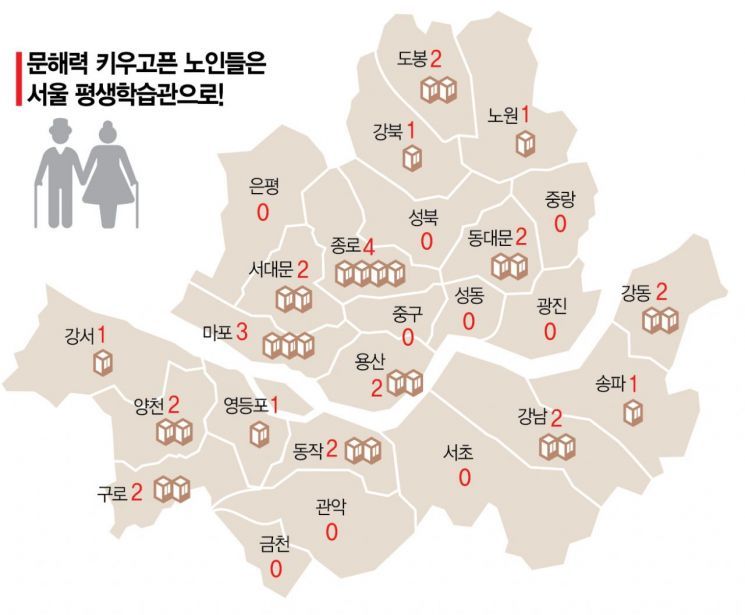 Elderly individuals who want to improve their literacy skills can receive education at lifelong learning centers in Seoul.
There have also been changes in educational programs operated by lifelong learning centers. Thirty lifelong learning centers under the Seoul Metropolitan Office of Education operate literacy education for the elderly. The education usually lasts about three months. A lifelong learning center official in Mapo-gu said, "Among seniors aged 65 and older, those who did not receive proper basic education come," adding, "Basic literacy education and poetry reading education are also subdivided." The satisfaction of the elderly is reportedly high. According to the lifelong learning center, there are even seniors who commute daily from Uijeongbu, Gyeonggi-do to Mapo-gu, Seoul to attend classes. The demand remains steady. The official said, "There are 3 to 4 new inquiries every month," adding, "Those who have been taking classes continue to apply, and with new registrants added, the number of students is gradually increasing."
© The Asia Business Daily(www.asiae.co.kr). All rights reserved.


















