Domestic Total Tax Revenue Share Seven Times OECD Average, Factor Deepening Wealth Polarization
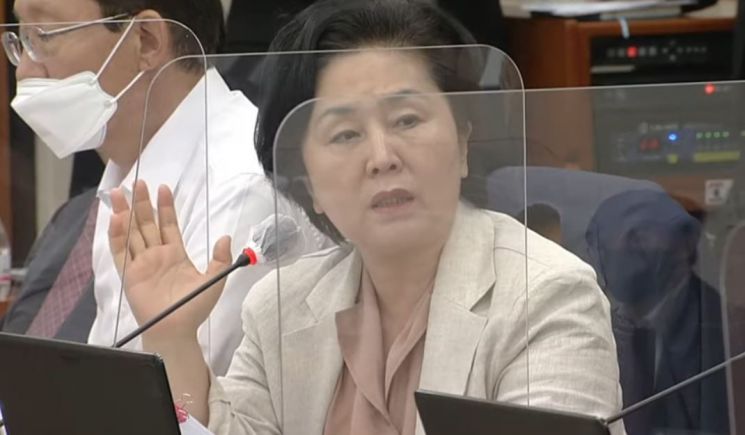 Kim Young-sun is questioning at the Ministry of Economy and Finance audit session. [Image source=National Assembly Broadcasting capture]
[Asia Economy Yeongnam Reporting Headquarters, Reporter Song Jong-gu] The inheritance and gift tax rates in Korea, which have been pointed out as the highest in the world and in urgent need of improvement, are expected to be actively discussed in the political arena.
Assemblyman Kim Young-sun pointed out that the inheritance and gift taxes collected by the Korean government are seven times the OECD average, and that this tax concentration could create a social structure more vulnerable to wealth polarization, making bold reform essential.
At the Ministry of Strategy and Finance’s audit held on the 5th, Assemblyman Kim said, “The proportion of total domestic tax revenue accounted for by inheritance and gift taxes is about 2.2%, approximately seven times the OECD average (0.4%). Korea’s inheritance tax rate, with a maximum of 60%, surpasses Japan’s (55%) and is the highest rate among OECD countries.”
Assemblyman Kim stated, “The Japanese Ministry of Economy, Trade and Industry predicts that due to low birthrates and aging population in Japan, 730,000 small and medium-sized enterprises (SMEs) will close by 2025, resulting in the loss of about 6.5 million jobs. Approximately 238 trillion won of domestic GDP is expected to vanish. Similarly, in Korea, by 2025, 2.45 million SME CEOs will be over 70 years old, and among them, 1.27 million SMEs will face difficulties in business succession.”
He then advocated for reforming the inheritance tax with conditions on business continuity and employment expansion, and for abolishing the limit on the deduction for business succession.
Assemblyman Kim added, “There have been ongoing claims that the so-called ‘Korea Discount,’ where Korean companies’ stock prices are undervalued compared to foreign companies, is due to the abnormal inheritance tax system. While the Korea Discount is mainly attributed to factors such as instability in inter-Korean relations, opaque governance and accounting, and labor market rigidity, the primary cause is the high inheritance tax.”
He concluded, “The main purpose of inheritance tax is wealth redistribution, not the confiscation or forced relinquishment of private property. Since the abnormally high inheritance tax system is causing harm to the people, I, as a member of the Planning and Finance Committee, will conduct in-depth discussions on this matter.”
© The Asia Business Daily(www.asiae.co.kr). All rights reserved.
![Clutching a Stolen Dior Bag, Saying "I Hate Being Poor but Real"... The Grotesque Con of a "Human Knockoff" [Slate]](https://cwcontent.asiae.co.kr/asiaresize/183/2026021902243444107_1771435474.jpg)
















