Prolonged Economic Recession
Consumers Seek Affordable Alternatives for Essentials
Coffee, a Preference-Driven Item, Also Shifts to Low-Cost Consumption
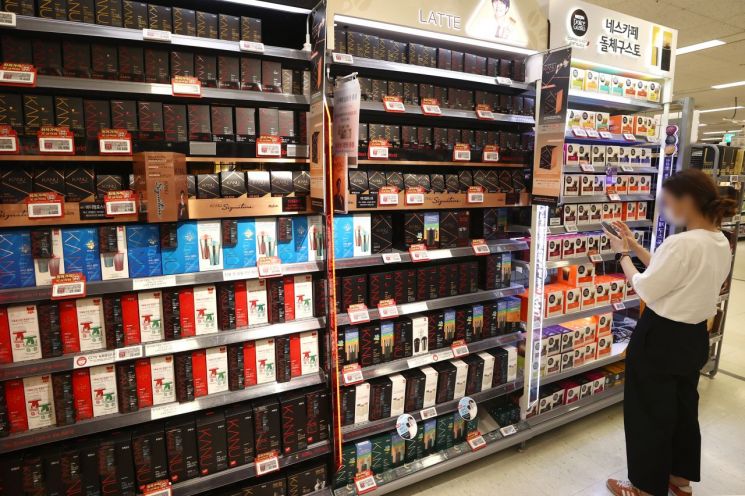 Consumption patterns are shifting from high-end coffee brands to low-cost coffee. The photo is not related to the specific content of the article. [Image source=Yonhap News]
[Asia Economy, Intern Reporter Lee Gyehwa] Amid the so-called 'three-high adversities' of interest rate hikes, sharp exchange rate increases, and high inflation, consumers are engaging in so-called 'recession-type consumption,' seeking cheaper alternatives of similar quality. As the economic downturn shows signs of prolonging, this trend is expected to continue for the time being.
Recently, purchases of convenience store ready meals and side dishes have increased. According to the distribution industry, major convenience stores' sales in August rose by 12.8% compared to the same month last year. This is interpreted as being because there are no food ingredients such as vegetables, meat, and flour that have not increased in price, making buying ready-made food cheaper than making it oneself. Additionally, sales of daily necessities and instant foods rose by 27.9% and 19.2%, respectively. The surge in demand for convenience store instant foods appears to be closely related to lunchflation (lunch + inflation).
The number of people drinking malt beverages, which are about 40% cheaper than regular beer, is also on the rise. Malt beverages are classified as other alcoholic beverages under the liquor tax law because their malt content is less than 10%, compared to over 70% in regular domestic beers, making them cheaper. According to Homeplus, sales of their beer and malt beverage items increased by 386% in March compared to the previous year, nearly quadrupling. Meanwhile, the domestic beer market size decreased by 10%, from 5 trillion won in 2019 to 4.5 trillion won last year. Malt beverages cost about 1,600 won per can (500ml), making them much cheaper, but their alcohol content and taste are similar to regular beer, which is interpreted as many consumers choosing them based on price-performance ratio.
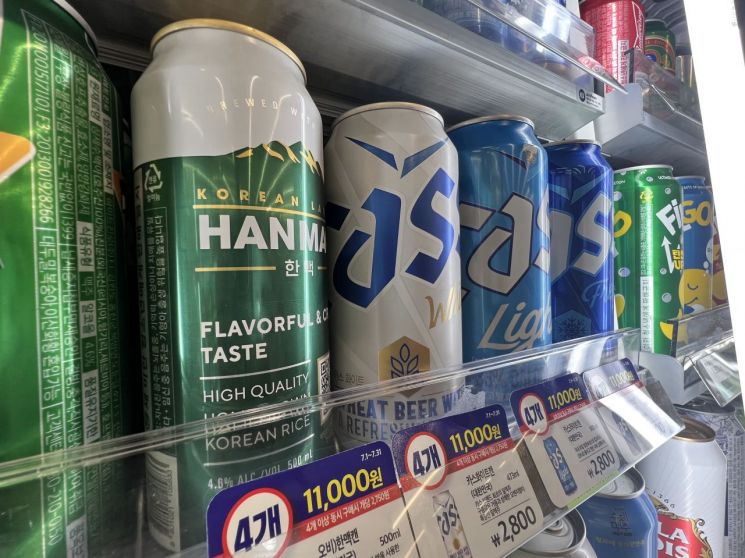 As prices rise, more consumers are turning to sparkling beer because it is cheaper than regular beer. The photo is not related to the specific content of the article. [Image source=Yonhap News]
As consumption, which had been recovering due to the expansion of face-to-face activities, shrinks, changes are also emerging in the coffee market. According to the Federation of Korean Industries on the 5th, a survey on 'National Consumer Spending Plans for the Second Half of 2022' showed that 59.7% of 1,000 respondents planned to reduce consumption in the second half compared to the first half.
Looking at coffee consumption, the number of users of high-priced coffee brands such as Starbucks, Twosome Place, and Coffee Bean is decreasing. According to the big data platform IGAWorks, Starbucks' weekly active app users decreased by 10.7% compared to early this year. Coffee Bean also saw a 17.4% decrease in users during the same period. Twosome Place and Hollys also declined by 6% and 14%, respectively, after peaking in June and July.
On the other hand, the number of users of low-priced coffee brands such as Mega Coffee and Mammoth Coffee is increasing significantly. The app user numbers for Mega Coffee, Mammoth Coffee, and Compose Coffee are rapidly rising. Mega Coffee and Mammoth Coffee apps saw user increases of 40.5% and 71.5%, respectively, compared to the beginning of the year. Compose Coffee app users also increased by 51.8%. Office workers and students, who have started cutting costs due to soaring dining prices, are shifting even coffee consumption?a representative item where taste was prioritized over price?to low-cost options.
A netizen who said it has been a long time since they visited high-priced coffee franchises due to inflation shared on a related online community, "I drink large sizes, but personally, I don't go because of the price," adding, "I have switched to low-priced coffee for quite some time due to increased meal expenses." They also added, "The price is cheap, and the coffee taste is not bad, so it has good cost-effectiveness."
As the high inflation situation continues, consumers are shifting their purchasing behavior to cheaper products with similar quality to those they have consumed before. Professor Lee Eunhee of Inha University's Department of Consumer Studies said, "From the consumer's perspective, they will try to reduce consumption, but if there is an item they want to consume, consumption patterns seem to be shifting toward finding alternatives that require less spending."
© The Asia Business Daily(www.asiae.co.kr). All rights reserved.
![Clutching a Stolen Dior Bag, Saying "I Hate Being Poor but Real"... The Grotesque Con of a "Human Knockoff" [Slate]](https://cwcontent.asiae.co.kr/asiaresize/183/2026021902243444107_1771435474.jpg)

















