370 Households of Severely Disabled Residents in Semi-basement
Priority Housing Condition and Interview Survey Conducted
Installation Begins with Flood Prevention Facility Applications
Relocation Support for Households Wishing to Upgrade Housing Starts in October
Special Semi-basement Vouchers Scheduled for December
City: "Continuous Discovery of Housing Vulnerable through Gradual Surveys"

[Asia Economy Reporter Hwang Seoyul] The Seoul Metropolitan Government will conduct a phased housing condition and interview survey on semi-basement households that caused human and property damage last August. Starting with severely disabled households who have difficulty evacuating during floods, sequential surveys will be conducted on elderly living alone and households raising children, with plans to prepare household-specific measures such as relocation support and installation of flood prevention facilities.
On the 5th, Seoul announced that it completed the "housing condition survey" and "resident characteristic interview survey" for 370 severely disabled households living in flood-risk semi-basement housing last month and will begin household-specific support from October.
Through a special task force (T/F) led by the Administrative Deputy Mayor formed last August, the city first selected 370 severely disabled households living in "semi-basement housing buried more than two-thirds underground and vulnerable to disasters such as flooding" and conducted a reality survey by separating the "housing condition survey" and "resident characteristic survey."
Field survey results: 204 out of 370 households require flood prevention facilities
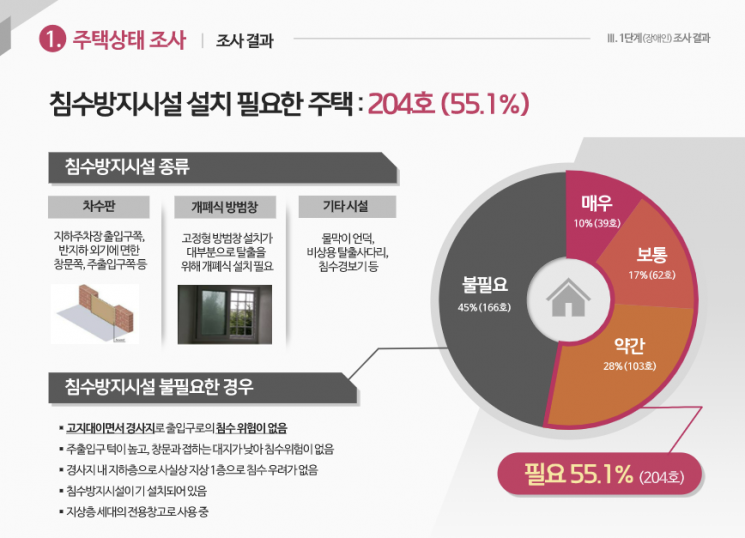
The "housing condition survey" was conducted to visually confirm the actual conditions of semi-basements inhabited by severely disabled persons and to identify the necessary facilities. The survey was conducted by a team of two architectural experts and one city or district government official.
The city conducted a detailed inspection of the exterior, including the road width and slope at the housing location, presence of drainage channels, and the semi-basement housing’s entrance doors and windows. Additionally, architectural drawings of each house were provided to mark where flood prevention facilities should be installed.
Furthermore, flood prevention facilities were subdivided into ▲waterproofing equipment ▲waterproof facilities ▲evacuation facilities, and the types of facilities were indicated to ensure proper installation at suitable locations.
As a result of the survey, 204 out of 370 households were identified as needing flood prevention facilities. Many places required flood barriers that prevent water from entering through low main entrances and operable security windows that can be opened like regular windows for escape during flooding.
On the 8th of last month, the city conducted a pilot installation of "operable security windows" at two semi-basement houses located in Yongsan and Seongdong. After installing them first in 67 households that requested installation during the interview survey, the city plans to sequentially support the remaining households.
Relocation support for 69 households wishing to move starts in October... vouchers from December
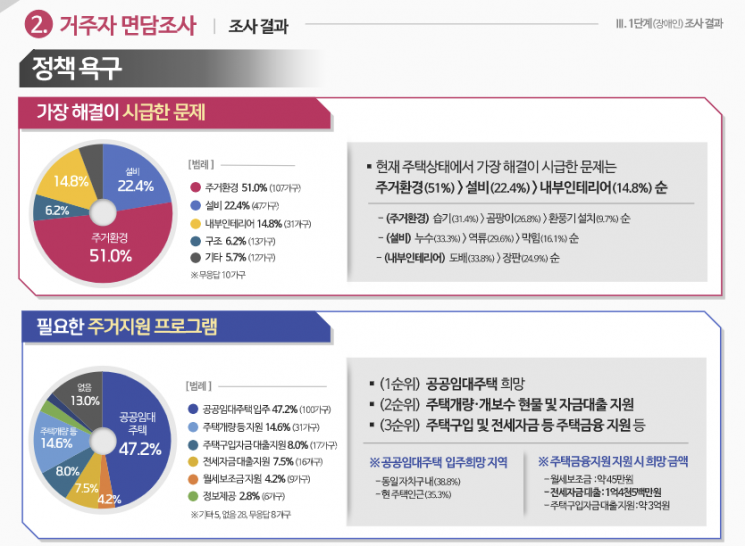
From the 13th to the 28th of last month, a team of three?comprising a housing welfare counselor from Seoul Housing and Communities Corporation and city and district government officials?visited 370 semi-basement households with severely disabled residents to conduct resident characteristic surveys. A total of 220 households responded to the interviews, which confirmed household characteristics such as number of members, income, occupancy type, housing costs, duration of residence, and willingness to relocate to above-ground floors.
According to the survey, 69 households receiving basic living subsidies expressed a desire to upgrade their housing. Among them, four households have completed applications for housing upgrades and are currently being matched with public rental housing. Sixteen households are preparing applications, and relocation is expected to begin as early as next month. The city plans to support not only relocation to public rental housing but also deposits, moving expenses, and essential daily necessities for initial settlement.
For households wishing to relocate to above-ground private rental housing rather than public rental housing, the city will provide a monthly "semi-basement specific voucher" of 200,000 KRW. Applications from interested households will be accepted in November, with payments starting in December.
"We will continuously identify housing-vulnerable households left in blind spots"
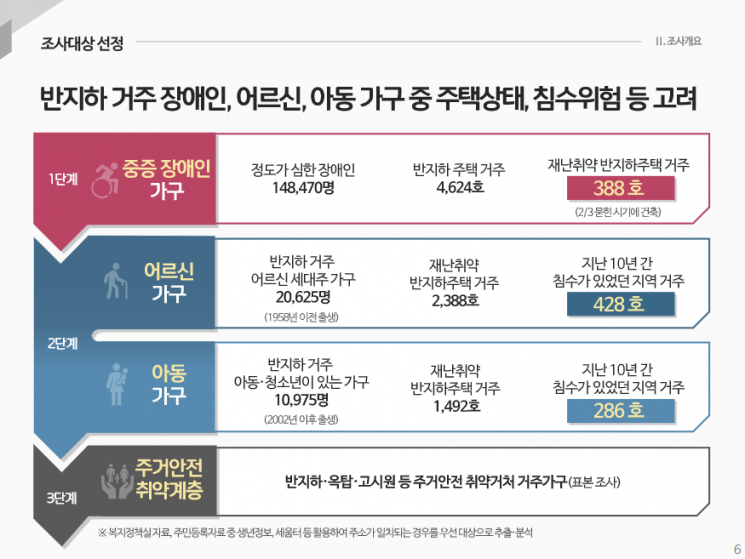
After this survey, the city plans to conduct phased surveys on elderly and child-rearing households as well as semi-basements in frequently flooded areas, while steadily identifying housing-vulnerable households left in blind spots. After completing the first and second phases (disabled, elderly, and child-rearing households), the city will establish a comprehensive plan with the Ministry of Land, Infrastructure and Transport and announce it jointly around the end of the year.
In addition to semi-basements, the city will conduct a "housing condition survey" every two years to identify and support housing-vulnerable households in rooftop rooms, goshiwon (small dormitory-style rooms), and other unsafe housing. It will also build a "housing safety net system" within the comprehensive architectural housing information system for tracking and management. This will serve as basic data for policies aimed at housing vulnerable groups.
Moreover, the city will prepare measures for improving the residential environment of semi-basement housing and managing flood prevention facilities, and will simultaneously manage the demolition of semi-basement housing through maintenance projects.
Yoo Chang-soo, Director of Housing Policy at Seoul City, said, "The support measures announced this time are not one-time surveys and support but reflect Seoul’s strong commitment to continuously identify housing-vulnerable households at real flood risk and in poor conditions and to improve safety and residential environments. We will steadily build a detailed housing safety net to support not only semi-basement housing but also rooftop rooms, goshiwon, jjokbang (tiny rooms), and other housing-vulnerable households."
© The Asia Business Daily(www.asiae.co.kr). All rights reserved.



















