Two Hyunmoo-2 Missiles Fired by Military, Two ATACMS Fired by US Forces in Korea into East Sea
Only 3 Retaliatory Strikes in 5 Years under Moon Jae-in Government... 3 Strikes in 5 Months under Current Administration
US Requests UN Security Council Meeting
Biden-Kishida Call... Close Cooperation Between Leaders
[Asia Economy Reporter Yoo In-ho, Military Specialist Yang Nak-gyu] As North Korea escalates provocations by launching an Intermediate-Range Ballistic Missile (IRBM), South Korea and the United States have begun to intensify their defense and diplomatic responses, including missile firing and cooperation with the international community. Following consultations among the foreign ministers of South Korea, the U.S., and Japan, coordination was reaffirmed through deputy minister-level talks, and the U.S. has requested a meeting of the United Nations Security Council. Japanese Prime Minister Fumio Kishida also expressed his intention to maintain close communication with South Korea in the security sector.
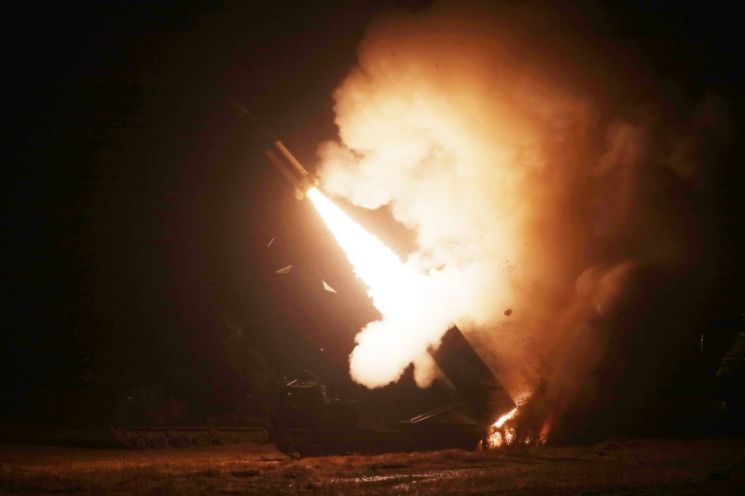
According to the Joint Chiefs of Staff on the 5th, the South Korea-U.S. military authorities conducted a joint surface-to-surface missile firing into the East Sea early that morning in response to North Korea’s IRBM provocation. In the joint surface-to-surface missile firing, the South Korean military launched two Hyunmoo-2 missiles, and the U.S. Forces Korea fired two ATACMS missiles into the East Sea, precisely striking simulated targets. One Hyunmoo-2 ballistic missile experienced abnormal flight immediately after launch and fell back within the base, prompting an investigation by the military. Until now, the South Korean military has only responded with Hyunmoo-2 missiles when North Korea launched Intercontinental Ballistic Missiles (ICBMs), as their range and destructive power are similar. However, this time, despite North Korea launching an IRBM with a shorter range than an ICBM, South Korea fired Hyunmoo-2 missiles. This is evaluated as a further escalation in the intensity of the South Korea-U.S. counterresponse.
The number of response firings involving U.S. forces has also increased. During the Moon Jae-in administration, there was only one such firing (on July 5, 2017), but under the current administration, all response firings have included U.S. forces. This is interpreted as a firm intention to conduct response firings whenever North Korea conducts missile provocations.
The Joint Chiefs of Staff emphasized, "This missile launch demonstrated the joint forces’ capability to respond to deter further provocations by North Korea," adding, "Regardless of where North Korea conducts provocations, we maintain a constant surveillance posture and possess the capability and readiness to neutralize the point of origin of provocations."
Alongside South Korea and the U.S., the international community has also taken joint action. Centered on South Korea, the U.S., and Japan, pressure on North Korea is being increased for violating United Nations Security Council resolutions. In particular, close attention is being paid to the possibility of future ICBM-class missile launches and a seventh nuclear test.
According to the Ministry of Foreign Affairs, following the foreign and security chiefs of South Korea, the U.S., and Japan, deputy foreign ministers of the three countries held a phone call on the 4th (local time) to condemn North Korea’s IRBM launch. On the same day, U.S. Deputy Secretary of State Wendy Sherman spoke with South Korea’s First Vice Foreign Minister Cho Hyun-dong and Japan’s Vice Minister for Foreign Affairs Takeo Mori, noting, according to the State Department, "We paid attention to the fact that this launch occurred after seven ballistic missile launches over the past week and confirmed that it violated multiple United Nations Security Council resolutions."
They reaffirmed the importance of trilateral cooperation in holding North Korea accountable for its ballistic missile launches. The three deputy foreign ministers agreed to hold a trilateral meeting in Tokyo within weeks.
United Nations Secretary-General Ant?nio Guterres also strongly condemned North Korea’s IRBM launch on the same day. Through spokesperson St?phane Dujarric, Guterres issued a statement saying, "This is a reckless act and a violation of Security Council resolutions." As North Korea’s ballistic missile provocations, which violate Security Council resolutions, continue, the U.S. requested a Security Council meeting on the 5th to address the issue.
Cooperation among heads of state is also prominent. U.S. President Joe Biden spoke with Japanese Prime Minister Fumio Kishida and strongly condemned North Korea’s recent ballistic missile launches. The White House stated, "The two leaders condemned North Korea’s missile tests in the strongest terms, assessing that the launches pose a threat to the Japanese people, destabilize the region, and are clear violations of United Nations Security Council resolutions." It added, "The two leaders confirmed that they will coordinate closely and continuously on immediate and long-term responses bilaterally, trilaterally with South Korea, and with the international community."
Prime Minister Kishida also emphasized close communication with South Korea. According to the Japanese Prime Minister’s Office, after his phone call with President Biden, Kishida said, "The security field relates to the lives and daily lives of our people, so I want to promote close communication."
© The Asia Business Daily(www.asiae.co.kr). All rights reserved.

















