Opposite Trading at 17.1 Trillion Won as of September 30
Lowest Level Since November 2020
Decreased by Over 2 Trillion Won in One Month from 19.5 Trillion Won in Early September
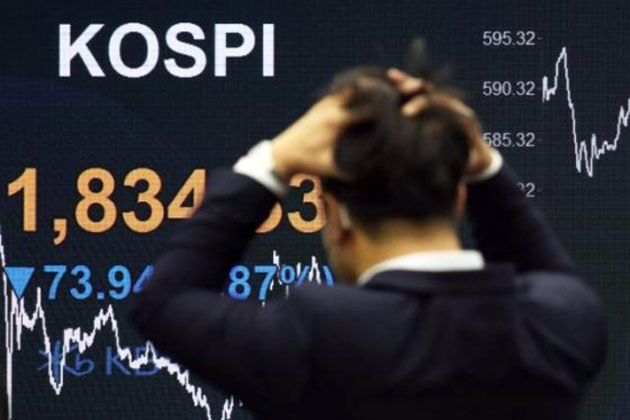
[Asia Economy Reporter Ji Yeon-jin] The so-called "debt investment" scale, where investors borrow money from securities firms to buy stocks, has fallen to its lowest level this year. It appears that investor sentiment was significantly dampened by the large-scale "forced liquidation" last week, when the stock market plunged due to soaring dollar value amid global recession concerns.
According to the Korea Financial Investment Association on the 5th, as of the 30th of last month, the credit loan balance stood at 17.1647 trillion won. This is the lowest level this year and the lowest since November 2020, when the stock market rose due to liquidity triggered by COVID-19. The credit loan balance exceeded 25 trillion won in September last year, decreased to the 23 trillion won range at the beginning of this year, and then dropped to 17.5 trillion won in June when the KOSPI hit its first lower low.
However, it rapidly increased after the "summer rally" that began in July, surpassing 19 trillion won earlier this month. In July, the Financial Services Commission exempted securities firms from the obligation to maintain the collateral ratio for credit loans to slow down forced liquidations, leading securities firms to lower the collateral ratio from the previous 140% to 120%. It is pointed out that this boosted the scale of debt investment during the rebound market.
The credit loan balance sharply decreased by more than 2 trillion won in a month as forced liquidations poured in during the steep market decline last month amid growing global recession concerns. Individual investors facing collateral shortages are subject to forced liquidation if they fail to add funds within the deadline. Securities firms forcibly dispose of stocks at prices lower than the market price two trading days later in accounts using credit trading when the evaluated amount falls below the collateral maintenance ratio due to stock price declines.
The proportion of forced liquidation relative to outstanding loans soared to 20.3% on the 27th, and on the 28th and 29th, the forced liquidation ratio remained in double digits at 13% and 10%, respectively. On the 30th of last month, the forced liquidation ratio was 8.5%, higher than this year's average of 7.2%. Forced liquidations conducted throughout last month amounted to 391.5 billion won. In particular, on the 28th, two days after the "Black Monday" when the KOSPI fell more than 3% and the KOSDAQ more than 5% on the 26th, a flood of forced liquidation volume caused the KOSPI to drop more than 2%.
This year, last month marked the third time forced liquidations led to sharp stock price declines. Similar situations occurred in January and June this year, when forced liquidations took place at KOSPI levels of 2600?2700 and 2300?2400, respectively, expanding the short-term stock index decline from about 7% to around 12%.
Kim Young-hwan, a researcher at NH Investment & Securities, said, "Since the KOSPI decline reached about 12% after the August peak, the possibility of a sharp additional drop due to forced liquidations is limited." However, he added, "Given the U.S. interest rate hikes accepting recession risks, the Bank of Korea's inevitable accompanying rate hikes, uncertainties in corporate earnings next year due to economic slowdown, and the potential emergence of emerging market credit risks, despite the short-term sharp decline, it is not an easy situation to bet on the direction of the stock index, such as approaching an oversold condition."
© The Asia Business Daily(www.asiae.co.kr). All rights reserved.
![Clutching a Stolen Dior Bag, Saying "I Hate Being Poor but Real"... The Grotesque Con of a "Human Knockoff" [Slate]](https://cwcontent.asiae.co.kr/asiaresize/183/2026021902243444107_1771435474.jpg)
















