"Do Not Approach Suspicious Items"
First Time in 5 Years Since September 2017
Train Services Suspended and School Start Times Adjusted
Major Newspapers Simultaneously Feature as Front-Page Top Stories
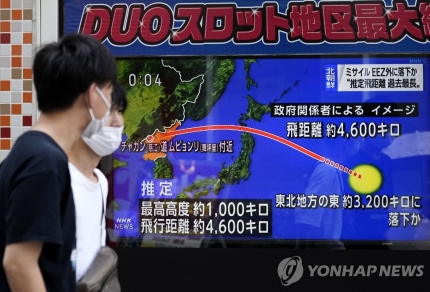 On the 4th, citizens in Tokyo, Japan, are watching news coverage of North Korea's ballistic missile launch. The ballistic missile launched by North Korea that day fell into the exclusive economic zone (EEZ) about 3,000 km east of the Japanese archipelago. Following the missile launch, Japanese authorities issued a nationwide alert system (J-ALERT) to provide relevant information to citizens. Photo by EPA Yonhap News
[Asia Economy Reporter Kim Juri] The Japanese archipelago has been put on high alert following the launch of a medium-range ballistic missile (IRBM) by North Korea on the 4th.
According to local media such as Jiji Press, the Japanese government issued an evacuation order at 7:27 a.m. through the nationwide alert system (J-ALERT), stating, "Missile launch. Missile launch. It appears that a missile has been launched from North Korea. Please take shelter inside buildings or underground."
Additionally, they warned, "The missile is expected to pass over Hokkaido and Aomori Prefecture around 7:29 a.m. and continue into the Pacific Ocean," and urged, "If you find any suspicious objects, do not approach them under any circumstances and immediately contact the police or fire authorities."
The nationwide alert system is a mechanism that delivers disaster prevention and public protection information to local governments within seconds via satellite, and all municipalities in Japan have adopted it.
The Asahi Shimbun reported, "This is the first time in five years since September 2017 that missile information from North Korea has been transmitted through the nationwide alert system, and it is the fifth time since the system began operation in 2007."
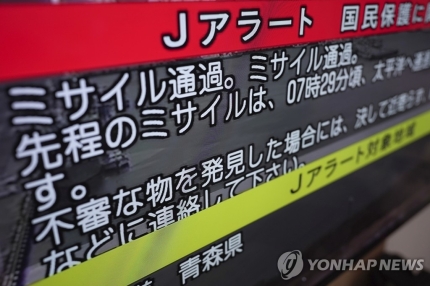 On the 4th, a breaking news alert about North Korea's missile launch using Japan's nationwide early warning system (J-ALERT) appeared on TV screens. Photo by AP Yonhap News
The nationwide alert system information was promptly transmitted to local governments around 7:27?28 a.m., but there was some confusion.
For example, among the municipalities that received the missile information, four basic local governments in Hokkaido and Aomori experienced difficulties in relaying the information to residents via disaster prevention administrative radio systems.
The missile passed over the northernmost part of Honshu near Aomori Prefecture, but nine island municipalities in Tokyo Metropolis were also included in the nationwide alert system's information dissemination target, drawing criticism for inappropriate response.
Chief Cabinet Secretary Hirokazu Matsuno explained, "It was not an area requiring missile caution," and added, "We are investigating the cause."
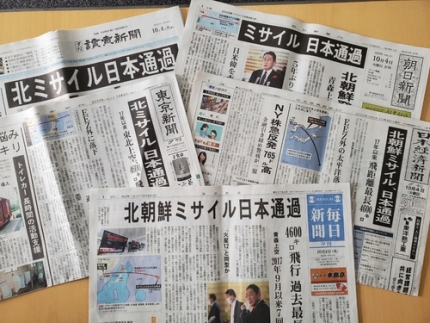 Major Japanese evening newspapers such as Yomiuri, Asahi, Mainichi, Nihon Keizai, and Tokyo Shimbun all featured the news of North Korea's missile passing over Japanese airspace as their front-page top story on the 4th. Photo by Yonhap News Agency
According to NHK, the North Korean missile passing over the Tohoku region of Japan led to the suspension of operations on some sections of the Tohoku Shinkansen.
JR Hokkaido also temporarily halted train services, and Sapporo City's subway stopped operations but has since resumed.
There was also an impact on schools.
According to the Asahi Shimbun, some elementary and junior high schools in Sapporo City delayed their start times by 30 to 45 minutes.
The Obihiro City Board of Education in Hokkaido sent text messages to parents advising, "It is acceptable to be late; please calmly proceed to school." Asahi also reported that some schools in the city independently instructed students to wait at home.
Major Japanese evening newspapers such as Yomiuri, Asahi, Mainichi, Nihon Keizai, and Tokyo Shimbun all featured the news of the North Korean missile passing over Japan on their front pages.
Since the first time a North Korean missile passed over the Japanese archipelago in August 1998 (Tohoku and other areas along the route), it has passed over in April 2009 (Tohoku), December 2012 (Okinawa), February 2016 (Okinawa), August 2017 (Hokkaido), and September 2017 (between Hokkaido and Tohoku), respectively.
© The Asia Business Daily(www.asiae.co.kr). All rights reserved.



















