Strengthening Support for Socially Vulnerable Groups Including Emergency Welfare Household Field Discovery
Reducing Public Sector Share from 80% Level and Enhancing Work Experience Competitiveness to Connect Employment in the Private Sector
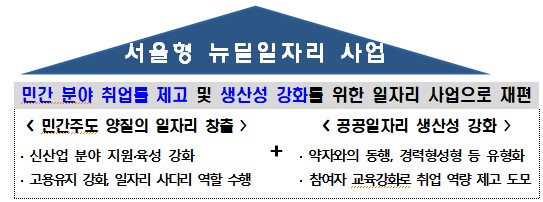
[Asia Economy Reporter Lim Cheol-young] The Seoul Metropolitan Government is reorganizing its major public job projects. The plan aims to enhance the 'productivity of public job projects,' which had a high dependency on budget, and strengthen the fundamental purpose of public job projects as a ‘job ladder function’ by focusing on two main pillars: increasing the self-reliance foundation for employment-vulnerable groups in line with the administrative philosophy of accompanying the disadvantaged.
On the 5th, Seoul announced that it has established the ‘Basic Plan for Reorganizing Seoul’s Public Job Projects’ based on these contents and will implement it from 2023. Currently, Seoul is working to improve the existing issues of the Anshim Job Project and enhance the effectiveness of public job projects by pursuing improvements in three directions: ▲establishing a self-help and self-reliance foundation ▲improving work productivity and efficiency ▲securing continuity in necessary sites for Anshim Jobs.
First, Seoul will promote auxiliary job projects for major administrative projects such as social safety and digital support for the disadvantaged, aligning with the 8th-term municipal administration’s policy of ‘accompanying the disadvantaged.’ While the Anshim Job Project has mainly been a supplier-centered administrative support project driven by public institutions’ needs, after reorganization, the Anshim Job Project will focus on ‘self-help’ based projects where disadvantaged participants help other disadvantaged groups, such as public medical support for pediatric and adolescent treatment and digital device usage education for the elderly.
For Anshim Job Projects involving a large number of participants, pre-job practical training linked with specialized institutions will be strengthened, and through professional personnel management, participants will easily adapt to job content, thereby increasing work productivity and efficiency. The meaningful project management methods, such as job training and on-site participant management, will be modeled and applied to other workplaces to improve the overall productivity of the projects.
Additionally, to provide robust protection for employment-vulnerable groups who find it difficult to enter private companies, such as residents of small rooms, persons with disabilities, and homeless people who need livelihood support, participation in the Anshim Job Project will be expanded to allow continuous participation up to three times (currently a maximum of two times), ensuring continuity of livelihood support.
Seoul will reorganize the ‘Seoul-type New Deal Jobs’ to focus on the original purpose of the project, which is ‘strengthening employment in the private sector.’ It will enhance job experience competitiveness in the public sector, discover and expand jobs in the private sector, and operate so that participants can connect to employment. Seoul-type New Deal Jobs, started in 2013, are designed to serve as stepping stones for entering private jobs through specialized job experiences such as constructing 3D indoor maps of buildings and energy design, rather than simple labor jobs. Now in its 9th year, Seoul-type New Deal Jobs are currently operated with about 80% public institution type and 20% private type.
The existing method of allocating and operating public sector jobs by Seoul City, autonomous districts, and investment-funded institutions will be improved. The projects will be reorganized into two main pillars: ‘projects related to accompanying the disadvantaged’ and ‘career formation type’ projects. From 2023, the proportion of public institution-type projects will be reduced from the current 80% to about half (50%), and the proportion of jobs in fields needed by companies will be expanded from the current 20% to 50%, increasing the employment linkage rate in the private sector.
In particular, in the private sector, focus will be placed on fields where it is difficult to build careers, such as zoos, museums, and international organizations, to support participants in building competitive careers. The maximum working period, currently 23 months, will also be adjusted to one-year units. During the one-year working period, one month of education will be provided before starting work so that participants can acquire job skills and be deployed on-site. Currently, the Seoul-type New Deal Jobs project in autonomous districts, which is 100% funded by Seoul City, will have Seoul’s budget support adjusted to 90% in 2023. This will be gradually adjusted by 2025 to increase the responsibility of autonomous districts.
Furthermore, specialized training for participants in public institution-type jobs within the Seoul-type New Deal Jobs will be strengthened. Participants from Seoul City, autonomous districts, and affiliated institutions will be required to complete a total of 160 hours of training to enhance expertise, and 10 ‘Job Career Managers’ will be assigned to intensively support participants’ job-seeking activities.
Hwang Bo-yeon, Director of Seoul’s Economic Policy Office, said, “Given the difficult economic situation, jobs for socially vulnerable groups are important. We will completely reorganize the operation method of public jobs, which had been run from a formal and welfare perspective, to help the social disadvantaged become self-reliant and to draw out practical employment connections, thereby strengthening the job ladder function of our society.”
© The Asia Business Daily(www.asiae.co.kr). All rights reserved.
![Clutching a Stolen Dior Bag, Saying "I Hate Being Poor but Real"... The Grotesque Con of a "Human Knockoff" [Slate]](https://cwcontent.asiae.co.kr/asiaresize/183/2026021902243444107_1771435474.jpg)











