The 11th KCCI ESG (Environmental, Social, and Governance) Management Forum
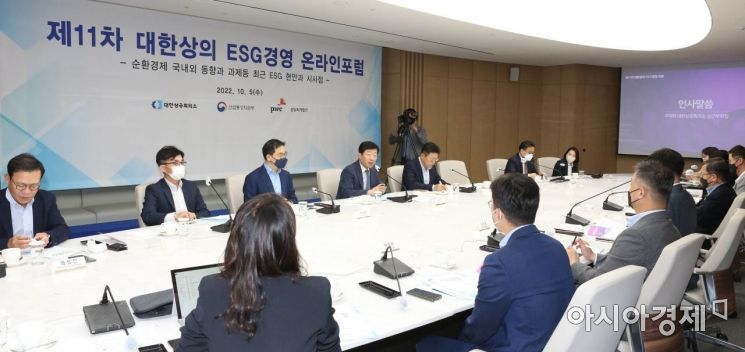 At the '11th KCCI ESG Management Forum' held on the 5th at the Korea Chamber of Commerce and Industry Hall in Seoul, Woo Tae-hee, Executive Vice Chairman of the Korea Chamber of Commerce and Industry, is delivering a greeting.
[Asia Economy Reporter Oh Hyung-gil] It has been pointed out that companies need to address the climate crisis and resource depletion risks through a circular economy and pioneer new markets.
The Korea Chamber of Commerce and Industry (KCCI), together with the Ministry of Trade, Industry and Energy and Samil PwC, held the "11th KCCI ESG (Environment, Social, Governance) Management Forum" on the 5th, discussing recent ESG issues and implications, including domestic and international trends and challenges of the circular economy.
Attendees included Woo Tae-hee, Executive Vice Chairman of KCCI; Choi Woo-seok, Director of Industrial Policy at the Ministry of Trade, Industry and Energy; Yoon Young-chang, Partner at Samil PwC; Lee Bo-hwa, Director at Samil PwC; Lee Jun-hee, Head of ESG Center Group at Jipyong Law Firm; Kim Go-woon, Research Fellow at Seoul Institute; Cho Shin, Professor at Yonsei University; Yoo Hoon, Head of ESG Management Center at the Korean Standards Association; and Lee Sun-kyung, Head of ESG Center at the Korea ESG Institute.
Kim Go-woon, Research Fellow at Seoul Institute, who presented on "Domestic and International Trends and Challenges of the Circular Economy," stated, "The climate crisis and resource depletion are core issues threatening humanity's future and difficult challenges currently faced by our companies. Our companies should focus on the circular economy, which can achieve both greenhouse gas reduction and raw material procurement through resource recycling."
He added, "Since the circular economy covers the entire process from production, consumption, to disposal of products, it can be considered a practical solution for carbon neutrality. Recycling industries related to waste plastics and waste batteries are expected to grow enormously in the future, providing our companies with an opportunity to catch two rabbits at once: reducing carbon emissions and pioneering new markets."
Next, Lee Jun-hee, Head of ESG Center Group at Jipyong Law Firm, who presented on "ESG Management Environment and Greenwashing Issues," pointed out, "As ESG management becomes mainstream, companies are required to strengthen management strategies and communication to build and maintain trust with stakeholders such as investors and consumers regarding their ESG activities. In this process, cases of greenwashing?where companies promote their products and services as environmentally friendly when they are not?continue to occur, causing damage to corporate image and even legal liabilities."
He continued, "According to the seven greenwashing criteria presented by TerraChoice, a global environmental consulting firm, greenwashing is classified into ▲hidden trade-offs ▲lack of proof ▲vagueness ▲irrelevance ▲fibbing ▲justification of harmful products ▲inappropriate labels. Among greenwashing cases, the most frequent were fibbing?false advertising?followed by vague claims using broad or misleading terms, and the use of false labels."
Lee advised, "Domestic companies must clearly understand and check for greenwashing and ESG washing in their products, services, processes, and communication. To this end, it is essential to establish a decision-making structure and governance that can monitor and review greenwashing in advance."
Lee Bo-hwa, Director at Samil PwC, gave the final presentation on "Supply Chain Management Measures to Strengthen ESG Competitiveness."
He stated, "With the start of the new Cold War era, changes in the global economy, and climate change risks, the global supply chain order is being reorganized, leading to decreased stability in raw material supply. The importance of supply chain management is greater than ever."
He added, "Supply chain ESG management is being strengthened from voluntary corporate participation to legislation. If companies fail to secure a stable supply chain in terms of both supply and ESG, their fundamental competitiveness may weaken. It is important to measure supply chain risks linked to the company's ESG strategic direction and proactively manage them. More active supply chain management is necessary to enhance competitiveness."
During the subsequent open discussion, participants agreed that the circular economy is a practical solution for responding to resource depletion and achieving carbon neutrality, and that close cooperation between the public and private sectors should be actively utilized as an opportunity for the Korean economy and companies to take a step forward.
Executive Vice Chairman Woo Tae-hee said, "The circular economy can accelerate national carbon reduction from the product development and design stages, and generate profits through raw material procurement and waste disposal, making it a practical way to achieve both carbon neutrality and corporate growth. To revitalize the circular economy, bold technological development and investment by companies and institutional support from the government are both necessary, and close communication and collaboration between the public and private sectors are essential."
© The Asia Business Daily(www.asiae.co.kr). All rights reserved.
![Clutching a Stolen Dior Bag, Saying "I Hate Being Poor but Real"... The Grotesque Con of a "Human Knockoff" [Slate]](https://cwcontent.asiae.co.kr/asiaresize/183/2026021902243444107_1771435474.jpg)
















