Electricity and Gas Price Hikes... Consumer Price Inflation Expected to Reach 6%
"Working After Hours" Rising Management and Food Expenses
Consumption Down, Savings and Loan Repayments Up, Changing Spending Patterns
Government Maintains 'October Inflation Peak' Theory
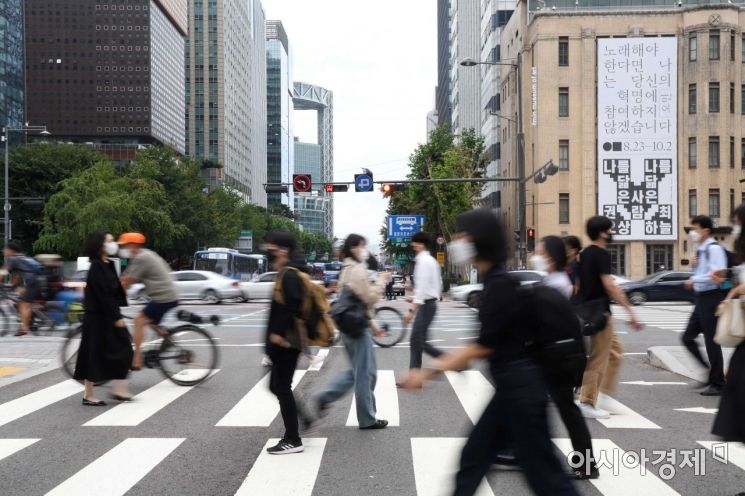 On the first working day after the Chuseok holiday, on the 13th of last month, office workers hurried their steps at the Gwanghwamun intersection in Seoul. Photo by Moon Honam munonam@
[Asia Economy Reporter Kim Jung-wan] #. Jin (29), an office worker living alone in Mapo-gu, Seoul, has been working part-time at a restaurant run by an acquaintance since last month after work. He said that from this month, the rent and maintenance fees of the officetel where he lived increased, making the inflation feel more real. He added, "Although prices have risen a lot, I was trying to endure by saving as much as possible, but with the rent going up, I definitely felt I need to earn more," and said, "I work from a minimum of 2 hours to up to 4 hours a day."
Recently, it seems that the number of single-person households earning supplementary income through side jobs besides their main work is increasing. With forecasts that the consumer price inflation rate will rise again in October, the increase in electricity and gas bills as well as food prices is deepening the inflation burden on ordinary people.
According to the Ministry of Economy and Finance, due to the increase in electricity and gas charges, the inflation rate is expected to rise by 0.3 percentage points (p) from this month. The inflation rate, which had been continuously rising, peaked at the 6% range in June and July and dropped to the 5% range in August, but there are projections that inflation may continue even after October, which was originally expected to be the peak period.
Red lights have also turned on for food prices such as ramen and kimchi. Paldo raised the average price of 12 ramen brands by 9.8% from this month, and Ottogi will increase ramen prices by an average of 11.0% starting from the 10th. Earlier, Nongshim raised the average shipment price of major products by 11.3% from the 15th of last month. CJ CheilJedang and Daesang raised kimchi prices by an average of 11% and 9.8%, respectively. According to the National Statistical Portal (KOSIS) of Statistics Korea, food prices in August increased by 8.4% compared to a year ago, marking the highest rise in 13 years and 4 months since April 2009 (8.5%).
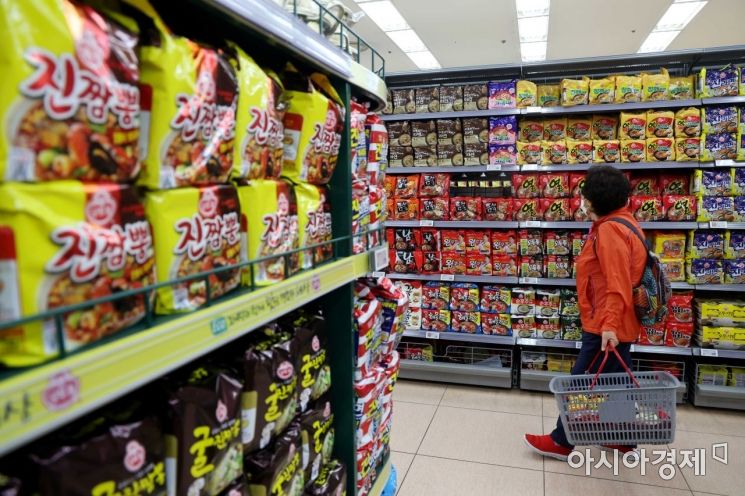 A citizen is shopping at a large supermarket in downtown Seoul on the 20th of last month. Photo by Mun Ho-nam munonam@
Due to this situation, the number of people trying to increase their income by working side jobs is also rising. According to the '2022 Korea Single-Person Household Report' released on the 3rd by KB Financial Group Management Research Institute, which surveyed 2,000 single-person households aged 25 to 59 nationwide, 42% (839 respondents) reported earning income through side jobs besides their main job. The reasons for having side jobs were 'to prepare spare or emergency funds (31.5%)', 'because they have free time (19.4%)', and 'due to insufficient living expenses (14.1%)', in that order.
There were also opinions that dual employment is inevitable due to increased basic expenses. Shin (35), who has been working at a company in Seoul for 5 years, has been increasing his income by doing delivery work after work for two months. He said, "With food expenses and the general rise in prices these days, even with planned consumption, expenses have increased," and added, "I am also increasing my working hours on weekends."
There is an analysis that consumption patterns have changed due to high inflation. Compared to 2020, consumption has decreased, and the proportion of income used for savings and loan repayments has increased. 44.2% of monthly income was used for consumption activities, which is a decrease of 13.4 percentage points compared to 57.6% in 2020. The proportion of income used for savings (44.1%) and loan repayments (11.7%) was 55.8%, which increased by 9.8 percentage points and 3.5 percentage points, respectively, compared to 42.5% in the same period.
Meanwhile, the government still considers the 'October inflation peak theory' valid, as Deputy Prime Minister and Minister of Economy and Finance Choo Kyung-ho has repeatedly mentioned, expecting inflation to peak this month and gradually stabilize. Considering the slowdown in the rise of oil prices and agricultural, livestock, and fishery product prices that have driven inflation, and the base effect on the inflation rate that has been rising in the 3% range since October last year, it is analyzed that the inflation rate may ease after October.
© The Asia Business Daily(www.asiae.co.kr). All rights reserved.
![Clutching a Stolen Dior Bag, Saying "I Hate Being Poor but Real"... The Grotesque Con of a "Human Knockoff" [Slate]](https://cwcontent.asiae.co.kr/asiaresize/183/2026021902243444107_1771435474.jpg)

















