Ministry of Industry Reports 'Nuclear Phase-Out Bill' to Moon Administration... Electricity Rates to Rise 40%
"Electricity Rates Must Increase 2.6% Annually Until 2030... Additional 140 Trillion Won Required"
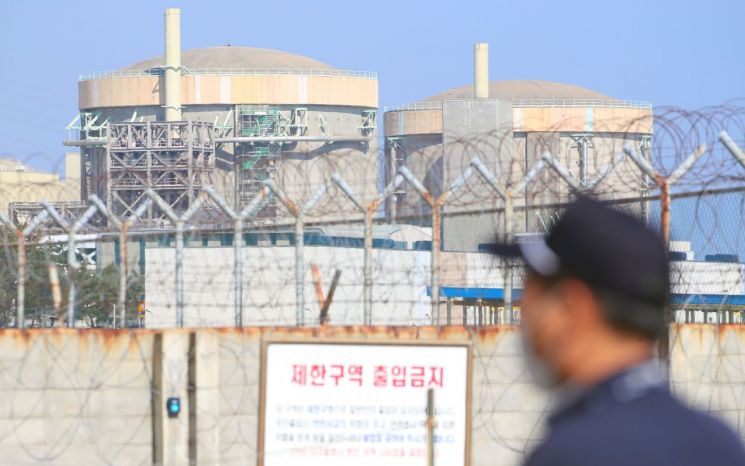 Wolseong Unit 1 (right), which has been shut down, can be seen at the Wolseong Nuclear Power Plant in Yangnam-myeon, Gyeongju-si.
 [Image source=Yonhap News]
[Asia Economy Sejong=Reporter Lee Jun-hyung] It has been revealed that the Ministry of Trade, Industry and Energy reported the necessity of electricity rate increases twice in the early days of the Moon Jae-in administration due to the nuclear phase-out policy. There are criticisms that the previous government ignored reports from the relevant ministry to push forward the nuclear phase-out policy.
According to materials submitted by the Ministry of Trade, Industry and Energy to Rep. Yang Geum-hee of the People Power Party on the 4th, the ministry reported a "plan for electricity rate increases to fulfill campaign promises" to the Moon Jae-in government’s National Policy Planning Advisory Committee, equivalent to the presidential transition committee, on May 24 and June 2, 2017. The core of the ministry’s report was that implementing the nuclear phase-out policy requires checking the power supply reserve rate, raising electricity rates, and enacting or revising related laws and regulations.
First, on May 24, 2017, the ministry reported that electricity rates must be raised by 2.6% annually until 2030 to fulfill the nuclear phase-out pledge. The ministry analyzed in the report that electricity rates in 2030 would increase by about 40% compared to 2017 due to the nuclear phase-out policy. This was based on calculations that power purchase costs would increase by nearly 140 trillion won by 2030. The ministry also reported that halting construction of nuclear power plants under construction could infringe on property rights, necessitating legal enactment or revision.
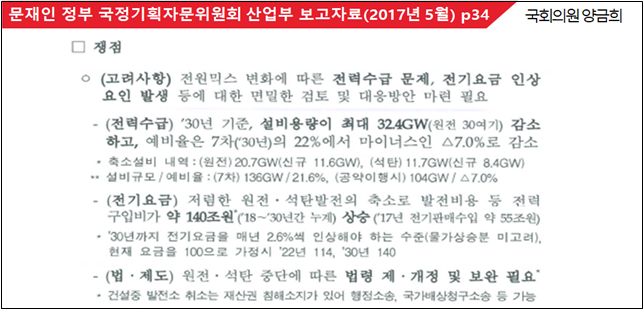 Part of the data reported by the Ministry of Trade, Industry and Energy to the Moon Jae-in administration's State Affairs Planning Advisory Committee in 2017. [Photo by Yang Geum-hee, Office of the People Power Party lawmaker]
On June 2, 2017, a more detailed plan for electricity rate increases was reported. It stated that the share of nuclear power, which has relatively low generation costs, would be reduced, requiring an additional 4 trillion won in power purchase costs from 2018 to 2020. The ministry projected that the nuclear phase-out policy would require additional cumulative power purchase costs reaching 140 trillion won by 2030, including 4 trillion won last year, 7 trillion won this year, and 20 trillion won in 2030.
The ministry also emphasized the necessity of electricity rate increases. It reported to the National Policy Planning Advisory Committee that Korea Electric Power Corporation (KEPCO) could absorb the factors for electricity rate increases until 2020, but after that, increases in industrial and general electricity rates would be inevitable. Furthermore, it reported that from this year, electricity rates for all uses should be gradually increased.
However, despite these reports from the ministry, the previous government declared a "freeze on electricity rates." In fact, Baek Woon-gyu, the first Minister of Trade, Industry and Energy under the Moon Jae-in administration, said at his confirmation hearing on July 19, 2017, "It is understood that there will be almost no electricity rate increases over the next five years." On the same day, Baek and the Democratic Party also announced at a ruling party-government meeting on the nuclear phase-out policy held at the National Assembly on July 31 that "there will be no electricity rate increases."
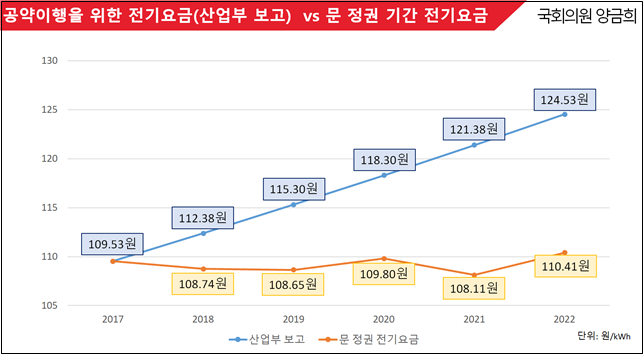 The trend of electricity rate increases reported by the Ministry of Trade, Industry and Energy to the Moon Jae-in administration's National Policy Planning Advisory Committee and the actual trend of electricity rate increases.
 [Photo by Yang Geum-hee, Office of the People Power Party Lawmaker]
Meanwhile, the costs incurred due to the Moon Jae-in administration’s nuclear phase-out policy have already reached 900 billion won. Korea Hydro & Nuclear Power recently applied to the Ministry of Trade, Industry and Energy for compensation of 727.7 billion won for the Wolseong Unit 1 nuclear power plant. Wolseong Unit 1 is the second nuclear power plant in South Korea to be shut down and was closed early in 2019. Additionally, KHNP completed a board report on July 20 to apply for compensation of 6.9 billion won for the Daejin nuclear power plant. Procedures are also underway for compensation related to the Cheonji nuclear power plant, estimated at 97.92 billion won.
Rep. Yang said, "It is natural that electricity rates rise when relatively cheap nuclear and coal power are reduced and solar, wind, and liquefied natural gas (LNG) are increased," adding, "The Moon administration ignored reports from the relevant ministry throughout its term and made no attempt to persuade the public."
© The Asia Business Daily(www.asiae.co.kr). All rights reserved.
![Clutching a Stolen Dior Bag, Saying "I Hate Being Poor but Real"... The Grotesque Con of a "Human Knockoff" [Slate]](https://cwcontent.asiae.co.kr/asiaresize/183/2026021902243444107_1771435474.jpg)


















