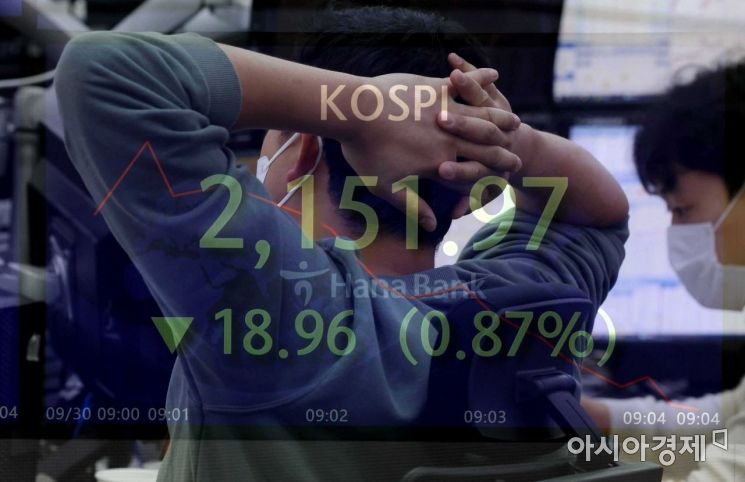
 On the 30th, influenced by the sharp decline in the U.S. stock market, the domestic stock market also started lower, and dealers were busy working in the dealing room of Hana Bank in Euljiro, Seoul. Photo by Moon Honam munonam@
[Asia Economy Reporter Kwon Jae-hee] In September, which recorded the worst crash, foreign investors were found to have sold semiconductor stocks and bought secondary battery-related stocks. On the other hand, individual investors purchased nearly 2 trillion won worth of Samsung Electronics shares, and especially as short selling was concentrated on Samsung Electronics and other large-cap stocks, the scale of damage to individual investors appeared to be greater.
According to the Korea Exchange on the 4th, the KOSPI index fell by 12.8% in September. This decline was even steeper compared to the S&P 500 index in the U.S., which fell 9.3%, and the Nasdaq index, which fell 10.1% during the same period. Notably, the KOSPI index has dropped 27.61% since the beginning of this year (January to September), with about half of the decline occurring in September alone. During the same period, the KOSDAQ index plunged 16.6%.
Amid the worsening stock market, looking at the stocks purchased by different investors, Samsung Electronics was the most bought stock by individual investors. Individual investors net purchased stocks worth 2.9902 trillion won in the KOSPI market alone during September, of which 1.941 trillion won was spent on Samsung Electronics. Following that, among individual stocks, Doosan Enerbility (348.9 billion won), SK Hynix (233.8 billion won), Korea Aerospace Industries (199.2 billion won), Samsung Electronics Preferred (191.8 billion won), Kakao (189.8 billion won), NAVER (174.2 billion won), LG Electronics (156.4 billion won), and POSCO Holdings (134 billion won) were notable. It is interpreted that they mainly took advantage of the excessive price drops in large-cap stocks to buy at low prices.
On the other hand, foreign investors sold Samsung Electronics the most during this period, net selling 1.8575 trillion won worth of shares. Essentially, the volume sold by foreign investors was fully absorbed by individual investors. Instead of Samsung Electronics, foreign investors mainly bought secondary battery stocks that could benefit from the high exchange rate environment. The most net purchased stock was Samsung SDI, with 212.4 billion won bought. Following that were Hanwha Solutions (200.1 billion won), KT&G (184.8 billion won), LG Energy Solution (183.9 billion won), Hyundai Motor (181.2 billion won), Hanwha Aerospace (163.8 billion won), LG Chem (99.3 billion won), POSCO Chemical (96 billion won), and SKC (79.3 billion won). It appears they mainly bought 'secondary battery' and defensive stocks.
It is analyzed that individual investors suffered greater damage as they focused on buying large-cap stocks including Samsung Electronics. This is because short selling was concentrated on large-cap stocks. The average daily short selling amount in the KOSPI market last month was 490.6 billion won, about a 40% increase compared to the previous month (August). Especially, the top three stocks in short selling last month were Samsung Electronics (557.5 billion won), LG Energy Solution (534.4 billion won), and SK Hynix (358.5 billion won), indicating that individual investors who bought mainly large-cap stocks likely experienced greater losses.
Kim Jung-won, a researcher at Hyundai Motor Securities, said, "The overall market short selling volume rapidly increased during the market correction in September," adding, "Stocks with a high proportion of short selling are showing relatively weak prices, so special caution is needed when investing in top short-sold stocks for the time being."
© The Asia Business Daily(www.asiae.co.kr). All rights reserved.

















