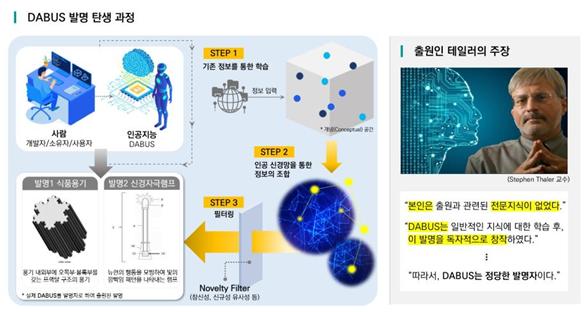
 Overview of the invention process by the artificial intelligence 'Dabus'. Provided by the Korean Intellectual Property Office
[Asia Economy (Daejeon) Reporter Jeong Il-woong] “There will come a time when artificial intelligence must be recognized as an inventor, but we judge that now is not that time.” The Korean Intellectual Property Office (KIPO) recently invalidated a patent application claiming that the invention was made by artificial intelligence.
According to KIPO on the 3rd, American AI developer Steven Taylor filed an international patent (Patent Cooperation Treaty·PCT) listing the AI ‘DABUS (Device for the Autonomous Bootstrapping of Unified Sentience)’ as the inventor in 16 countries including South Korea.
The applicant claims to have no knowledge of the inventions filed and asserts that the ‘DABUS’ AI he developed independently created two different inventions, including a food container, by learning general knowledge.
However, KIPO concluded that “patent applications listing artificial intelligence, which is not a natural person, as the inventor are not permitted” and invalidated the application.
KIPO requested the applicant to amend the inventor from AI to a natural person (notification of correction request), but since the applicant did not comply, the case was closed as if the application had never existed (invalidated).
The background to KIPO’s conclusion lies in the fact that current domestic patent law and related precedents recognize only natural persons as inventors, and this principle is similarly stipulated in the patent laws of all countries including the United States, the United Kingdom, and Germany.
In fact, major patent offices worldwide have reached conclusions not to recognize AI inventions as patentable, and courts in countries such as the US and UK have supported these conclusions, KIPO explained.
However, in July last year, Australia’s Federal Court of First Instance recognized AI as an inventor. But in April this year, the Federal Court of Appeal unanimously ruled that the first-instance court’s decision was incorrect, so currently AI’s status as an inventor is not recognized.
Meanwhile, in March, the German Federal Patent Court ruled that only natural persons are recognized as inventors but allowed the inclusion of information about AI when recording the inventor’s name, leaving some room for interpretation.
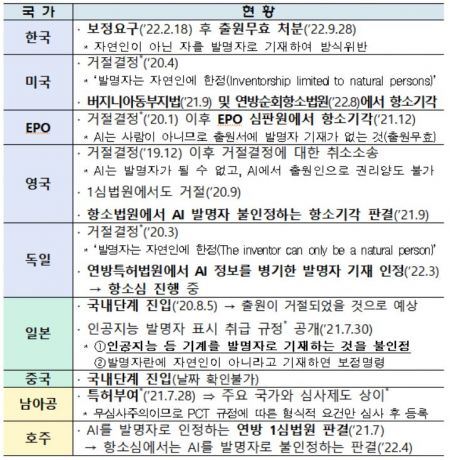 Decisions (progress) of various national patent offices regarding the international patent application of the artificial intelligence 'Dabus'. Provided by the Korean Intellectual Property Office
At present, there is clearly a strong negative perception regarding AI inventions and the granting of patent rights for such inventions. However, whether AI will be recognized as an inventor is expected to remain a “hot potato” in the patent market going forward. Above all, there is growing sentiment that at some point in the future, after a transitional period, AI will have to be recognized as an inventor.
This trend was also detected at an international conference held last December.
At this conference, attended by patent offices from seven countries including Korea, the US, Europe, and China, participants agreed that “AI has not yet reached the level where it can independently invent without human intervention,” but also concurred that “in future legal and institutional reforms, discrepancies between countries (regarding recognition of AI as an inventor) could hinder AI industry development, so international consensus and harmonization are essential.”
Lee In-sil, Commissioner of KIPO, said, “Considering the current pace of AI development, there may come a time when AI must be recognized as an inventor,” and added, “KIPO will continue to discuss issues surrounding AI inventions with academia, industry, and patent offices worldwide in preparation for this trend.”
He emphasized, “KIPO will lead these discussions and strive to pioneer the intellectual property system for the upcoming Fourth Industrial Revolution era.”
© The Asia Business Daily(www.asiae.co.kr). All rights reserved.


















