Xi Jinping Invites C919 Developers to the Great Hall of the People, Inspiring Pride Among 1.4 Billion Chinese
Aircraft Reliability and Stability Require Time to Be Recognized... Overseas Sales Remain Uncertain
[Asia Economy Senior Reporter Cho Young-shin] The aviation 'national pride' of 1.4 billion Chinese is soaring to the skies.
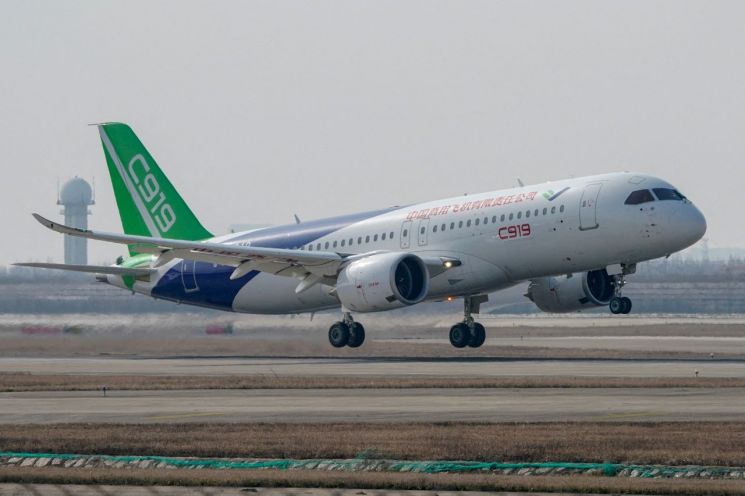
China's state-owned Commercial Aircraft Corporation of China (COMAC) held the airworthiness certification ceremony for its self-developed aircraft (passenger plane) C919 on the 29th of last month. The airworthiness certification is the final step for the commercial operation of the C919. It is a kind of flight permit indicating that there are no technical issues with carrying civilians on board right now.
The C919 airworthiness certification ceremony was held two days before National Day (October 1). Chinese media rushed to report on the C919 airworthiness certification ceremony. The Chinese media conveyed the meaning that China's civil aircraft industry has grown to a level comparable to that of the United States and Europe.
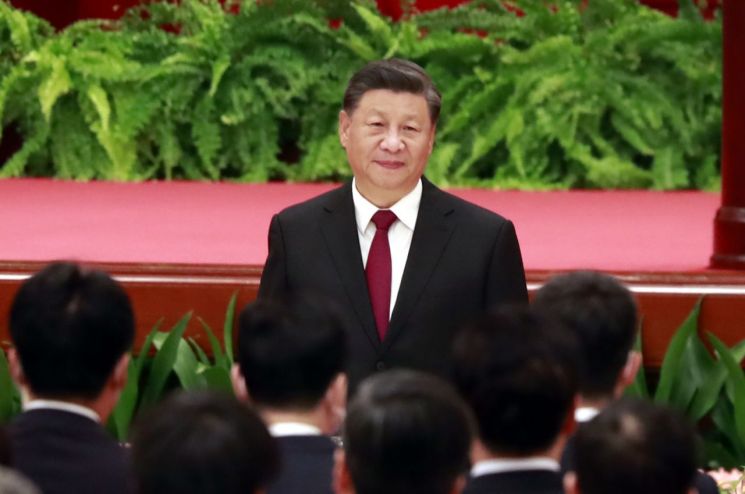
The Chinese leadership also politically utilized the C919 airworthiness certification ceremony. Ahead of the 20th National Congress of the Communist Party of China (CPC), President Xi Jinping invited the C919 developers to the Great Hall of the People the next day to commend their hard work. At this event, President Xi said, "The domestically produced large passenger aircraft embodies the country's will and dreams, as well as the people's expectations," adding, "We must strive to reach the global pinnacle of science and technology for the great rejuvenation of the Chinese nation."
The People's Daily, the official newspaper of the Communist Party of China, filled the front page of its October 1 edition with photos and articles praising the C919 developers alongside President Xi's 73rd National Day event. Given that the 20th Party Congress, where his third term will be decided, is scheduled for the 16th, the C919 airworthiness certification ceremony is a politically beneficial event for President Xi.
The civil aircraft market is dominated by the United States' Boeing and Europe's Airbus. The entry barriers are very high. COMAC's C919 airworthiness certification ceremony reflects the Chinese authorities' determination to challenge the aircraft industry monopolized by Boeing and Airbus. It is a topic sufficient to stimulate the national pride of the Chinese people.
COMAC is expected to first deploy the C919 on domestic routes in China and then target overseas markets. COMAC applied for the C919 type certification from the European Aviation Safety Agency (EASA) in April 2017. For overseas operation of the C919, it must meet the airworthiness requirements of both EASA and the U.S. Federal Aviation Administration (FAA).
Chinese media expect the C919 to break the global passenger aircraft industry monopoly held by Boeing and Airbus. They explain that the B737 and A320 series are the target models for the C919. In fact, the C919 has a seating capacity of 158 to 168 seats and a range of 4,075 to 5,555 km. The aircraft specifications are similar to those of the B737 and A320 series. The B737 and A320 are the best-selling flagship models of Boeing and Airbus, respectively. China's competitive edge lies in price. According to a public announcement by China Eastern Airlines, the price per C919 is $99 million. The prices of the B737 and A320 range from $110 million to $130 million, making the C919 about 20% cheaper.
It is expected to take considerable time for the C919's reliability and stability to be internationally recognized. Also, it is uncertain whether the U.S. and Europe will readily approve the C919's flight in their airspace. Therefore, the C919 is likely to operate only within Chinese airspace for a significant period.
Insurance is also an issue. Chinese insurers (primary insurers) will underwrite C919 insurance, but it is highly likely that U.S. and European reinsurers, who dominate the global reinsurance market, will be reluctant to take on the risk. Even if they do, they may demand high premiums. This will impose a financial burden on airlines operating the C919. Chinese media have not addressed C919 aviation insurance.
Professor Zhang Weigui of Shanghai International Studies University forecasted, "The duopoly of Boeing and Airbus, which dominates the global aviation market, will continue until the mid-2030s," but also said that since China has entered the civil aircraft market, the duopoly will be broken.
The U.S. and Europe are likely to intensify their scrutiny of China, which has knocked on the door of the civil aircraft market. The cost of national pride that China must pay may not be insignificant.
© The Asia Business Daily(www.asiae.co.kr). All rights reserved.


















