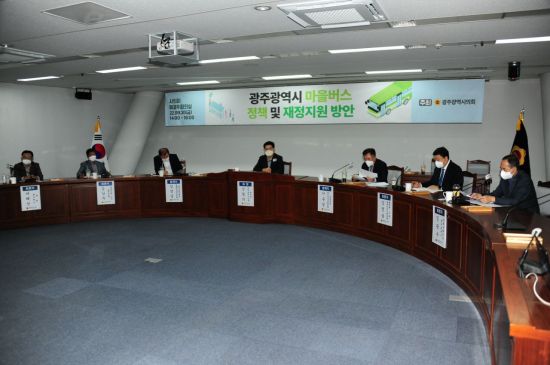
[Asia Economy Honam Reporting Headquarters Reporter Yoon Jamin] A forum was held to prepare policies and financial support measures for village buses in the Gwangju area.
According to the Gwangju Metropolitan Council on the 30th, the policy forum chaired by Vice Chairman Shim Cheol-ui of the city council was successfully concluded.
At the forum, in-depth discussions took place with about 100 participants from various sectors including Im Young-gil, head of the Gwangju-Jeonnam branch of the Transportation Safety National Forum; Lee Jun-young, executive director of the Gwangju Green Transportation Movement; Kim Myung-sul, advisor to the Gwangju Citizens' Social Organizations Federation; Nam Ju, director of the Gwangsan District branch of the Korea Senior Citizens Association; Lee Hae-shin, representative of Gwangsan Bus; Kim Kwang-soo, head of the Public Transportation Division of Gwangju Metropolitan City; as well as citizens and officials.
The first presenter, Im Young-gil, head of the Gwangju-Jeonnam branch of the Transportation Safety National Forum, emphasized that village buses are not merely a means to meet short-distance demand but play a complementary role with other public transportation such as urban rail and city buses, highlighting coexistence. He proposed financial and infrastructural support for the sustainability of village buses.
The second presenter, Lee Jun-young, executive director of the Gwangju Green Transportation Movement, compared the support systems for village buses in other cities and Gwangju Metropolitan City, emphasizing the need for changes in Gwangju’s transportation policy.
Nam Ju, director of the Gwangsan District branch of the Korea Senior Citizens Association, who participated as a discussant, stressed the necessity of rural route transportation policies and ensuring smooth public transportation use for rural elderly and students. He requested that when revising village bus routes, the opinions of transportation companies, district offices, and local residents be reflected.
Additionally, Lee Hae-shin, representative of Gwangsan Bus, complained that when two drivers worked the same 14 days per month, village bus drivers experienced a salary difference of about 1.5 million KRW due to issues such as overtime, night work, and weekly holiday allowances. He mentioned the differences in financial and institutional support between city buses and village buses and advocated for a quasi-public operation system for village buses.
Kim Kwang-soo, head of the Public Transportation Division of Gwangju Metropolitan City, spoke about the limitations of financial and policy support for village buses in Gwangju and future improvement plans.
Councilman Shim Cheol-ui stated, “Village buses are the most convenient means of transportation for vulnerable groups and citizens living in transportation-poor areas, and their importance is expected to increase with the opening of Subway Line 2. The city is making continuous efforts to support village buses, but we will continue to seek improvement and support directions so that village buses can operate within the institutional framework with additional financial and policy support for sustainability.”
© The Asia Business Daily(www.asiae.co.kr). All rights reserved.
![Clutching a Stolen Dior Bag, Saying "I Hate Being Poor but Real"... The Grotesque Con of a "Human Knockoff" [Slate]](https://cwcontent.asiae.co.kr/asiaresize/183/2026021902243444107_1771435474.jpg)











