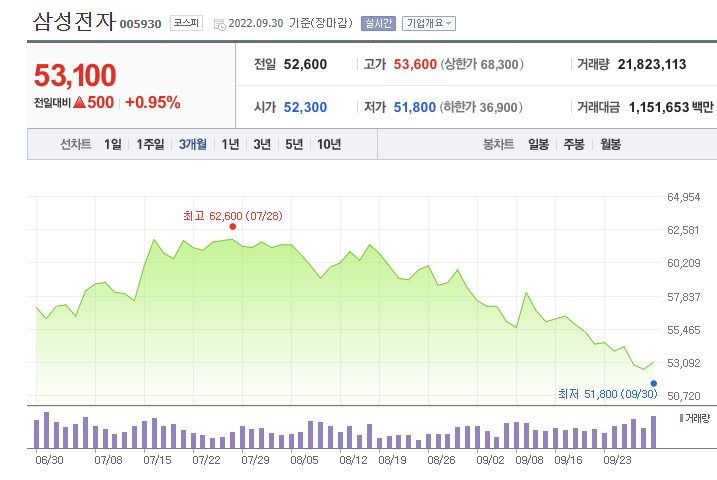
[Asia Economy Reporter Lee Seon-ae] The love-hate relationship of individual investors toward Samsung Electronics, the top blue-chip stock in the domestic market, is drawing attention. Both net buying and short selling have surged simultaneously. Individual investors, convinced that the stock price has hit bottom, have started buying in installments, causing a sharp increase in the net buying amount of Samsung Electronics by individuals. On the other hand, as Samsung Electronics' stock price has been falling day after day recently, raising concerns about the so-called '40,000 won Samsung Electronics,' the number of individual investors short selling in anticipation of further declines is increasing, leading to a sharp rise in the short selling trading volume of Samsung Electronics.
According to the Korea Exchange on the 1st, on the last trading day of September, Samsung Electronics hit a 52-week low of 51,800 won during the session but rebounded to close at 53,100 won. Although foreign investors' counter-buying pushed the stock price into a firm range, the general analysis is that the upward trend has not been restored.
There is even an analysis that Samsung Electronics' stock price could fall as low as 46,300 won in the worst-case scenario. Song Myung-seop, a researcher at Hi Investment & Securities, said, "Assuming the stock price falls to a historical low multiple of 0.94 times, it could drop to 46,300 won," adding, "In this case, the maximum downside risk is about 12%." Hi Investment & Securities forecasts that the period of trend-wise price increase for Samsung Electronics will begin from the first quarter of next year. Researcher Song explained, "Samsung Electronics' stock price moves in line with leading economic indicators such as the year-over-year change in global liquidity and the U.S. Institute for Supply Management (ISM) manufacturing index," and "These indicators are expected to turn upward starting from the first quarter of next year."
As concerns about Samsung Electronics becoming a '40,000 won stock' have surfaced, the short selling trading volume has also increased. The average daily short selling trading volume of Samsung Electronics in September (from the 1st to the 29th) was 26.944 billion won, nearly double that of August (14.91 billion won). The average proportion of short selling relative to total trading volume also rose to 3.32%, up from 2.22% last month.
Despite the surge in short selling, individual investors simultaneously bought Samsung Electronics the most. This indicates that many individual investors are also convinced that Samsung Electronics' stock price is at the bottom. Hi Investment & Securities also views the current stock price of Samsung Electronics as close to the bottom. Researcher Song recommended, "I advise a strategy of buying in installments whenever the stock price undergoes a correction in the future."
During the entire month of September (from the 1st to the 29th), Samsung Electronics was also the most purchased stock by individual investors. The net buying amount reached 2.04 trillion won. Compared to the second-ranked Doosan Enerbility (358 billion won) and third-ranked SK Hynix (300 billion won), the gap is overwhelming.
Although the outlook for the semiconductor sector is not bright for the time being, the securities industry's view that Samsung Electronics' stock price is at the bottom appears to have driven their net buying.
Park Yu-ak, a researcher at Kiwoom Securities, said, "Due to supply chain instability over the past two years, Samsung Electronics' customers have started reducing their accumulated inventory, and inventory adjustments are expected to be completed by the first quarter of next year," adding, "Since the stock price has approached a historical low level, it has come down to a price range worth considering for buying."
© The Asia Business Daily(www.asiae.co.kr). All rights reserved.

















