[Asia Economy Reporter Lee Seon-ae] Influenced by the sharp decline in the U.S. stock market, the domestic stock market also started lower on the 30th. Individual investors showed a selling bias right at the opening, reflecting an overall deterioration in investor sentiment.
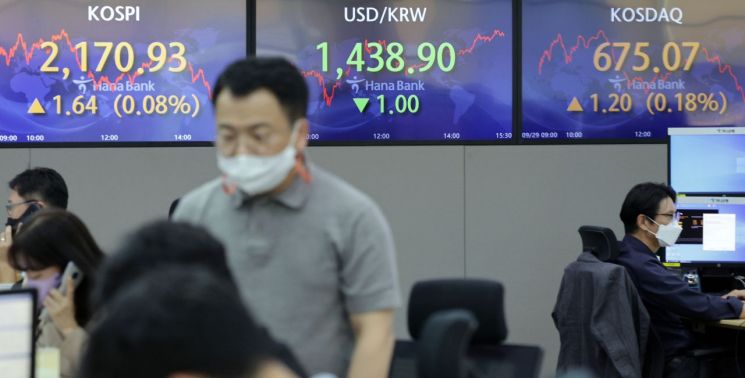
On this day, the KOSPI opened at 2161.11, down 9.82 points (0.45%). The KOSDAQ started at 668.26, down 6.81 points (1.01%).
As of 9:15 a.m., the KOSPI was down 0.24% at 2165.82, and the KOSDAQ was down 0.35% at 672.69. This was influenced by the U.S. New York stock market, which had briefly rebounded the previous day but then collapsed again. On the 29th (local time), the Dow Jones Industrial Average, which gathers blue-chip stocks, closed at 29,225.61, down 1.54% from the previous trading day at the New York Stock Exchange. The large-cap focused Standard & Poor's (S&P) 500 index recorded 3,640.47, down 2.11%, marking a yearly low. The tech-heavy Nasdaq index plunged 2.84% to close at 10,737.51. Additionally, the Russell 2000 index, which focuses on small and mid-cap stocks, fell 2.35% to 1,674.93.
The sharp drop in shares of Apple, the largest market cap company, and electric vehicle maker Tesla led the index decline. The unexpectedly strong employment data also influenced expectations that the Federal Reserve's monetary tightening policy would continue unwaveringly.
In the early trading session, only individual investors are net sellers. Individuals have sold approximately 184.1 billion KRW in the KOSPI and about 32.5 billion KRW in the KOSDAQ markets. Foreign investors show a net selling bias of 17.3 billion KRW only in the KOSPI market, while they are net buyers of 32.2 billion KRW in the KOSDAQ market. Institutions are net buyers of about 200.7 billion KRW in the KOSPI market but net sellers of about 4.3 billion KRW in the KOSDAQ market.
Seosangyoung, a researcher at Mirae Asset Securities, forecasted, "The Korean stock market is expected to proceed with a stock-specific market amid a clash between rebound buying sentiment and recession issues after starting with a relatively mild decline of around 1% compared to the U.S. stock market." He pointed out that the U.S. stock market’s sharp decline, despite dollar weakness, was due to recession concerns highlighted by some individual companies’ negative factors, which would negatively impact the Korean stock market. Particularly, the Philadelphia Semiconductor Index’s 3.2% drop due to the slowdown in the PC industry is a burden.
However, he viewed the potential inflow of a won appreciation trend as a positive factor. Additionally, although the U.S. stock market fell sharply, the stability shown in the foreign exchange, bond, and commodity markets is noteworthy. There is a possibility that month-end and quarter-end portfolio rebalancing caused the sharp decline in the U.S. stock market, as suggested by some.
Han Ji-young, a researcher at Kiwoom Securities, noted, "There are upward factors such as exchange rate decline, U.S. interest rate decline, and anticipation of bad news being priced in advance, but due to existing downward factors like the Fed’s tightening causing a sharp drop in the U.S. stock market and domestic individual investors’ margin call selling, the market started lower. Also, the poor after-hours stock prices of major U.S. semiconductor and consumer goods companies will constrain investment sentiment in related domestic stocks."
© The Asia Business Daily(www.asiae.co.kr). All rights reserved.

















