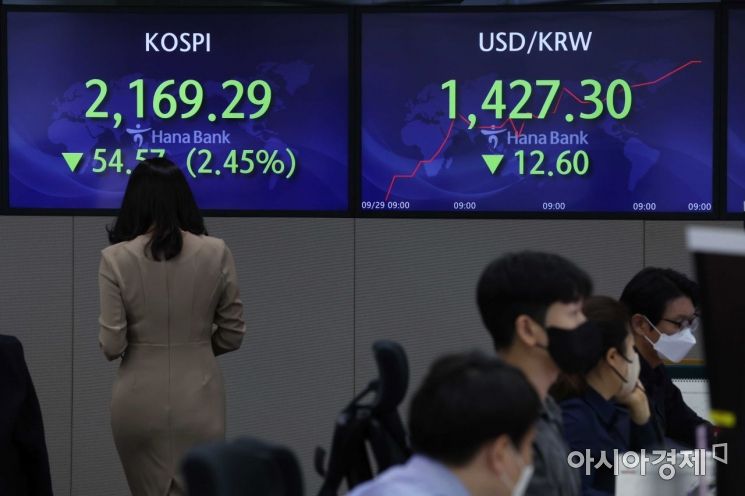
 On the 29th, dealers were working in the dealing room of Hana Bank in Euljiro, Seoul. On this day, the KOSPI index opened at 2197.75, up 28.46 points (1.31%) from the previous trading day. The won-dollar exchange rate opened at 1424.5, down 15.4 won. Photo by Moon Honam munonam@
[Asia Economy Reporter Hwang Yoon-joo] 'The Bank of England (BOE) Effect Ended in Half a Day'
The KOSPI and KOSDAQ indices failed to maintain their rebound momentum on the 29th and closed flat. Thanks to the BOE's commencement of government bond purchases, the KOSPI surged up to 1.90% and the KOSDAQ up to 3.21%. However, buying by institutional investors sharply contracted before the market close, causing the momentum to fade.
In the KOSPI market, semiconductors and big tech stocks turned to losses, while in the KOSDAQ market, the battery sector ended in decline.
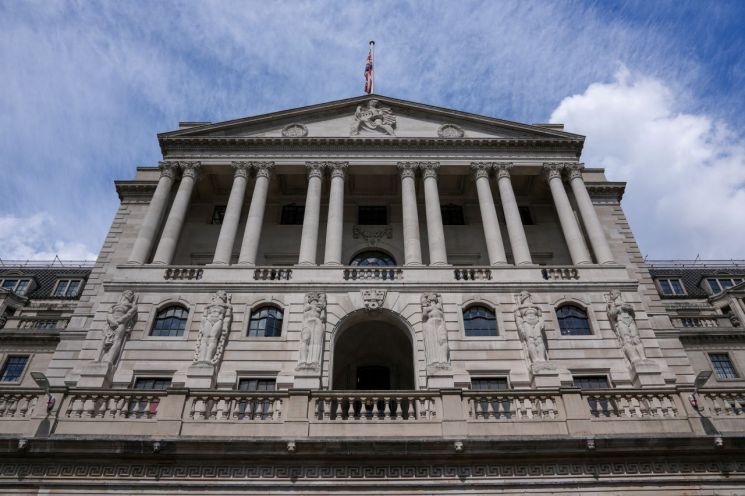
◆ BOE Good News 'Flicker'... Samsung Electronics, SK Hynix, Naver, Kakao Turn to Losses= On that day, the KOSPI index closed at 2170.93, up 0.08% (1.64 points) from the previous trading day. The KOSPI started at 2197.75, up 1.31% (8.46 points), and pushed up to 2210.61 (+1.90%) during the session. However, it fell below the 2200 level in the afternoon and barely held the 2170 level to close the session.
Following news that the BOE had started emergency government bond purchases of up to 65 billion pounds (approximately 101 trillion won) to counter the pound's sharp decline, foreign and institutional investors showed a 'buying' stance from the early session.
The BOE plans to purchase long-term government bonds worth 5 billion pounds (about 7.8 trillion won) daily for 13 days to stabilize the financial market. This decision came after the Liz Truss cabinet announced large-scale tax cuts, causing turmoil in the financial markets. After the tax cut announcement, the pound's value against the dollar hit its lowest since 1985, and government bond yields surged, triggering market turmoil. With this emergency measure, the pound rose to around 1.088 dollars against the dollar.
◆ Eurozone Risks Remain... Unable to Ease Investor Sentiment= However, the positive momentum did not last long. It is interpreted that caution about domestic market volatility still remains. Institutional investors switched to 'selling' before the market close. After the opening, foreign and institutional investors were both in a 'buying' mode in the KOSPI market. But before the close, institutional buying sharply diminished and eventually turned into selling.
As a result, individual and institutional investors net sold 223.2 billion won and 2.2 billion won, respectively. Foreign investors alone net bought 219.5 billion won. Foreign investors also purchased futures worth 535.5 billion won. Foreign investors returned to net buying after 12 trading days since the 13th.
The top 10 KOSPI market capitalization stocks all rose after the opening but semiconductors and big tech stocks turned to losses. Naver fell 2.00%, Kakao 1.93%, SK Hynix 0.62%, and Samsung Electronics 0.19%. Samsung Biologics surged throughout the session, closing up 6.00%.
Seo Sang-young, head of the Media Content Division at Mirae Asset Securities, analyzed, "Considering the ongoing possibility of economic recession in the Eurozone and the UK, psychological stability has not been achieved. Also, the supply-demand flow considering the month-end and quarter-end could influence the market, so the possibility of increased financial market volatility still exists."
◆ KOSDAQ, Foreign and Institutional Investors 'Buy'... Battery Stocks Turn to Losses= The KOSDAQ index closed at 675.07, up 0.18% (1.20 points). It started at 686.63, up 1.89% (2.76 points), and recorded 695.49 (+3.21%) during the session.
In the KOSDAQ market, foreign and individual investors net bought 136.9 billion won and 107.5 billion won, respectively. However, individuals alone net sold 246 billion won.
Looking at the KOSDAQ market capitalization, all stocks rose after the opening, but battery-related stocks ended in decline before the close. Ecopro fell 4.01%, Ecopro BM 1.41%, and L&F 0.16%. JYP Entertainment rose 6.22%, Celltrion Pharm 3.94%, and Celltrion Healthcare 3.90% significantly.
Meanwhile, the German Consumer Price Index (CPI), to be announced at 9 PM today, is also a factor suppressing investor sentiment. The German CPI is expected to rise sharply to 9.4% year-on-year from the previous 7.9%. Some reports suggest it could exceed 10%, citing reasons such as subsidy suspensions.
Seo Sang-young stated, "Ultimately, this could accelerate the economic recession in the Eurozone, especially Germany, leading to an increase in institutions betting on euro weakness and causing government bond yields to rise, thus increasing the possibility of volatility."
He added, "For the time being, after key economic indicators such as the German CPI, tomorrow's US PCE inflation data, and next week's US employment report are released, and as the earnings season begins, the financial market is expected to stabilize."
© The Asia Business Daily(www.asiae.co.kr). All rights reserved.



















