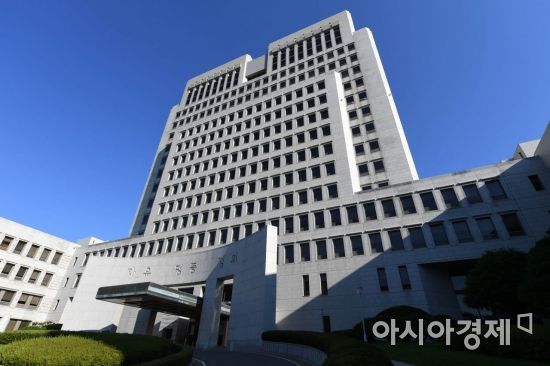
[Asia Economy Reporter Choi Seok-jin, Legal Affairs Specialist] The Supreme Court has ruled that when labor and management agree to allow workers who reach a certain age to choose between applying a wage peak system or special retirement conditional on reemployment, such special reemployment conditions constitute "employment rules," thereby imposing a reemployment obligation on the company for workers who took special retirement.
Typically, employment rules are premised on the continuation of the employment relationship, but this ruling is the first to clarify that even matters concerning rights and obligations after the termination of the employment relationship, if directly related to the ongoing employment relationship between the worker and employer and pertain to the treatment of the worker, fall under the working conditions stipulated in the employment rules.
The Supreme Court's First Division (Presiding Justice No Tae-ak) and Third Division (Presiding Justice Lee Heung-gu) on the 29th upheld the appellate court's partial ruling in favor of the plaintiffs in a final appeal case where over 100 workers who had worked for more than 30 years after joining Korea Exchange Bank filed a lawsuit against Hana Bank, which merged with Korea Exchange Bank, demanding "an expression of intent to employ and payment of overdue wages" for enforcement of employment obligations.
The plaintiffs, born in the latter half of 1959 or the first half of 1960, joined Korea Exchange Bank and worked there until it merged with Hana Bank in 2015. While working at Hana Bank, they had to choose between the wage peak system or special retirement around late 2015 to early 2016.
At that time, the special retirement under Hana Bank's wage peak system improvement plan involved retiring first and then being reemployed as contract-based special staff, guaranteeing a monthly salary of 2 million KRW up to a maximum age of 58.
However, Hana Bank did not reemploy the plaintiffs who took special retirement in 2015-2016 as agreed, leading to litigation.
The plaintiffs claimed that Hana Bank should employ them as agreed and pay the overdue wages, but Hana Bank argued, "There was no definitive promise or agreement to reemploy all workers applying for special retirement; it only offered an opportunity for reemployment as contract-based special staff."
Hana Bank also contended, "This wage peak system improvement plan is invalid as a collective agreement due to lacking formal requirements. While the plan may qualify as employment rules, the reemployment part does not constitute working conditions and therefore does not have the nature of employment rules."
Ultimately, the key issue in the trial was whether the labor-management agreement on 'special contract staff reemployment' could be regarded as employment rules.
Regarding this, Hana Bank argued that the service regulations or working conditions stipulated in employment rules presuppose the continuation of the employment relationship, but the reemployment demanded by the plaintiffs is 'employment' after 'retirement,' so it does not qualify as working conditions.
The first and second trials of two separate cases, although differing slightly in reasoning, agreed on the conclusion that Hana Bank has a reemployment obligation toward workers who chose special retirement.
The Supreme Court also agreed that the conclusions of these lower court rulings were correct.
First, the court stated, "It cannot be concluded that a contract-based special staff employment contract was established solely by the special retirement agreement. In this case, the conditions and effects differ from those applicable to the doctrine of legitimate expectation, so that doctrine cannot be applied."
The court further explained, "Although the act of reemployment of special retirees occurs after the termination of the previous employment relationship between the special retirees and the defendant, the reemployment part in this case is directly related to the ongoing employment relationship between the retiring workers and the defendant and sets conditions regarding the treatment of the retiring workers, thus possessing the nature of employment rules."
It added, "Moreover, the reemployment part in this case is intended to impose a reemployment obligation on the defendant toward special retirees in principle, and it is difficult to view that there was a definitive mutual agreement between the plaintiffs and the defendant to change the special retirement condition to merely granting an opportunity to apply for reemployment."
The court also noted, "Even if there were individual agreements between some special retirees and Hana Bank that only an opportunity to apply for reemployment needed to be granted, such agreements are disadvantageous to the plaintiffs and contrary to the reemployment part in this case, thus invalid under Article 97 of the Labor Standards Act. Therefore, the defendant has a reemployment obligation toward the plaintiffs."
Meanwhile, the court clarified that a previous Supreme Court ruling stating "standards concerning hiring are not included in employment rules" pertains to new hires, and cannot be applied to cases like this one involving reemployment after special retirement between an existing employer and employee relationship.
A Supreme Court official stated, "In this case, the issue was whether reemployment after 'retirement' qualifies as working conditions. While service regulations and working conditions stipulated in employment rules presuppose the continuation of the employment relationship, even matters concerning rights and obligations after the termination of the employment relationship, if directly related to the ongoing employment relationship between the worker and employer and pertain to the treatment of the worker, also qualify as working conditions under employment rules. This was clarified for the first time."
He added, "When special retirement is implemented as an option under the wage peak system or voluntary retirement is conducted as part of workforce restructuring, granting reemployment conditions to induce voluntary retirement allows workers to recognize reemployment conditions as working conditions and seek remedies, and also provides guidelines for employers regarding system implementation. This Supreme Court ruling is expected to provide a standard for many pending lower court cases related to this issue."
© The Asia Business Daily(www.asiae.co.kr). All rights reserved.

















