US-China Conflict Leads to 15% Drop in Chinese Students at US Universities... Financial Strain on Colleges
Germany, France, Korea, Singapore, Japan Favorable Countries for Chinese Students
[Asia Economy Senior Reporter Cho Young-shin] The number of Chinese international students at American universities has decreased for the first time in 10 years due to US-China conflicts.
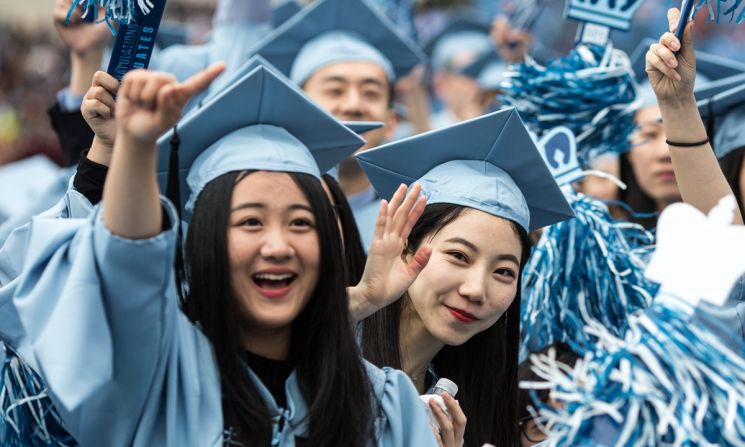
Australia, which is also in conflict with China, has seen a significant decline in Chinese international students over the past two years. The decrease in Chinese students is expected to trigger alarms in American and Australian universities, as it impacts university finances.
According to China News Network, citing a report on the development of Chinese overseas study by the Chinese think tank Center for China and Globalization (CCG), the number of Chinese students in the US during the 2020-2021 academic year dropped by 14.6% compared to the previous year (2019-2020). This marks the first decline in Chinese students in the US in 10 years.
According to the National Association of Foreign Student Advisers (NAFSA), there were 369,548 Chinese students studying in the US during the 2018-2019 academic year. Chinese students make up 33.7% of all international students in the US. During the same period, international students contributed $41 billion (approximately 58.77 trillion KRW) to the US economy, with Chinese students accounting for more than 30% of that contribution. Therefore, a decrease in Chinese students inevitably poses financial challenges for American universities.
CCG forecasts that due to US-China conflicts and US visa policies, the number of Chinese students will continue to decline.
CCG also analyzed that a similar situation is occurring in Australia. In 2020, the number of Chinese students decreased by 9.9% compared to the previous year, and last year it dropped by as much as 11.9%.
Diplomatic relations between China and Australia have deteriorated since 2020. Former Australian Prime Minister Scott Morrison referred to China as the origin of COVID-19, straining bilateral relations. Military pressures from the US and Australia, including the Five Eyes intelligence alliance (comprising the US, UK, Canada, Australia, and New Zealand) and Australia's acquisition of nuclear-powered submarines, have also negatively affected the relationship.
CCG pointed out that the US is tightening controls over advanced technologies such as artificial intelligence (AI), semiconductors, and quantum computing, while Australia is also protecting key technologies. This can be interpreted as a kind of guide discouraging Chinese students from studying in the US and Australia, which are hostile to China.
Instead, CCG advised Chinese students preparing to study abroad to choose countries with more favorable visa policies and friendlier attitudes toward Chinese nationals. It explained that Germany and France are welcoming countries for Chinese students and offer opportunities to learn advanced cultures. Considering geographical proximity, cultural similarities, and relatively affordable tuition fees, South Korea, Singapore, and Japan were also mentioned as good environments for studying abroad.
Chinese portal site Sohu.com reported that as Chinese students decline, seven major Australian universities have fallen outside the top 100 in global university rankings, and 13 major UK universities are facing financial crises.
Meanwhile, since China's reform and opening up in 1978 until 2018, it is known that over 5.85 million Chinese students have studied abroad over the past 40 years.
© The Asia Business Daily(www.asiae.co.kr). All rights reserved.
![Clutching a Stolen Dior Bag, Saying "I Hate Being Poor but Real"... The Grotesque Con of a "Human Knockoff" [Slate]](https://cwcontent.asiae.co.kr/asiaresize/183/2026021902243444107_1771435474.jpg)
















