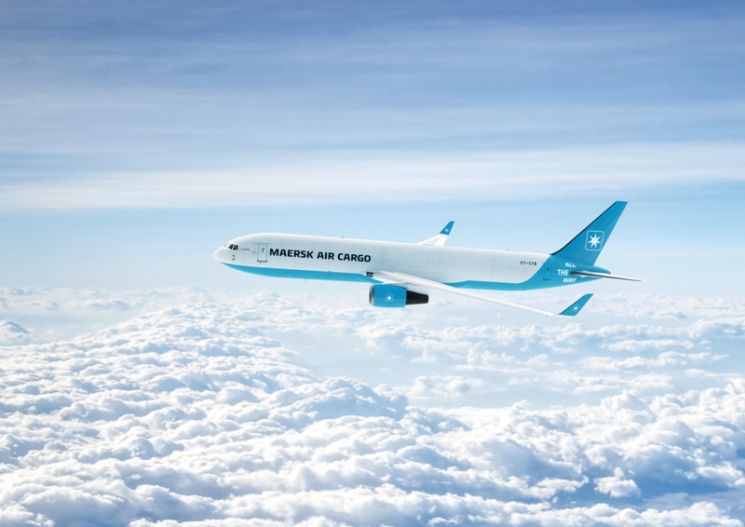
[Asia Economy Reporter Yujin Cho] Global shipping companies are accelerating their expansion into the aviation business sector. The logistics crisis that swept the world during the COVID-19 pandemic and the uncertainties caused by the Ukraine situation have accelerated attempts to strengthen supply chain dominance. Some financially robust shipping companies aim to evolve into 'integrated logistics companies' covering land, sea, and air by acquiring logistics firms through mergers and acquisitions (M&A) following their entry into aviation.
Maersk, the world's largest shipping company by fleet capacity, reportedly applied to the U.S. Department of Transportation for an air transport license on the 29th of last month (local time) to transfer its existing air logistics subsidiary Star Air's business to Maersk Air Cargo, according to major foreign media. Maersk Air Cargo is a separate entity established by Maersk in April to enter the air cargo business.
Maersk, which was the fastest to enter the air cargo business, currently operates a fleet of 15 Boeing 767 freighters through aircraft investments. To respond to recent increases in cargo volume, it has deployed three additional Boeing 767-300F freighters on U.S.-China routes and plans to receive two more newly ordered Boeing 777F aircraft in two years.
CMA CGM also stepped into the air logistics business last year by establishing an air logistics subsidiary called CMA CGM Air Cargo. To this end, it purchased four used Airbus 330-200F freighters from Qatar Airways and acquired two additional Boeing 777s this year.
MSC, headquartered in Switzerland, partnered with Atlas Air to launch the cargo airline MSC Air Cargo. MSC Air Cargo is preparing to start service next year with four Boeing 777-200F aircraft.
◆ Opening the era of 'door-to-door transport' linking land, sea, and air = The expansion of the aviation business by global shipping companies stems from the supply chain disruptions experienced during the COVID-19 pandemic. Severe labor shortages and lockdown measures during the pandemic caused unprecedented logistics difficulties worldwide, temporarily halting ships traveling between Asia and the Americas.
In October last year, the number of ships waiting to enter the two major ports on the U.S. West Coast, Los Angeles (LA) and Long Beach, surged to record highs. To resolve the logistics crisis reminiscent of a battlefield, the White House directly chaired emergency meetings, and state governments even considered deploying military police.
Experiencing such turmoil, shippers' demands for avoiding uncertainty and timely transportation increased. British shipping consultancy Drewry reported that, following COVID-19, shippers increasingly prefer relatively stable air transport despite higher costs. As shippers' demands diversify, shipping companies' ultimate goal is to go beyond container ships and aircraft services to realize 'door-to-door transport' by linking trucks and railways.
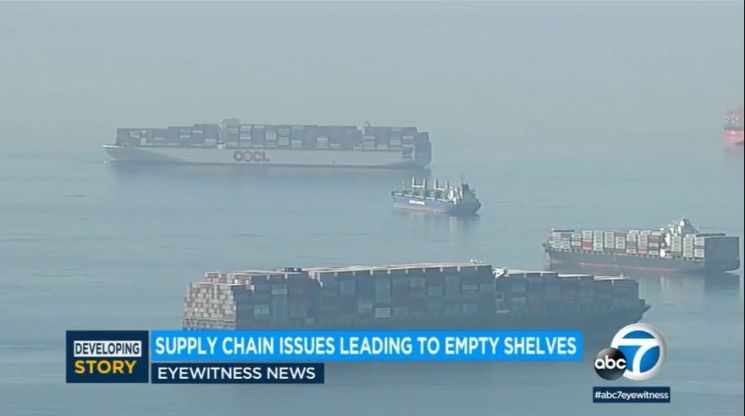 Container ships waiting to enter the port in the offshore waters of the US West Coast on October 19 last year. (Photo by ABC News)
To this end, MSC acquired the African division of the French logistics company Bollor? Logistics for 5.7 billion euros. The acquisition included 16 terminals operating in eight African countries, over 80 agencies, and railway operating rights. Maersk also secured land infrastructure in Asia by acquiring an Asian logistics company for 3.6 billion dollars.
◆ Strong reserves... Big 3 embark on shopping spree for airlines and logistics companies = The Big 3 shipping companies are leveraging their substantial reserves accumulated over many years to acquire airlines and logistics firms. The market heated up further as airlines facing bankruptcy due to a sharp drop in passenger demand and financial difficulties during COVID-19 flooded the market with available assets.
For example, MSC teamed up with German airline Lufthansa to enter the bidding for Italy's state-owned airline ITA Airways. MSC conducted three months of due diligence to complete the M&A but ultimately failed to acquire the airline, losing out to a consortium led by Air France-KLM and U.S. Delta Air Lines.
MSC hired Jenny Dable, who led cargo operations at Delta Air Lines and Emirates Airlines for 28 years, as head to explore business expansion through M&A or partnerships. It is also reported that MSC is discussing securing ground handling companies independently to enhance competitiveness in handling large air cargo.
Ocean freight rates are expected to continue their high-level trend this year. The Shanghai Containerized Freight Index (SCFI), which rose sharply during the pandemic, hovered around 5,000 points earlier this year. Although it recently dropped to the 2,000 range due to recession concerns, it remains about twice as high as pre-COVID-19 levels.
The outlook for shipping companies' earnings is also not bleak. Drewry forecasted that the industry's profits from 2021 to 2023 would be similar to the total profits earned over the past 60 years until 2020. Global shipping companies' operating profits, which were around 7 billion dollars in 2019 before the pandemic, surged to 26 billion dollars in 2020 and 210 billion dollars last year, driven by rising freight rates. Although the industry expects next year's profits to be lower than this year due to the global economic downturn, they are still projected to be much higher than pre-pandemic levels.
© The Asia Business Daily(www.asiae.co.kr). All rights reserved.


















