Research Team Led by Professor Yum Myungsoon, Seoul National University Graduate School of Public Health
Survey Results on Awareness Among 1,000 Adults
[Asia Economy Reporter Kim Young-won] More than half of the nation's population believes that the indoor mask-wearing mandate can be lifted.
A research team led by Professor Yoo Myung-soon from the Graduate School of Public Health at Seoul National University, in collaboration with Case Stat Research, conducted a 'Public Perception Survey on the Indoor Mask-Wearing Mandate' from the 22nd to the 26th of last month, targeting 1,000 adults aged 18 and over nationwide. The results were announced on the 29th.
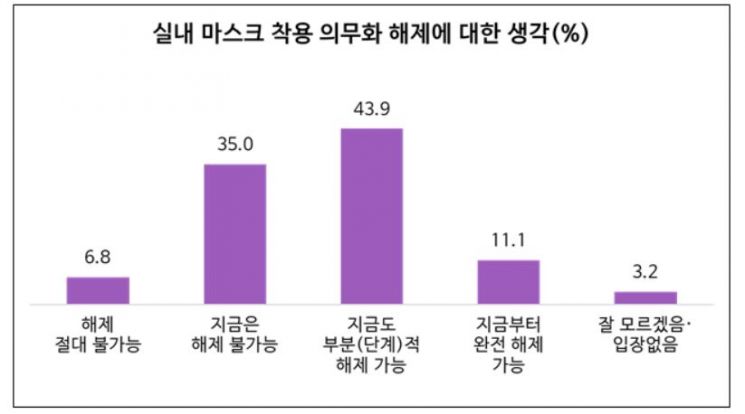
In the survey, 55% of respondents answered that the indoor mask-wearing mandate could be "lifted," exceeding half. Those who believed it could not be lifted accounted for 41.8% of the total. The remaining 3.2% answered "don't know." Among detailed responses, "partial (phased) lifting is possible even now" was the most common at 43.9%.
When considering the lifting of the indoor mask mandate, respondents most frequently thought about the impact of infections such as a resurgence of COVID-19 (45.8%). Next, they considered the impact on high-risk groups (28.1%) and concerns about the future generation, such as children's language and emotional development (11%). Only 3.2% considered overseas cases regarding maintaining or lifting the mask mandate, the lowest response rate.
Positive perceptions of lifting the mask mandate varied by age and COVID-19 infection experience. Younger age groups viewed lifting the mask mandate more favorably. Among those in their 20s and 30s, 64.6% believed indoor mask mandates could be lifted; 56.6% of those in their 40s and 50s agreed, and 49.2% of those aged 60 and above thought so.
Regarding COVID-19 infection experience, those who had been infected (60.3%) were more in favor of lifting the mask mandate than those who had not been infected (54.3%).
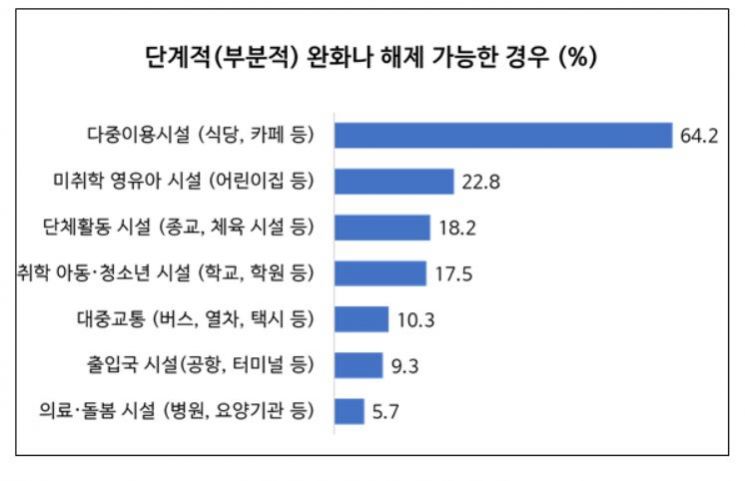
Among the 439 respondents who answered that phased lifting is possible at this stage, when asked in which places lifting could be implemented, 64.2% said phased lifting could be possible in multi-use facilities such as restaurants and cafes, the highest response rate. This was followed by facilities for preschool children (22.8%), religious and group activity facilities (18.2%), and facilities for school-age children and adolescents such as schools and academies (17.5%). Medical and care facilities such as hospitals and nursing institutions were chosen by the fewest respondents at 5.7%.
© The Asia Business Daily(www.asiae.co.kr). All rights reserved.


















