Monthly Rent, Transportation, Food Expenses... "No Money Left Even After Receiving Salary"
"Can't Afford to Live Alone"... Saving 'Living Expenses' by Living with Parents
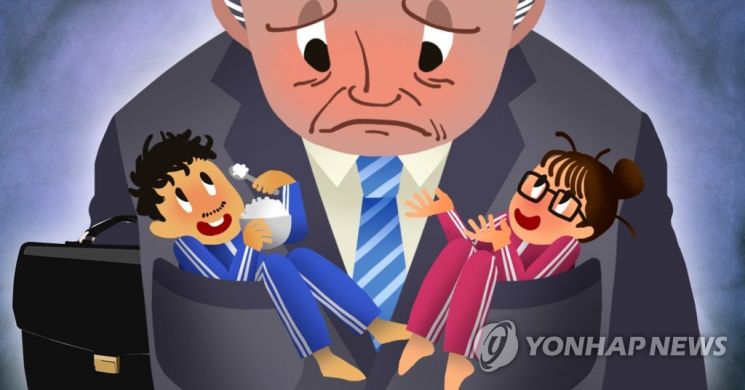 Young adults in their 20s and 30s who are just starting their careers are becoming so-called "kangaroo kids," returning to live with their parents after failing to cover living expenses independently.
 [Image source=Yonhap News]
[Asia Economy Culture Young Intern Reporter] # A, a young adult in their second year of living alone, said, "If given the chance, I would like to live with my parents." For A, who left their hometown and moved to Seoul, monthly rent and living expenses are a significant burden. In fact, A spends 500,000 KRW monthly on rent and 300,000 KRW on fixed living expenses, including utility bills. Considering food, transportation, mobile phone charges, and insurance fees, A says saving money is 'impossible.'
As the high inflation era makes it difficult to cover rent and living expenses with a salary, more people in their 20s and 30s are returning to live with their parents. This has led to calls for support and measures to help young people live independently.
According to data released by the Korea Institute for Health and Social Affairs, 29.9% of adults aged 19 to 49 live with their parents. Among those aged 25 to 29, 48.5% live with their parents. The main reasons for living with parents were cited as economic difficulties such as high inflation and high interest rates.
Additionally, according to the '2020 Population and Housing Census Sample Aggregation Results' released by Statistics Korea, 38.9% of people in their 20s responded that they rely on their parents for living expenses. This means 4 out of 10 receive parental support. B, who received financial help from their parents for two years after starting work, said, "Although I had a steady income from working, I received support for insurance fees and part of the rent."
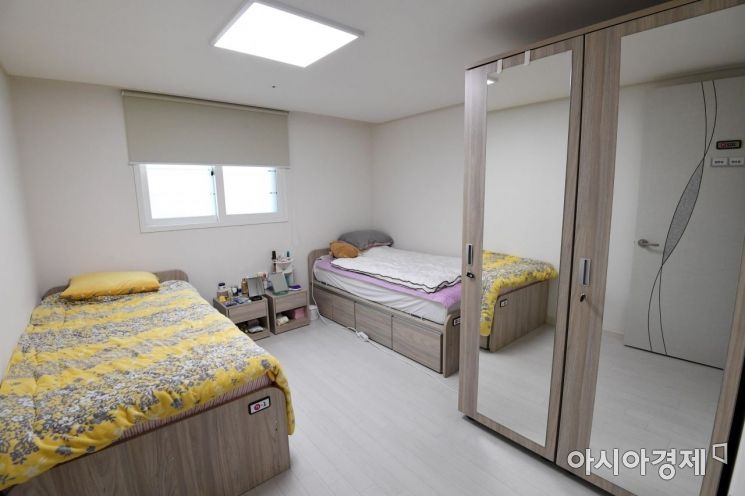 Interior view of the dormitory-style youth housing that first opened in Gaebong-dong, Guro-gu, Seoul in 2019. The photo is not related to the specific content of the article. Photo by Jinhyung Kang aymsdream@
Rising housing costs, including rent, also drive young people back to their parents. In Seoul, 65.8% of young people live in rented housing, more than three times the rate of general households. According to a survey of actual rental transactions in Seoul from January to October last year by Station3, which operates the real estate platform Dabang, the average monthly rent for a studio apartment under 30㎡ was 400,000 KRW. At the minimum wage at that time, 22% of the salary would go toward rent. The average rents were 550,000 KRW in Gangnam-gu, 510,000 KRW in Seocho-gu, 480,000 KRW in Jung-gu, and 450,000 KRW in Mapo-gu.
To ease the housing and living cost burdens of young people who wish to live independently or have already done so, the government is expanding 'youth housing' provisions and implementing programs such as the 'Youth Exclusive Stepping Stone Jeonse Loan,' 'Small and Medium Enterprise Employment Youth Jeonse Deposit Loan,' and 'Youth Housing Benefit Separate Payment.'
However, there are criticisms that there are few properties available for these policies and that the youth housing system is still not adequately established. Due to limited supply compared to demand, competition for youth housing subscriptions is becoming increasingly fierce. Last year, 36,000 applicants applied for Seoul's youth monthly rent support in the first half alone, prompting an increase in support scale.
According to the Korea Land and Housing Corporation (LH), the average competition rate for the second round of youth purchase rental housing was 102.3 to 1. The competition rate for youth housing subscriptions provided by SH Seoul Housing and Communities Corporation was 23.4 to 1 in 2019 but rose to 60 to 1 in 2021.

Young people also voiced difficulties caused by high inflation. Recently, C, who did a credit-linked internship, said, "The internship salary is not much. But I had to buy lunch every time," adding, "Since the company is near Yeoksam Station, where food is already expensive, rising prices increased my food expenses." Another intern, D, said, "I am always surprised when grocery shopping alone," and added, "Single-serving food is more expensive than buying in bulk."
In summary, young people who economically depend on their parents are called 'Kangaroo tribe,' and young workers who become independent but return home due to economic hardship caused by recessions are called 'Salmon tribe.' Young people say, "The reality is that the environment does not allow young people to live independently." D, who returned home after about a year of living alone, said, "People around me ask why I came back," and added, "Honestly, I couldn't afford the rent. Even if the company is far, I want to live at my parents' house."
Professor Seol Dong-hoon of the Sociology Department at Jeonbuk National University analyzed, "It is natural to return to the parents' house when money is insufficient." He added, "In the past, there were shared housing systems like boarding houses, but nowadays young people want their 'own space.' So they become independent, but when living expenses are insufficient, they change strategies by living with friends or moving back to their parents' house."
© The Asia Business Daily(www.asiae.co.kr). All rights reserved.



















