Forced to reduce working hours during childcare period instead of taking parental leave
Low utilization of substitute workforce bank and ineffective substitute workforce subsidies
Experts say "Urgent need to expand joint workplace daycare centers for SMEs"
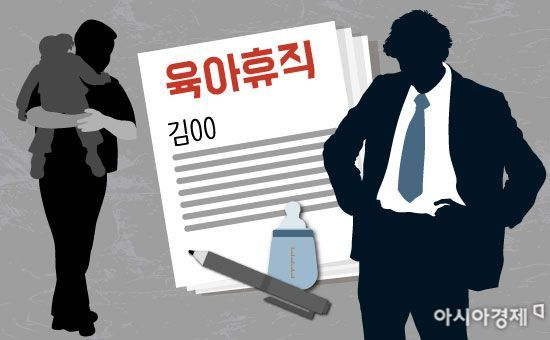
[Asia Economy Reporter Lee Hyunjung] Lee Jeongho (34), an employee at a small and medium-sized enterprise (SME) who is six weeks pregnant, suddenly experienced a deterioration in her health during work, leading to an unintended "Imming-out" (a combination of pregnancy and coming out). The company immediately asked about her resignation plans. Lee said, "I never expected to be advised to resign right after imming-out."
The situation of Kim Jisoo, a pregnant woman in her 30s working at an SME, is not much different. Kim said, "There is no precedent of female employees taking parental leave, so the company is at a loss about how to handle it." She added, "Even if they announce a recruitment for a replacement, there is a high possibility that no one will apply, and even if someone does, hiring them as a regular employee means my position disappears. In any case, the probability of ending with resignation is high," she lamented.
Although men now confidently take parental leave, it is almost impossible in SMEs struggling with labor shortages. According to Statistics Korea's "2020 Parental Leave Statistics," 63.5% of all parental leave users were employees of companies with 300 or more employees. The parental leave usage rate by company size was highest at 31.3% in companies with 300 or more employees, followed by 22.6% in companies with 50-299 employees, 19.2% in companies with 5-49 employees, and 9.8% in companies with 4 or fewer employees, showing a decline in usage rate according to employee size.
In SMEs, even if employees barely avoid resignation, they are often pushed to use the reduced working hours system during childcare instead of parental leave. The reduced working hours system during childcare allows employees to apply for reduced working hours to care for children aged 8 or younger or in the second grade of elementary school or below. Combining parental leave and reduced working hours during childcare, employees can use up to two years in total. However, if the employer permits reduced working hours, the working hours after reduction must be between 15 and 35 hours per week.
In labor-short SMEs, there are many cases where employees are persuaded to use the reduced working hours system during childcare instead of parental leave. According to the Ministry of Employment and Labor's employment insurance network data on the number of users of reduced working hours during childcare by company size, in 2021, large companies had 5,615 users, while SMEs designated as priority support companies had 11,074 users, indicating higher usage in SMEs. The government provides subsidies for replacement personnel for maternity leave and reduced working hours during childcare.
However, since it is not easy to find replacement personnel, the government abolished the replacement personnel hiring subsidy system, which was given separately from the parental leave incentive to employers who hired replacement personnel, starting this year after operating it since 2004. Instead, the system was reformed by introducing a special case that supports 2 million KRW per month for the first three months for children under 12 months of age.
The Replacement Personnel Bank, operated since 2014, is also ineffective. Especially nowadays, with higher marriage and childbirth ages, replacement personnel suitable for team leader-level parental leave demands, who perform key tasks in companies, rarely come even with extra pay. Yang Oksuk, head of the Human Resources Policy Office at the Korea Federation of SMEs, explained, "Since there are simply not enough people willing to work at SMEs, the utilization rate of the Replacement Personnel Bank is also low." Replacement personnel hiring is limited to certain industries where replacement is relatively easy, such as nursing assistants and childcare teachers.
Dr. Kang Minjung of the Korean Women's Development Institute said, "Although the government has established various systems such as providing subsidies for replacement personnel hiring and operating the Replacement Personnel Bank, the results have been unsatisfactory." Dr. Kang emphasized, "To increase the parental leave usage rate in SMEs, a public childcare system that naturally connects maternity leave, parental leave, and workplace daycare centers must be properly established." She noted that increasing daycare centers for dual-income families and joint daycare centers for SMEs could be alternatives.
In reality, this is also difficult. The government has been running a public contest project for joint daycare centers for SMEs for 10 years, supporting installation and operating costs. However, even when centers are established with difficulty, many face operational challenges and end up closing. Among 1,248 workplace daycare centers nationwide (as of 2021), only about 110 are joint workplace daycare centers for SMEs as of the end of August this year.
© The Asia Business Daily(www.asiae.co.kr). All rights reserved.
![Clutching a Stolen Dior Bag, Saying "I Hate Being Poor but Real"... The Grotesque Con of a "Human Knockoff" [Slate]](https://cwcontent.asiae.co.kr/asiaresize/183/2026021902243444107_1771435474.jpg)
















