Last Year, Corporate Card Spending on Golf Courses Nears 2 Trillion Won
One in Three Koreans Still Say "Golf Is a Luxury Sport"
[Asia Economy Reporter Jang Hee-jun] An analysis revealed that more than a quarter of golf course sales are made through corporate card payments. The amount approaches 2 trillion won. Some critics argue that considering cash payments as well, domestic golf culture still strongly reflects corporate entertainment characteristics.
Corporate Card Usage Approaches 2 Trillion Won... Accounts for 27.5% of Golf Course Sales
According to the trend analysis of corporate card usage at golf courses by the Korea Golf Consumer Agency based on data from Rep. Yoon Chang-hyun of the People Power Party on the 29th, the corporate card spending at domestic golf courses last year amounted to 1.916 trillion won. This represents a 48.6% surge compared to 2019, before the COVID-19 pandemic began.
By year, corporate card spending at domestic golf courses was 1.0244 trillion won in 2011, ten years ago. The amount, which was 1.2892 trillion won until 2019, increased to 1.5195 trillion won in 2020. This is attributed to the rising popularity of golf during the pandemic and increased usage fees.
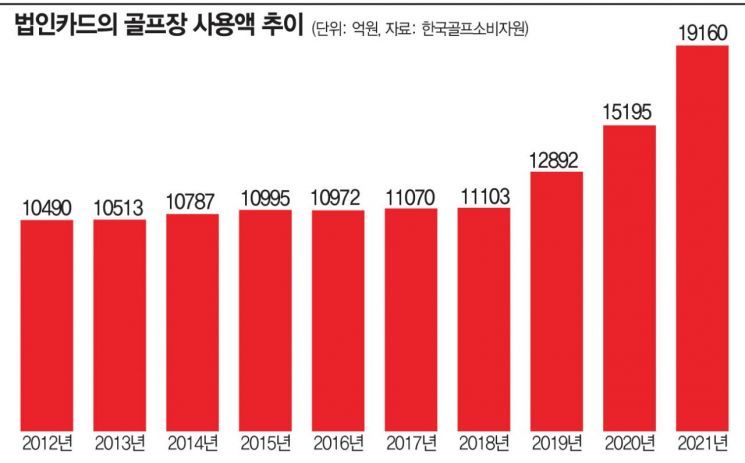
The proportion of corporate card spending in golf course sales also shows an increasing trend. Last year, corporate card usage at golf courses accounted for 27.5% of total sales of 6.9599 trillion won. Although the share, which exceeded 30% in 2011, dropped to 26.0% in 2018 due to the Act on the Prevention of Corruption and the Establishment and Management of the Anti-Corruption and Civil Rights Commission (commonly known as the "Kim Young-ran Act"), it has recently been rising again.
One in Three Citizens Still Views Golf as a "Luxurious High-End Sport"
This result can also be interpreted as meaning that corporate entertainment golf has not decreased despite the enforcement of the Kim Young-ran Act.
Such 'entertainment golf' has influenced the public perception of golf negatively. For example, according to a Gallup Korea survey this year, 36% responded that "golf is a luxurious sport." This means that one in three citizens still considers golf a luxury sport.
"Discourage Entertainment Culture... Reduce the Scope of Deductible Expenses for Golf Courses"
Some argue that institutional measures should be established to reduce entertainment golf.
The Korea Golf Consumer Agency suggests that tax authorities should narrow the scope of deductible expenses for corporate card spending at golf courses, excluding employee welfare purposes. The agency believes that reducing the deductible scope could also lead to effects such as lowering green fees and easing weekend booking difficulties.
They also claim it would help stabilize the skyrocketing membership prices. According to the agency, as of July, the average price of full membership exceeded 300 million won, approaching the record high of 317.05 million won in April 2008.
Seo Cheon-beom, director of the Korea Golf Consumer Agency, said, "In Japanese golf courses, corporate card spending is not recognized as consumption," adding, "Korea, having joined the ranks of advanced countries, should discourage entertainment golf culture so that golf courses can escape the public’s negative perception as hotbeds of corruption."
© The Asia Business Daily(www.asiae.co.kr). All rights reserved.


















