Endemic Atmosphere Rises and Revenge Spending Combine to Increase Overseas Travel Demand
Relaxation of Entry Restrictions for Southeast Asia and Japan Also Contributes
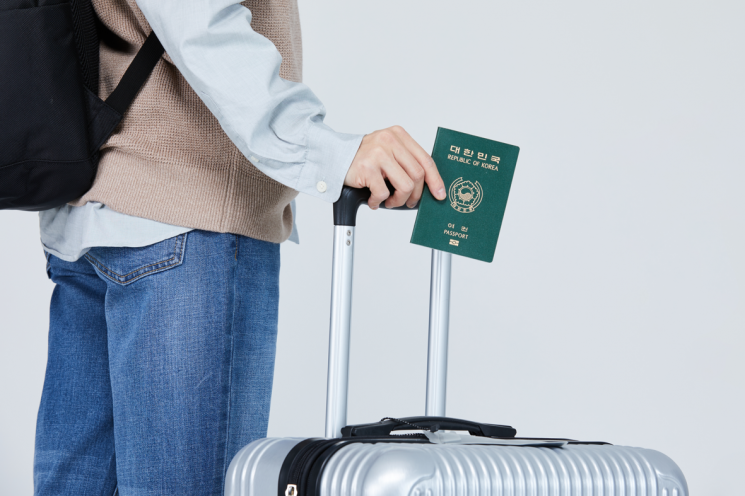 As COVID-19 becomes endemic and travel restrictions ease, demand for overseas travel is surging. [Image source=Getty Images]
[Asia Economy Reporter Yoon Seul-gi] As countries ease entry restrictions that were implemented due to the large-scale spread of COVID-19, travel is becoming freer, leading to a surge in demand for overseas travel. With the endemic atmosphere of COVID-19 intensifying, it is expected that the flow of travelers heading abroad will continue during the October golden holidays, which include National Foundation Day (Gaecheonjeol) and Hangul Day.
According to the '2022 First Half Payment Trends' released by the Bank of Korea on the 29th, the use of payment cards in the first half of this year increased by 12.4% compared to the same period last year. Both credit card usage (+13.1%) and check card usage (+9.0%) increased due to the recovery of private consumption, and by payment type, both face-to-face payments (+8.6%) and non-face-to-face payments (+9.6%) expanded compared to the same period last year.
In particular, consumption increased in the travel and dining sectors. Looking at consumption types based on individual credit cards, the amount spent in travel-related industries such as airlines, duty-free shops, accommodations, and rental cars increased by 58.4% compared to the same period last year, and spending at restaurants increased by 20.0%.
This is interpreted as a result of the growing demand for face-to-face industries such as travel and dining as the social distancing measures were gradually eased and the atmosphere of returning to normal life deepened. The government lifted all restrictions on business hours and private gatherings from April 18, and after limited easing of outdoor mask mandates in May, fully lifted the outdoor mask-wearing requirement on the 26th.
The mandatory pre-entry PCR test, which had been a significant burden for overseas travelers, was exempted in early September, and with the COVID-19 emergency response system shifting to a 'daily quarantine' policy, the abolition of mandatory post-entry PCR testing is also under consideration.
Additionally, the pent-up consumer sentiment from the COVID-19 pandemic has erupted as 'revenge consumption,' which also had an impact. According to data compiled by Incheon International Airport last month, the number of passengers using Incheon Airport during the summer peak season (July 22 to August 10) was 1,259,120 (provisional), more than 6.5 times higher than the same period last year (193,586).
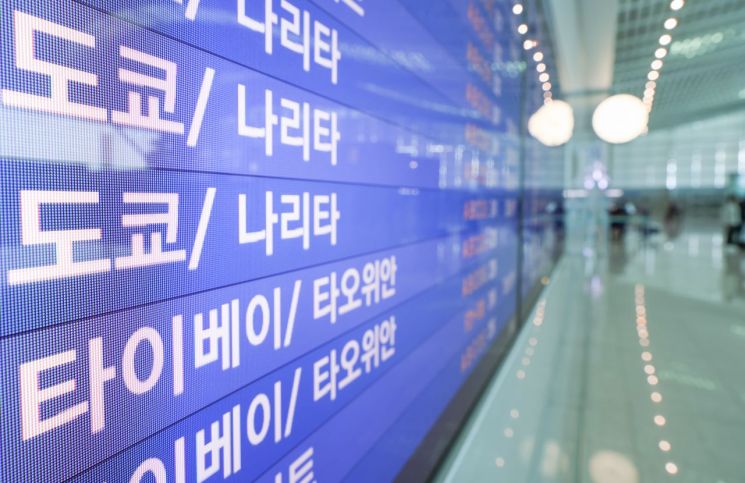 As the government is expected to ease COVID-19 entry restrictions by next month, aiming to exempt visas and allow individual travel for foreign tourists, information about a flight to Japan is displayed on the screen at the departure hall of Terminal 2, Incheon International Airport on the morning of the 20th.
 [Image source=Yonhap News]
As a result, overseas travel demand is expected to be high during the last holiday period of the year, the October golden holidays (October 1 to 10). According to TMON on the 28th, analyzing airline ticket data for major Japanese cities (Osaka, Tokyo, Fukuoka, Sapporo) from October 1 to 25 this month, airline ticket sales surged about 73 times (7,196%) compared to the same period last month (August 1 to 25). Due to the short holiday period, nearby overseas destinations were popular, with Osaka, Japan ranked first, followed by Guam, USA; Da Nang, Vietnam; Tokyo, Japan; Bangkok, Thailand; and Fukuoka, Japan.
Countries have already lifted or are planning to lift entry restrictions and are taking steps toward normalization. Vietnam lifted the mandatory pre-departure COVID-19 test for arrivals in May. Thailand significantly eased regulations from July, including abolishing the requirement to issue the Thailand Pass for foreign tourists and extending operating hours for entertainment establishments.
Taiwan will resume visa-free entry for countries including Korea and Japan starting on the 29th. Additionally, from that day, the main number of entrants will increase from the previous 50,000 to 60,000. The PCR test regulation for asymptomatic entrants upon arrival will be canceled and replaced with four rapid antigen tests. The 3-day self-quarantine and 4-day self-monitoring will be maintained, but from the 13th of next month, it will change to 7 days of self-monitoring without self-quarantine.
Japan, which had maintained strict entry procedures, is also easing most travel restrictions by relaxing the pre-entry COVID-19 test requirement and allowing package tours without guides. Japanese Prime Minister Fumio Kishida announced at a press conference in New York on the 23rd that from November 11, the daily cap of 50,000 entrants will be lifted, and visa-free individual travel for foreigners to Japan will be permitted.
© The Asia Business Daily(www.asiae.co.kr). All rights reserved.
![Clutching a Stolen Dior Bag, Saying "I Hate Being Poor but Real"... The Grotesque Con of a "Human Knockoff" [Slate]](https://cwcontent.asiae.co.kr/asiaresize/183/2026021902243444107_1771435474.jpg)

















