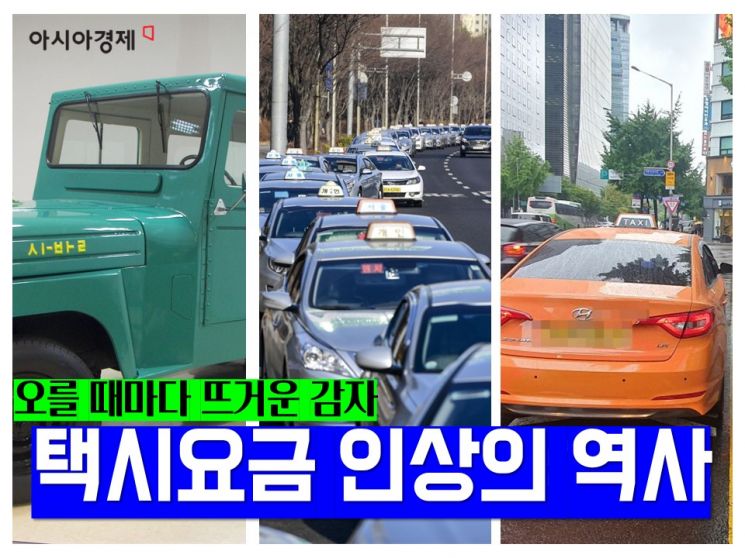
 Taxi fares have steadily increased from the 1960s to the present. / Photo by Song Hyun-do, Asia Economy intern reporter
[Asia Economy Reporter Lim Ju-hyung, Intern Reporter Song Hyun-do] The base fare for medium-sized taxis in Seoul is expected to increase by 1,000 won to 4,800 won starting February next year. This measure aims to resolve the 'late-night taxi crisis' that has worsened since COVID-19. Taxi fares are a 'hot potato' issue in Korean society. While citizens sensitive to their budgets oppose the increase, the taxi industry, suffering from chronic labor shortages, has been demanding a steep hike. We look back on the difficult history of taxi fares since the taxi industry was established in Korea.
History of Taxi Fare Changes in Korea
The Seoul Metropolitan Council passed a proposal to adjust the basic taxi fare at the plenary session of the extraordinary meeting held on the 28th. If the new adjustment is finalized, taxi fares will rise from the current 3,800 won to 4,800 won starting February next year. Separately, the government and the People Power Party held a party-government consultation on the same day to discuss raising the late-night taxi surge fare.
This fare increase is a measure to alleviate the severe labor shortage in the taxi industry. Since the COVID-19 pandemic and the implementation of social distancing, the taxi industry has suffered significant damage. According to the Ministry of Land, Infrastructure and Transport, out of 102,000 corporate taxi drivers, about 29,000 have moved to other industries. Although taxi demand has recovered after the end of social distancing, the workforce that left has not returned. The shortage is even more severe for late-night taxis, which have harsh working conditions.
Accordingly, the Seoul taxi base fare, which was 30 won (based on 2 km) in 1963, has risen to 3,800 won in 2022 and will increase to 4,800 won next year.
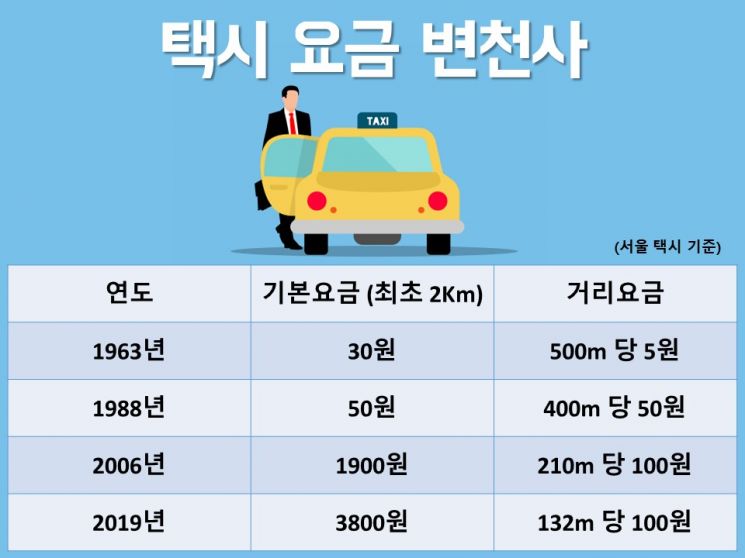
In 1966, when the first-ever taxi fare increase in Seoul was decided, both the base fare and distance fare doubled. This remains the largest rate of increase to date. Since the late 1990s, the taxi base fare has increased by about 20-30% each time it was raised.
For example, during the 1998 Seoul taxi fare increase, the fare rose from 1,000 won to 1,300 won, a 30% increase, and in 2001 it increased by 23% to 1,600 won. The base fare adjusted in 2019 (3,800 won) increased by 26%. The newly decided base fare of 4,800 won this year also represents a 26% increase compared to before.
However, considering late-night surcharges, changes in the fare system, and inflation rates, citizens’ perception of the fare increase may differ. A 20% late-night surcharge has been in effect since 1982. In 1985, the 'time-distance mutual calculation system' was implemented, where fares were calculated based on distance when traveling above 15 km/h and based on time when below that speed. However, since 1994, it changed to a simultaneous calculation system where both time and distance fares are charged.
Conflict Between Burden on Ordinary Citizens and Realistic Fare Adjustment
Every time taxi fares rise, citizens express dissatisfaction. They criticize that fares increase annually without visible improvements such as refusal of passengers, reckless driving, or poor service. On the other hand, the taxi industry warns that without realistic fare adjustments, the labor shortage could worsen.
According to the 'Taxi Service Survey Report' published last year by the Seoul Institute, the average monthly transport income of corporate taxi drivers was 1,694,000 won, which was lower than the monthly minimum wage equivalent of 1,914,440 won that year.
The cause of taxi drivers’ low pay is attributed to the long-standing practice in the taxi industry called the 'sanapgeum system' (daily quota system). Corporate taxi drivers are required to pay a fixed amount to the company after each day’s operation, and drivers who fail to meet the daily quota have their wages cut. Labor disputes over sanapgeum led to the establishment of the 'National Taxi Labor Union Federation' in 1988. In 2003, a controversy over sanapgeum increases in a taxi union in Cheongju, Chungbuk, escalated to the point where a union member stabbed the union chairman of the same company to death with a weapon.
In response, the government introduced the 'full management system,' where taxi drivers pay all their income to the company and receive a salary, to eradicate the illegal sanapgeum system. However, a controversial 'variant sanapgeum system' emerged in some corporations, where a daily target is set and wages are cut if the target is not met.
© The Asia Business Daily(www.asiae.co.kr). All rights reserved.


















