Daewoo Shipbuilding & Marine Engineering Acquisition Drive
Big 3 Shipbuilders Anticipate Accelerated Robotic Processes
Foundation Established for Collaboration with Related Affiliates
Expecting Synergy in Robotics Business to Outperform China in Price Competitiveness and More
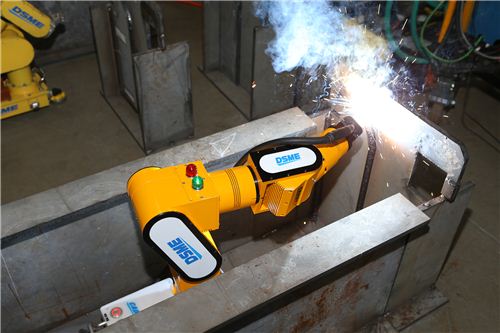 Daewoo Shipbuilding & Marine Engineering's self-developed welding robot 'Caddy' welding. Photo by Daewoo Shipbuilding & Marine Engineering
Hanwha Group, which has strengths in the robotics business, is pushing for the acquisition of Daewoo Shipbuilding & Marine Engineering (DSME), raising expectations that the introduction of robotic processes in the shipbuilding industry will accelerate.
According to the industry on the 29th, Hanwha Group, which is pursuing the acquisition of DSME, operates Hanwha Precision Machinery, which is engaged in robotics and automation businesses within the group, and a collaborative robot business team within Hanwha Momentum division. Korea Shipbuilding & Offshore Engineering has Hyundai Robotics, a subsidiary of Hyundai Heavy Industries Group, producing industrial robots, and Samsung Heavy Industries is also expecting synergy as Samsung Electronics launched a robotics business team earlier this year. Hanwha Precision Machinery and Hyundai Robotics, along with Doosan Robotics, are considered the big three domestic manufacturers of industrial robots. If Hanwha joins the shipbuilding industry, a foundation will be established for all three major shipbuilders to collaborate with robotics business affiliates within their groups.
In fact, the three major shipbuilders are introducing collaborative robots and other automation in their processes due to labor shortages and safety concerns. According to the Korea Offshore & Shipbuilding Association, as of this month, 60,336 workers are needed to handle the order volume. As of December last year, the shipbuilding industry workforce stood at 50,827, indicating a shortage of approximately 9,509 workers. By occupation, the shortages are 4,160 in welding, 1,875 in electrical work, and 1,599 in painting?all of which are jobs avoided by domestic workers. The expected labor shortage in the shipbuilding industry will increase to 11,099 by June next year.
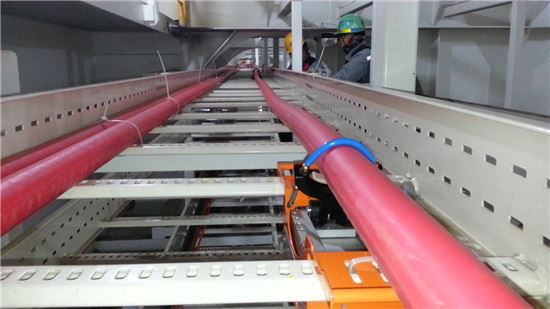 Daewoo Shipbuilding & Marine Engineering's industry-first developed cable laying robot applied on site
Accordingly, shipbuilders plan to expand the introduction of robots in shipbuilding processes. In fact, shipbuilders are gradually increasing the use of robots in processes such as welding and laying (installing equipment over wide areas) in confined spaces.
DSME developed a small welding robot in 2015 that automatically performs high-difficulty hull welding for icebreaking LNG (liquefied natural gas) carriers. At Samsung Heavy Industries’ Geoje shipyard, robots perform welding processes instead of humans. Hyundai Heavy Industries is promoting the construction of a future-oriented smart shipyard that extensively applies robotics and artificial intelligence (AI) technologies. To this end, Hyundai Heavy Industries plans to invest more than 320 billion KRW in smart shipyard construction and related production facilities by 2030.
If the big three shipbuilders all generate synergy with their robotics businesses, they are expected to gain an edge again in price competitiveness and efficiency against latecomer China. The shipbuilding industry has long struggled to escape a deficit structure amid fierce competition with Chinese shipbuilders, who leverage chronic labor shortages and low labor costs.
An industry insider said, "Although each shipbuilder has attempted to introduce robots and smart technologies in their processes, large-scale changes were difficult due to opposition from labor unions. With Hanwha joining the shipbuilding industry, it is expected that robotics and the shipbuilding industry can create synergy and bring a new wind."
Professor Lee Jang-hyun of the Department of Naval Architecture and Ocean Engineering at Inha University said, "By improving process efficiency through the introduction of robots, it is expected that safety and price competitiveness can be achieved together."
© The Asia Business Daily(www.asiae.co.kr). All rights reserved.
![Clutching a Stolen Dior Bag, Saying "I Hate Being Poor but Real"... The Grotesque Con of a "Human Knockoff" [Slate]](https://cwcontent.asiae.co.kr/asiaresize/183/2026021902243444107_1771435474.jpg)















