The audit period was set before the regular session but not observed
Concerns over inadequate budget and bill review
No disagreement between ruling and opposition lawmakers on conducting it before the regular session
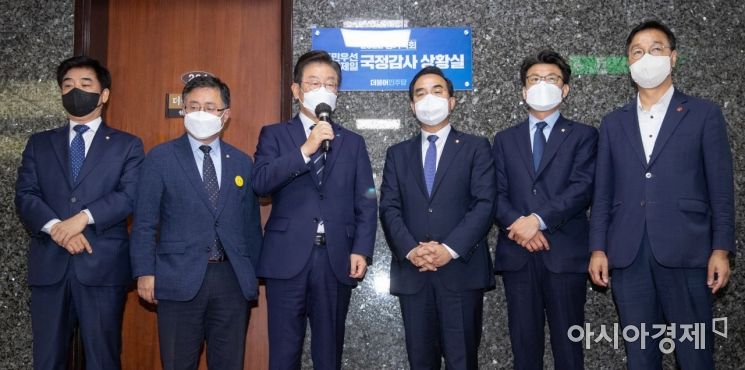 Lee Jae-myung, leader of the Democratic Party of Korea, is attending the plaque ceremony of the National Assembly's Comprehensive Situation Room for the National Assembly inspection on the 29th and delivering a greeting./Photo by Yoon Dong-joo doso7@
[Asia Economy Reporter Naju-seok] The annual National Assembly audit held every October has been pointed out as actually not aligning with the intent of current laws. The regular session of the National Assembly, which runs for 100 days from September, should focus on its core duties such as budget review and bill processing, while the audit should be conducted before the regular session to ‘normalize’ the audit schedule.
On the 26th, during the continuous forum on ‘Reflection and Innovation’ conducted by members of the Democratic Party of Korea, the issue of the audit was raised. Cho Eung-cheon, a Democratic Party lawmaker and the presenter, mentioned the provisions regarding the audit schedule in the current Act on the Audit and Inspection of State Affairs (National Assembly Audit Act), stating, "The law was amended to conduct the audit before the regular session, but it has never actually been implemented," and criticized, "The National Assembly operates not according to the National Assembly Act but rather by ‘exceptions (proviso clauses in the law).”
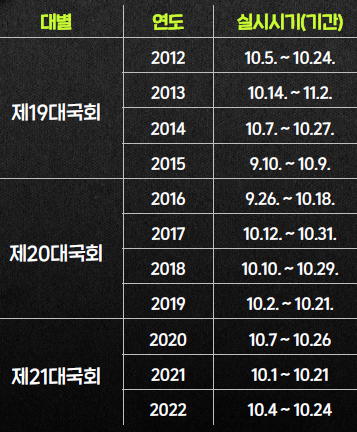
According to Article 2 of the National Assembly Audit Act, "The National Assembly shall conduct audits on state affairs by standing committees within 30 days before the convening date of the regular session each year. However, audits may be conducted during the regular session by resolution of the plenary session." This means that audits should be conducted before the regular session convenes on September 1, except in special circumstances when they may be held during the regular session.
This provision was introduced during the 2012 amendment of the National Assembly Audit Act. Reviewing the minutes from that time reveals that the rationale was "since conducting the audit during the regular session makes it difficult to secure sufficient time for reviewing important matters such as the budget, the audit should be conducted within 30 days before the convening date of the regular session."
The problem is that contrary to the legislative intent, in reality, the audit is held in October, right in the middle of the regular session. According to Cho’s analysis, since 2012, the audit has never been conducted before the regular session. Moreover, even the National Assembly resolutions to hold the audit during the regular session have often been decided after the regular session started, not before. This year as well, the timing of the audit was only finalized during the regular session starting September 1.
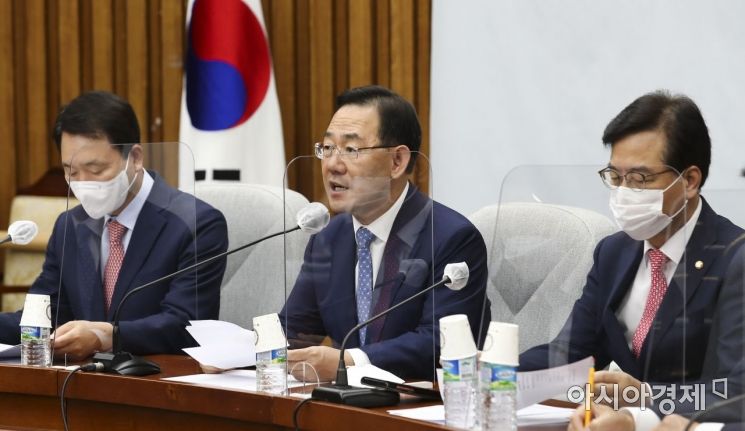 Joo Ho-young, floor leader of the People Power Party, is delivering opening remarks at the pre-inspection meeting for the National Assembly audit held at the National Assembly on the 27th. Photo by Yoon Dong-joo doso7@
The audit has been regarded as the highlight of the regular session since it questions the overall state affairs of the year. However, due to the audit being held in the middle of the 100-day regular session, both budget review and bill examination suffer from a lack of time.
Such criticism has continued in the National Assembly’s Special Committee on Political Reform. At a public hearing on strengthening the National Assembly’s budget and settlement review functions held on the 15th of this month, experts argued, "The audit period and the budget and settlement review period should be separated," criticizing, "When combined with the budget and settlement review, the quality of the budget and settlement review deteriorates."
At the hearing, Democratic Party lawmaker Kim Young-bae said, "Conducting the audit before June aligns with the original intent of the current Act on the Audit and Inspection of State Affairs, but the National Assembly is violating this," and added, "Our committee should resolve to uphold this and recommend it to all parties, including the negotiation groups."
Among lawmakers, proposals have been made to introduce a standing audit system instead of the annual audit ritual.
Lee Yang-su of the People Power Party said, "The current practice where public officials stay up all night copying documents only during the audit period should be eliminated. Instead, the entire standing committee should conduct audits year-round, handling witness summonses and document requests continuously, while the regular session should focus on the budget and bills."
Democratic Party lawmaker Lee Won-wook told this publication, "We should consider abolishing the regular audit system and instead conduct intensive audits over 4 to 5 days on specific institutions where issues arise," adding, "This would eliminate wasteful, one-day audits." Concentrated audits, rather than once-a-year formal audits per institution, would encourage audited institutions to operate more thoroughly to avoid becoming examples of poor management.
Strengthening current issue questioning conducted by the National Assembly is also being discussed. Democratic Party lawmaker Kang Byung-won said, "There is not much difference between current issue questioning and the audit, except that witnesses take an oath during the audit," and predicted, "If everyone answering in the National Assembly is required to take a witness oath, the effect of a standing audit can be realized."
© The Asia Business Daily(www.asiae.co.kr). All rights reserved.



















