Calls for Improvement of the Sunset System for Mandatory Wholesale Supply
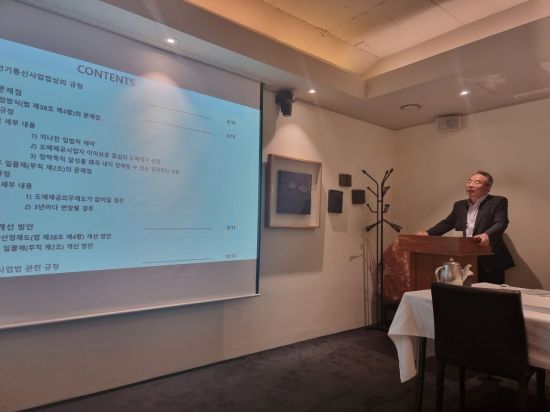 Hwang Seong-wook, Executive Vice President of the Korea Affordable Telecommunications Operators Association, held a briefing near Gwanghwamun, Seoul on the 27th, pointing out issues in the current MVNO system, including the wholesale price calculation method favoring mobile carriers and the sunset provision on the obligation to provide wholesale prices.
[Asia Economy Reporter Minyoung Cha] "The biggest problem with the current MVNO (Mobile Virtual Network Operator) system is the wholesale price calculation method that favors mobile carriers and the sunset provision on the wholesale price obligation."
Voices from the MVNO industry are calling for increased flexibility in the wholesale price calculation criteria and reform of the three-year temporary sunset provision. As the National Assembly's Science, Technology, Information and Broadcasting Committee has repeatedly stalled due to partisan conflicts, the sunset provision on wholesale price obligations expired on the 22nd of this month, heightening anxiety among MVNO operators.
Hwang Seong-wook, the full-time vice chairman of the Korea MVNO Association, also held a briefing near Gwanghwamun, Seoul on the 27th, pointing out "problems and improvement measures related to MVNO policies," emphasizing that "if the system is improved, a self-sustaining fourth mobile carrier like in Japan could emerge, and the market could expand."
"Wholesale Price Calculation Method Preserves Carrier Profits"
The association identified the biggest issue as the "retail-minus method" specified in Article 38, Paragraph 4 of the Telecommunications Business Act, which calculates wholesale prices by deducting avoidable costs from the retail price. In academic terms, this is called the retail-minus discount method. Since MVNOs operate by leasing networks from carriers, the wholesale price is a key factor determining industry competitiveness.
According to Article 38, Paragraph 4 of the Telecommunications Business Act, the wholesale price is calculated by deducting avoidable costs?such as marketing expenses and customer service (CS) costs?that can be avoided if direct services like sales and advertising are not provided, from the retail price. Ultimately, the wholesale price equals the sum of the wholesale provider's unavoidable costs and operating profit. The MVNO industry points out that MVNOs effectively cover 100% of the carriers' operating profits. Unavoidable costs include network investment expenses.
The MVNO industry argues that considering the current challenging business environment with operating profit margins around 1-5%, the wholesale price calculation method needs improvement. Vice Chairman Hwang noted, "Based on SK Telecom, our operators bear a carrier operating profit ratio of up to 15%," adding, "We have requested a reduction in this burden, but the response is that it is difficult because it is stipulated by law." He also claimed that specifying a single calculation method in law is a "legislative constraint."
However, some in the market argue that factors lowering wholesale prices, which are not included in the legally specified wholesale price calculation method, should also be considered. The Ministry of Science and ICT introduced a volume purchase discount system in 2020 to support data-only MVNO operators, offering additional discounts on wholesale prices when purchasing large amounts of data. Carriers are also known to provide MVNO operators with "sales promotion expenses" as incentives. The government has also pressured carriers to lower wholesale prices. Previously, the government reduced the wholesale price for metered data from 3.65 KRW per megabyte (MB) in 2018 to 2.95 KRW in 2019, 2.28 KRW in 2020, and 1.61 KRW in 2021.
Already Extended Three Times... Problems with the Three-Year Temporary Sunset Provision
The association points to the problem of the wholesale price obligation sunset provision, which has been extended every three years through legislative amendments. Currently, SK Telecom, the market leader, is the only operator obligated to provide wholesale services. KT and LG Uplus also provide networks but are not obligated operators. The law has been extended three times since 2013 and expired on September 22 this year. Upon expiration, the wholesale price obligation will sunset, causing the minister's authority to designate wholesale providers, revoke designations, and regulate procedures and price calculation notices to lose effect.
Vice Chairman Hwang lamented, "If the wholesale price obligation system disappears, it will be difficult for MVNO businesses to exist in the market," adding, "Even when the validity is extended every three years, long-term investment in MVNOs is difficult."
Based on this awareness, bills have been proposed in the National Assembly but have been pending for nearly two years. Kim Young-sik, a member of the Science, Technology, Information and Broadcasting Committee from the People Power Party, introduced the "Telecommunications Business Act Amendment" in December 2020 to revitalize MVNOs. The bill includes abolishing the sunset provision on the wholesale price obligation and expanding obligated providers to the three major carriers. Park Wan-joo, also a committee member, urged improvements on the 28th, stating, "Despite the wholesale price obligation clause being extended three times over 12 years, the Ministry of Science and ICT has yet to conclude the direction of the system."
The Ministry of Science and ICT, the competent authority, agrees with the intent to abolish the sunset provision but has consistently shown a passive attitude toward improving the current system or preparing government proposals. Vice Chairman Hwang said, "The government agrees that improvements are needed regarding wholesale prices and the sunset provision, but since it is stipulated by law, they agree with amendments," adding, "Who would invest knowing that the system is revised every three years?"
The MVNO industry also expects the emergence of operators equipped with facilities (MVNEs) through system improvements. MVNEs can independently develop and distribute various services and provide billing system construction and operation to other MVNO operators. Vice Chairman Hwang added, "Our industry also wants to invest in many products and enter new markets like Japan and Europe," emphasizing, "To do so, investment in facilities and IT infrastructure is essential."
© The Asia Business Daily(www.asiae.co.kr). All rights reserved.

















