"Previously Only the Korean Won Was Devalued, But Now All National Currencies Are Devalued"
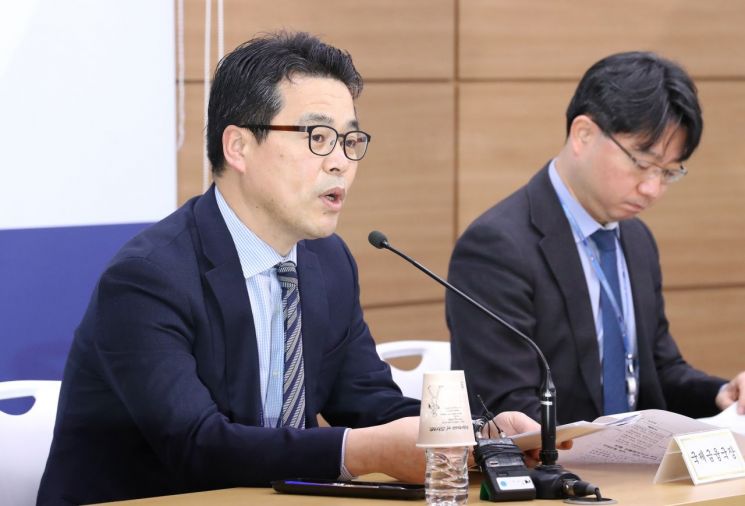
[Asia Economy Sejong=Reporter Kwon Haeyoung] On the 28th, regarding the sharp rise in the won-dollar exchange rate and the decrease in foreign exchange reserves, the government stated, "We cannot rapidly increase foreign exchange reserves under the current circumstances," emphasizing that the private sector has sufficient external assets and banks' foreign currency liquidity is also sound.
Kim Seongwook, Deputy Director-General of International Economic Management at the Ministry of Strategy and Finance, visited the press room in the afternoon and said, "Foreign exchange reserves are meant to be used." He added, "To increase foreign exchange reserves, the government can only buy foreign currency in the market. This is done when the exchange rate falls and the won is strong, not in the current situation."
The government also emphasized that rather than increasing foreign exchange reserves, it has focused its policy on expanding private external assets and strengthening foreign currency liquidity management indicators. Deputy Director-General Kim said, "There has been a view that the Korean government excessively intervenes in the foreign exchange market to maintain export competitiveness, so since 2014, private external assets have been expanded." He added, "It took 17 years for external assets to grow from $118.6 billion in 1997 to over $1 trillion at the end of 2014, but it only took 7 years to increase by another $1 trillion to $2 trillion (by the end of 2021)."
Regarding concerns over the recent rise in the external debt ratio, he explained that the government strengthened banks' foreign currency liquidity management indicators to enhance the private sector's response capability. Short-term external debt refers to loans borrowed from abroad with maturities of one year or less. The ratio of short-term external debt to foreign exchange reserves decreased from 657.9% at the end of 1997 and 72.4% at the end of 2008 to 35.6% at the end of 2021, but rose to 41.9% in the second quarter of this year.
Deputy Director-General Kim said, "The banks' foreign currency Liquidity Coverage Ratio (LCR) is currently around 120%, higher than the mandatory ratio of 80%, ensuring that banks can withstand foreign currency outflows for more than 30 days on their own." He explained, "Since the system was designed so that the private sector can manage this independently, we will first monitor whether there are any issues with the private sector's liquidity management indicators and respond accordingly if difficult situations arise."
He added, "In the past, the problem was that only the won depreciated sharply, but now all countries are moving together," emphasizing, "The cause of the (won-dollar exchange rate rise) is external, not internal."
© The Asia Business Daily(www.asiae.co.kr). All rights reserved.
![Clutching a Stolen Dior Bag, Saying "I Hate Being Poor but Real"... The Grotesque Con of a "Human Knockoff" [Slate]](https://cwcontent.asiae.co.kr/asiaresize/183/2026021902243444107_1771435474.jpg)
















