Increase in Linked Programming Compared to March Last Year, Decrease in Linkage Frequency
Promoting Voluntary Regulation by Operators to Protect Viewers
[Asia Economy Reporter Lim Hye-sun] Concerns are rising that continuous linked programming between terrestrial and comprehensive programming channels and home shopping may cause consumer harm.
On the 28th, the Korea Communications Commission announced the results of the July broadcast linked programming inspection for 7 terrestrial channels, 4 comprehensive programming channels, 7 TV home shopping channels, and 10 data home shopping channels at a plenary meeting. Linked programming refers to scheduling a program on terrestrial or comprehensive programming channels that introduces health (functional) foods, followed by home shopping channels selling the same or similar products in adjacent time slots.
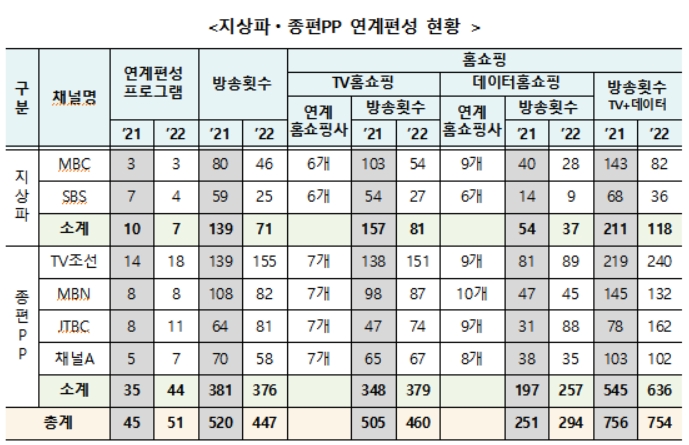
According to the inspection results, 447 broadcasts from 51 health information programs on 2 terrestrial channels and 4 comprehensive programming channels were linked a total of 754 times on 17 home shopping channels. Compared to the inspection period last year, the number of programs increased by 6, but the number of linked programming instances decreased by 2.
For terrestrial broadcasters, MBC scheduled 3 programs totaling 46 broadcasts, and SBS scheduled 4 programs totaling 25 broadcasts. For comprehensive programming channels, TV Chosun scheduled 18 programs totaling 155 broadcasts, MBN 8 programs totaling 82 broadcasts, JTBC 11 programs totaling 81 broadcasts, and Channel A 7 programs totaling 58 broadcasts.
There were 256 instances where one program from terrestrial or comprehensive programming channels was linked with one home shopping channel, and 191 instances where it was linked with two or more channels (up to 6 channels) simultaneously. The average number of health information program broadcasts by day of the week was highest on Saturday with 17.8 broadcasts, and the most frequent broadcast time was between 6 and 7 a.m.
The main products sold included 53 health (functional) foods scheduled for sales broadcasts on home shopping channels, maintaining the same level as the previous year's inspection period. The most frequently linked and sold product was protein (163 times), followed by probiotics (148 times), and collagen (70 times).
The Korea Communications Commission plans to continue monitoring linked programming and violations of sponsorship disclosures, and to encourage self-regulation by businesses by requiring home shopping operators to specify in basic transaction contracts that health (functional) food suppliers must not be forced to sponsor health information programs on terrestrial or comprehensive programming channels.
© The Asia Business Daily(www.asiae.co.kr). All rights reserved.
![Clutching a Stolen Dior Bag, Saying "I Hate Being Poor but Real"... The Grotesque Con of a "Human Knockoff" [Slate]](https://cwcontent.asiae.co.kr/asiaresize/183/2026021902243444107_1771435474.jpg)
















