Moon Administration Allocates 56% of Power Fund to Renewables as Part of 'Nuclear Phase-Out'
Renewable Capacity Surges 85% in 3 Years, Exceeding 20% of Total Facilities
Generation Fluctuations Due to Environment Raise Risk of Grid Overload
Concerns Over Support for Vulnerable Groups' Electricity Bills, Annual Scale 600 Billion Won
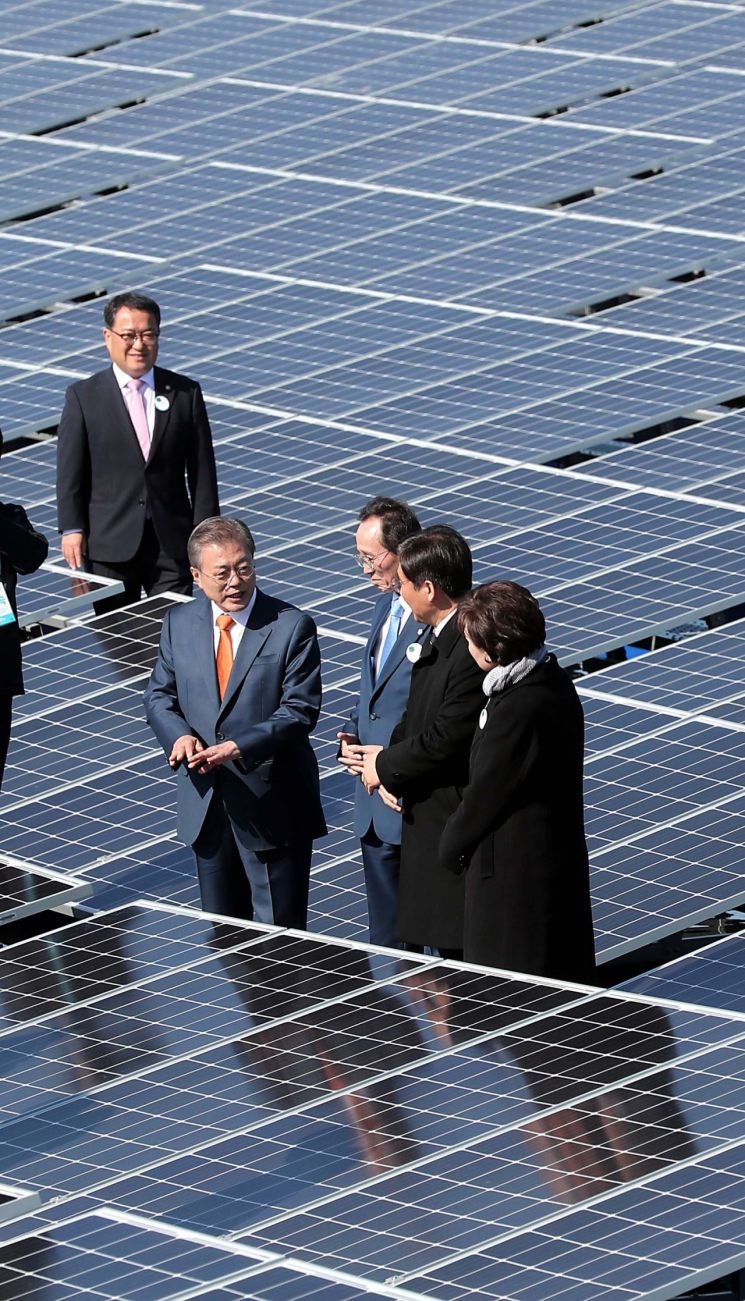 President Moon Inspects Floating Solar Power Facility
(Gunsan=Yonhap News) Photo by Hwang Kwang-mo = President Moon Jae-in is inspecting the floating solar power facility at the reservoir site in Gunsan, Jeonbuk, after the 'Saemangeum Renewable Energy Vision Declaration Ceremony' held on October 30, 2018. 2018.10.30
hkmpooh@yna.co.kr
(End)
<Copyright(c) Yonhap News Agency, Unauthorized reproduction and redistribution prohibited>
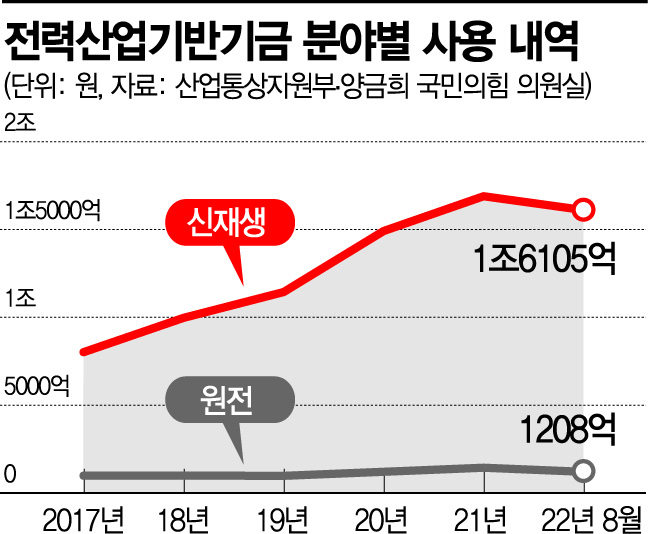
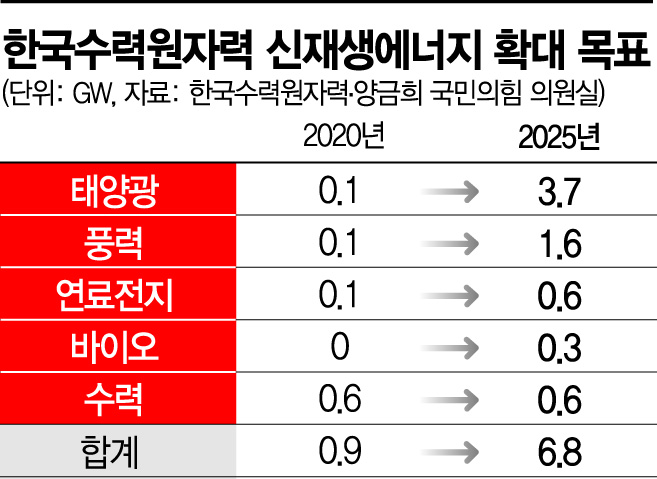
[Asia Economy Sejong=Reporter Dongwoo Lee, Sejong=Reporter Junhyung Lee] The Moon Jae-in administration invested more than half (56.2%) of the Electricity Industry Infrastructure Fund over the past five years into the expansion of solar power generation and other renewable energy sources. This was to develop renewable energy, proposed as an alternative alongside the nuclear phase-out policy, into a main power industry. As a result, the capacity of domestic renewable energy power generation facilities surged by 85.31% (11,442 MW) in just three years, from 13,413 MW in 2018 to 24,855 MW last year. Recently, renewable energy capacity reached 27,103 MW, surpassing 20% of the total power generation facility capacity for the first time in history.
However, the problem with renewable energy is that its power output fluctuates greatly depending on environmental factors such as sunlight and rainfall, making it difficult to become a main power source. According to the monthly electricity statistics report recently released by Korea Electric Power Corporation (KEPCO), renewable energy generation in July was only 4,581 GWh, accounting for just 8.3% of the total power generation (55,018 GWh). Considering that renewable energy accounted for 19.8% of the total domestic power generation facilities at that time, the actual power output was less than half of its facility share.
Concerns have also been raised about power grid overload due to the rapid expansion of renewable energy. For example, Jeju Island, which is increasing renewable energy generation to achieve carbon neutrality by 2030, had to implement nearly 90 output control measures in the first half of this year due to overproduction of solar power. Jeju Energy Corporation analyzed that by 2034, output control measures for renewable energy power plants on the island could reach 326 instances.
'Solution' ESS Projects Are Passive
To address the intermittency problem of renewable energy generation, energy storage systems (ESS) are necessary. By building large-scale ESS facilities, solar energy?which is difficult to produce on demand?can be stored and used when needed. Accordingly, overseas countries such as the United States invest hundreds of billions of won to simultaneously build ESS facilities when constructing large-scale solar power plants.
However, the previous administration was passive about ESS projects. In 2017, 1.3 billion won from the Electricity Fund was invested in the 'ESS Demonstration Research for Power Peak Response,' but no budget was allocated from the following year onward. The only public ESS construction project to strengthen the renewable energy power grid received 18.2 billion won last year. This has led to criticism that the previous government increased power generation facilities for short-term results without considering the necessary power grid infrastructure for renewable energy.
Another issue is the rapid depletion of the Electricity Fund due to the sharp increase in support for renewable energy. The Electricity Fund balance shrank by nearly 3 trillion won, from 4.13 trillion won in 2018, the second year of the Moon administration, to 1.18 trillion won last month. Considering future income and expenditure plans for the Electricity Fund, the balance is expected to plummet to the 800 billion won range next year. There are even concerns that the Electricity Fund could be exhausted within two to three years in the worst-case scenario.
Electricity Bill Support for Vulnerable Groups Also Faces Setbacks
As a result, the government's plan to support electricity bills for vulnerable groups is also facing setbacks. KEPCO spends 600 to 700 billion won annually to reduce electricity bills for disabled persons, national merit recipients, and others. The government is pushing a plan to have the Electricity Fund cover support payments for vulnerable groups starting next year, as electricity bill hikes have been delayed and KEPCO's deficit has ballooned. However, with the fund balance expected to drop to the 800 billion won range next year, there is a prevailing view that support for vulnerable groups will also be difficult.
Meanwhile, government exemptions, which act as subsidies driven by the renewable energy push, have also increased significantly. According to the Korea Rural Community Corporation, the farmland preservation charge exemptions due to solar power facility installations amounted to 15.1 billion won over five years from 2017 to last year. The farmland preservation charge is a levy imposed when existing farmland is converted to other uses for farmland preservation and management, and it is a major source of the Farmland Management Fund. Earlier, the Moon administration introduced a system in early 2018 that exempts 50% of the farmland preservation charge when solar power is installed on farmland owned by farmers and fishermen. As a result, the exemption amount in 2018 surged approximately 1,310 times to 7.22 billion won compared to 55.2 million won the previous year.
© The Asia Business Daily(www.asiae.co.kr). All rights reserved.
![Clutching a Stolen Dior Bag, Saying "I Hate Being Poor but Real"... The Grotesque Con of a "Human Knockoff" [Slate]](https://cwcontent.asiae.co.kr/asiaresize/183/2026021902243444107_1771435474.jpg)


















