'Baekja Cheonghwa Kim Gyeongon Tomb' and 'Baekja Cheolhwa Lee Seongrip Tomb'
"Tombs are artifacts that should obviously be returned to Korea"
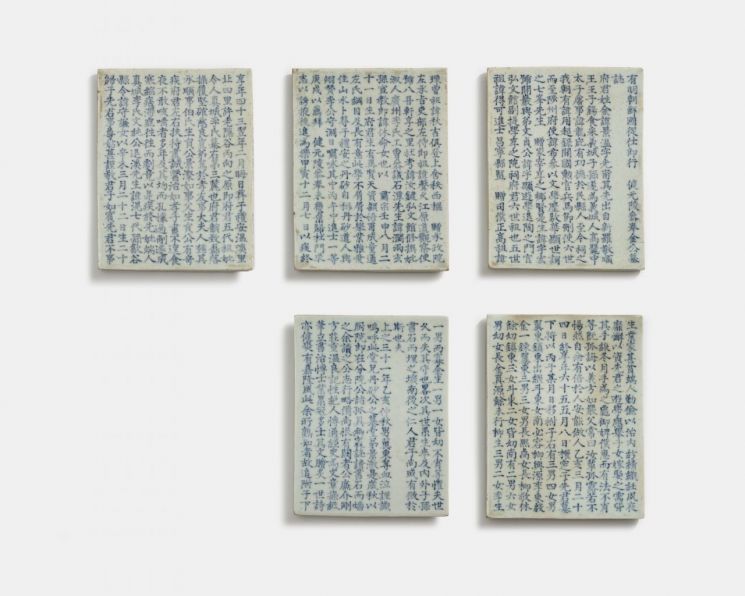
'Baekja Cheonghwa Kim Gyeong-on Myoji (白磁靑畵金景溫墓誌)' and 'Baekja Cheolhwa Lee Seong-rip Myoji (白磁鐵畵李成立墓誌)' have returned thanks to a donation from Japanese individuals.
The Cultural Heritage Administration and the Overseas Cultural Heritage Foundation will hold a public exhibition and donation ceremony for the two artifacts on the 28th at the Korea National Institute of Korean Studies in Andong, Gyeongbuk. Myoji are stone or ceramic plaques buried with the deceased that record their life, character, family relations, and other details. They hold significant value not only for individuals but also for historical research.
The Baekja Cheonghwa Kim Gyeong-on Myoji was made in 1755 and belongs to Dan-sa Kim Gyeong-on (1692-1734). Kim Gyeong-on passed the Jin-sa examination in the 2nd year of King Yeongjo's reign (1726) with first place and was appointed as a Cham-bong (?奉) at Geonwonneung. After resigning, he returned to his hometown Yean and devoted himself to educating younger scholars. Five complete plaques remain. Notably, the epitaph is neatly written in regular script using blue pigment on a white clay plaque. The Cultural Heritage Administration explained, "It is clearly recorded that the Baekja Cheonghwa Myoji was produced at a branch institute, which gives it high historical value."
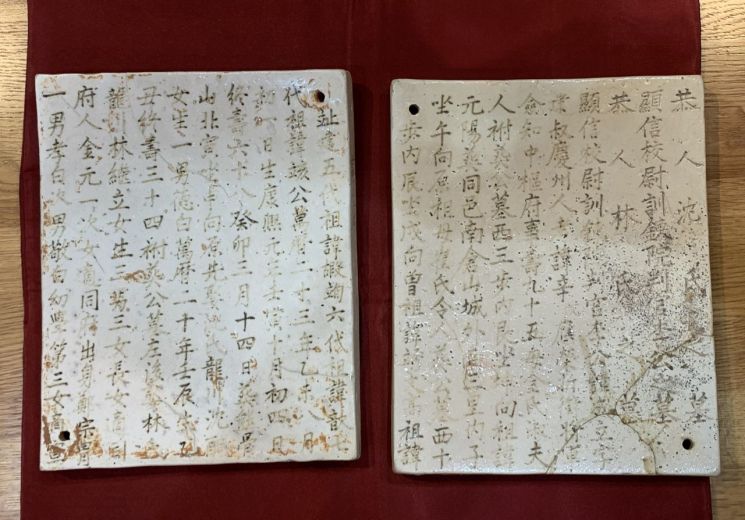
The owner of the Baekja Cheolhwa Lee Seong-rip Myoji, Lee Seong-rip (1595-1662), was a military officer during the Joseon Dynasty. He was mainly active in what is now North Korea. The epitaph consists of two simple plaques but is considered an important resource as it records the marital ties and funerary customs of military officers in the late 17th-century Joseon border regions. The plaques feature incised and iron-paint techniques, and holes are drilled to bind the two plaques together without separation, adding rarity and uniqueness.
The return was made possible largely thanks to Mr. Kim Kang-won, who runs the antique art dealer 'Cheonggodang' in Tokyo, Japan. Last year, he discovered the epitaphs, presumed to be from the Joseon period, being traded in the Japanese cultural heritage market and purchased them himself. He stated, "I believe these artifacts should naturally be returned to Korea," and expressed his intention to donate without any compensation or conditions. Based on the content of the epitaphs, the foundation visited the Uiseong Kim clan and Gyeongju Lee clan to discuss ways to utilize the artifacts in Korea. The clans expressed gratitude and decided to make the artifacts public and deposit them at the Korea National Institute of Korean Studies.
A Cultural Heritage Administration official said, "Thanks to the cooperation of the Korea Overseas Cultural Heritage Research Institute, which conducts cultural heritage projects centered in Gyeongbuk, the import and deposit processes proceeded smoothly," adding, "These are important materials that show Joseon Dynasty history and will be managed and utilized accordingly." The Korea National Institute of Korean Studies was established in 1995 as a research institution for collecting and managing Korean studies materials and cultural heritage.
© The Asia Business Daily(www.asiae.co.kr). All rights reserved.


















