
[Asia Economy Reporter Hwang Seoyul] Hyundai Engineering & Construction announced on the 28th that it received Innovation Awards in five categories at the 2022 Smart Construction Challenge.
Now in its third year, the Smart Construction Challenge is hosted by the Ministry of Land, Infrastructure and Transport and organized by related organizations (Korea Institute of Civil Engineering and Building Technology, Korea Land and Housing Corporation, Korea Expressway Corporation, Korea Railroad Corporation, National Agency for Safety Management, and Korea Agency for Infrastructure Technology Advancement) to promote excellent smart construction technologies through category-specific competitions.
Hyundai Engineering & Construction won Innovation Awards in five categories: ▲Smart Safety Technology, ▲Complex and Housing Construction Automation, ▲SOC (Social Overhead Capital) Design BIM including railroads, ▲BIM USE Live (Construction BIM) in the technical competition, and ▲Smart Construction R&D Proposal in the contest category.
In the Smart Safety Technology category, the technology titled “Innovation in Construction Site Safety Management Using Digital Technologies (Big Data/AI, IoT)” was awarded. Hyundai Engineering & Construction developed the nation’s first safety management platform that integrates big data, AI, and IoT technologies to conduct systematic safety management based on actual site data rather than the experience of managers.
Based on approximately 39 million data points accumulated over the past decade at construction sites, the platform digitizes the characteristics of 227 sites daily (as of Q2 2022, covering all domestic sites), and AI performs automatic learning to predict disaster risk levels. Based on this, customized pre-inspection checklists are provided for each site, and site managers can check detailed information on about 1,600 inspection items per construction type every day.
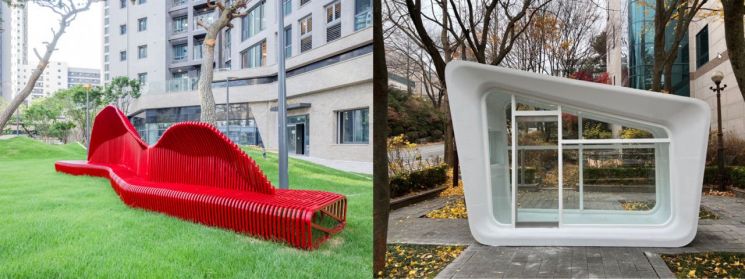 Outdoor bench made with 3D printing technology, which won the Innovation Award in the construction automation sector for apartment and housing fields (left), concrete structure made with 3D printed irregular formwork (right) / Photo by Hyundai Construction
In the Complex and Housing Construction Automation category, the technology titled “Advancement of Irregular Construction Processes Using Hyundai Engineering & Construction’s 3D Printing Technology” was awarded. Since installing the first 3D-printed outdoor bench in a multi-family housing complex at the Hillstate Lake Songdo Phase 2 site in 2020, the company has applied the technology in various fields, including manufacturing concrete structures using 3D-printed irregular formworks and reviewing new technologies and methods through 3D-printed prototype models for landscaping structures.
In the SOC Design BIM category, the full BIM technology applied during the basic and detailed design phases of the “Wolgok-Pangyo Double Track Railway Section 6” project was awarded. This project involves constructing a 3.2 km tunnel passing underground through downtown Anyang City, a new station, and a transfer passage connecting to the existing Anyang Station on the Gyeongbu Line. BIM was utilized from route planning review through various design processes, and it is planned to be used in construction and maintenance stages to improve productivity and quality at the site.
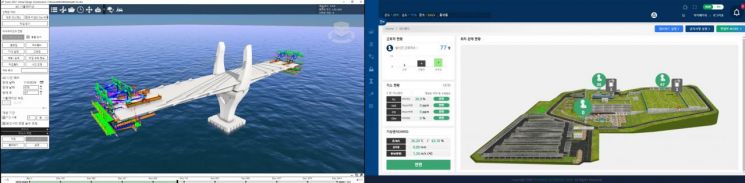 BIM-based temporary equipment construction safety review screen proving excellence at the BIM Use Live (Construction BIM) competition (left). Hyundai Engineering & Construction's digital technology-based safety management platform, which integrates big data, AI, and IoT technologies, won the Innovation Award in the smart safety technology field (right) / Photo by Hyundai Engineering & Construction
In the BIM Use Live (Construction BIM) competition, Hyundai Engineering & Construction advanced to the finals and won an award with the theme “Utilization Plan of BIM Throughout the Entire Road Construction Process.” This competition evaluates BIM technical capabilities by performing design changes and various BIM utilization missions based on BIM models provided by the host (Korea Institute of Civil Engineering and Building Technology).
Hyundai Engineering & Construction formed a team with Glotech and Korea Infrastructure BIM, using self-developed customized software for civil engineering facilities and BIM-based design automation technology to complete the missions. Notably, they proposed a method for performing design changes of tunnels and bridges using BIM, demonstrating excellence by improving work productivity such as design optimization, construction safety review, and quantity takeoff.
In the idea contest category “Smart Construction R&D Proposal,” Hyundai Engineering & Construction received an Innovation Award for proposing R&D on “Development of Domestic Construction Management Software.” The proposal emphasized the need for government-led research and development of K-Construction Management software tailored to the work environment of domestic construction sites and its distribution to the private sector to promote digitalization and productivity improvement in the Korean construction industry. This item was evaluated as aligning with smart construction activation policies.
Hyundai Engineering & Construction has established a dedicated smart construction organization to independently develop and advance technologies and systems, and to establish customized strategies according to the characteristics of each site, leading the digital transformation and paradigm shift in the construction industry. The developed advanced technologies are being demonstrated at various domestic and international sites, including smart construction innovation sites, optimizing utilization processes suited to site conditions and preparing guidelines to expand them across all sites.
A Hyundai Engineering & Construction official stated, “We are accelerating research on smart construction technologies that can respond to rapidly changing customer needs and future climate changes, as well as digital-based EPC (Engineering, Procurement, Construction) process innovation technologies that can be immediately applied on-site.” He added, “We will continue to lead the paradigm shift in construction technology and pioneer a new future for the construction industry.”
© The Asia Business Daily(www.asiae.co.kr). All rights reserved.



















