[Asia Economy Reporter Jeong Hyunjin] Vietnam, which is emerging as the ‘world’s factory’ following China, is showing remarkable growth. Amid global recession concerns in the US, Europe, and other regions this year, demand shifting from China after the COVID-19 pandemic is boosting Vietnam’s economy. Unlike China and other Asian countries struggling, Vietnam is expected to achieve rapid growth of around 7% this year. However, Vietnam is also facing inevitable impacts if the global economy falls into recession and has the challenge of creating high-skilled jobs in the mid to long term.
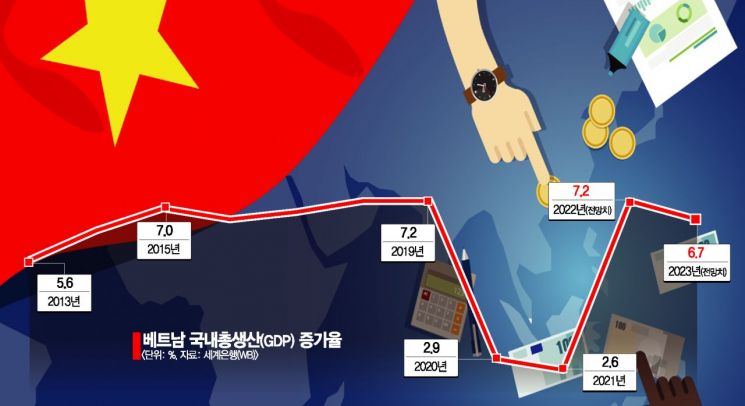
On the 26th (local time), the World Bank (WB) forecasted Vietnam’s GDP growth rate at 7.2% for this year in its report on developing countries in the East Asia and Pacific region. This is a 1.9 percentage point increase from the 5.3% forecast announced in April. The International Monetary Fund (IMF) also raised its forecast for Vietnam’s GDP growth rate from 6% in April to 7% in July. The IMF recently stated in an article about Vietnam’s economy, "Vietnam is the only major Asian economy to have revised its growth forecast upward by such a large margin."
According to the Vietnamese government’s announced GDP growth rates for the first half of this year, the first quarter grew by 5.05% and the second quarter by 7.72%. The Vietnamese government recently predicted that the third quarter will also record growth exceeding 7%. The government’s target for this year’s GDP growth rate is between 6.0% and 6.5%.
◇Vietnam, ‘Winner in the Era of Deglobalization’
Vietnam’s resilience amid the shaking of major economies is largely attributed to China’s influence. Since the US-China trade war began in 2018 and China’s strict ‘zero COVID’ policy, many factories previously located in China have relocated to Vietnam. The British magazine The Economist recently mentioned this, reporting that ‘Vietnam is emerging as a winner in the era of deglobalization.’ Vietnam, which opened its communist economy in the late 1980s, has grown its economy by attracting global companies’ factories based on cheap labor, and this strength has shone even more in the current deglobalization trend.
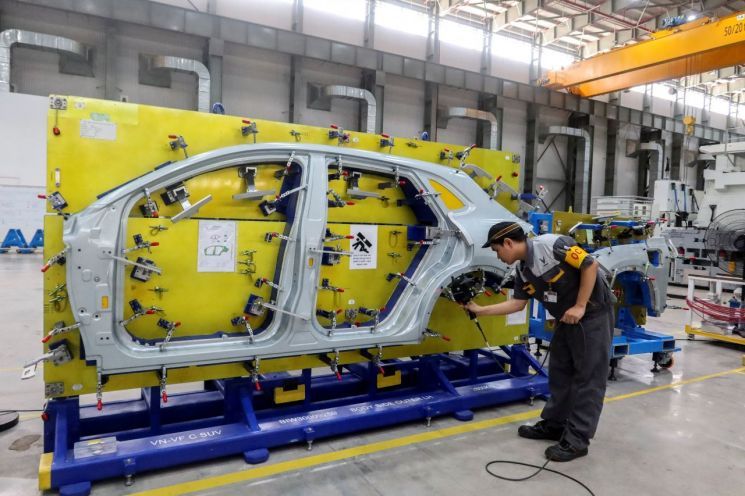
According to reports, nearly half of the $31 billion (about 44.2 trillion KRW) worth of US-bound exports that shifted from China to other Asian countries due to the US-China trade war in 2019 were produced in Vietnam. Last month, it was reported that Foxconn, Apple’s largest supplier pursuing a ‘China exit’ policy, signed a memorandum of understanding with a local developer to invest $300 million in northern Vietnam. There were also reports that some iPad and AirPods production factories were relocated. Additionally, Microsoft (MS) ships Xbox gaming consoles from Ho Chi Minh City, Vietnam, and Google is known to have moved its factory from China to Vietnam this year to start assembling the latest Pixel 7 model.
The Economist stated, "While China is aging, Vietnam’s workforce is still young and vibrant," and added, "Vietnam has the advantage of having signed free trade agreements (FTAs) with many countries, making access to its domestic market easier." It also noted that Vietnam fully reopened its borders in March after COVID-19, whereas China still maintains a zero COVID policy, making Vietnam politically less restrictive compared to China.
◇A Situation That Cannot Be Taken for Granted... Challenges Such as Workforce Development
Despite this growth, Vietnam cannot be completely assured. Since its economy relies on factories of global companies, if the global economy falls into recession, factory orders will decrease, inevitably impacting Vietnam’s economy. The World Bank’s forecast of Vietnam’s GDP growth rate dropping to 6.7% next year from this year reflects this concern. The Vietnamese government recently stated, "Vietnam’s economy is small but open with limited resilience," and warned that even small external shocks could have adverse effects. Vietnam’s consumer price index rose by 3.6% in August, currently below the government’s target of 4%, but the State Bank of Vietnam recently raised the benchmark interest rate by 1 percentage point as a preemptive measure.
Alongside addressing the immediate recession, Vietnam faces mid- to long-term challenges such as workforce development and expanding its manufacturing base. Vietnam’s economy grew in the past by producing garments and other goods, but with the influx of electronics companies, the need for highly skilled workers is increasing. However, according to the International Labour Organization (ILO), only 9% of jobs in Vietnam last year were high-skilled. Another issue is that most products manufactured by global companies operating locally are simple assemblies of parts imported from other countries.
The Economist reported, "The Vietnamese government aims to increase per capita GDP from the current level of $2,800 to $18,000 by 2045," but added, "Vietnam still has a lot to do to move further up the value chain."
© The Asia Business Daily(www.asiae.co.kr). All rights reserved.
![Clutching a Stolen Dior Bag, Saying "I Hate Being Poor but Real"... The Grotesque Con of a "Human Knockoff" [Slate]](https://cwcontent.asiae.co.kr/asiaresize/183/2026021902243444107_1771435474.jpg)


















