Sangui to Host the 6th Fair Competition Forum on the 28th
Discussion on 'Improvement Measures for the Designation System of Large Business Groups'
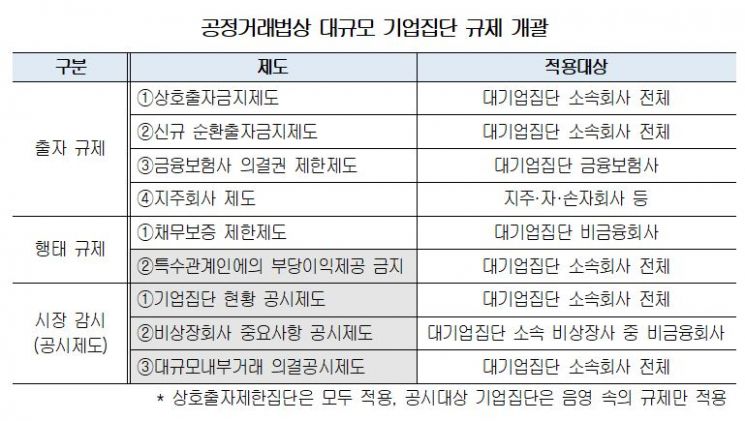
[Asia Economy Reporter Donghoon Jung] As the government is promoting the ‘Improvement of the Large Business Group System’ as a national agenda, claims have been raised that the unreasonable problems of the same-person designation system need to be improved.
The Korea Chamber of Commerce and Industry (KCCI) announced on the 28th that it held the ‘6th Fair Competition Forum’ and discussed the ‘Problems and Improvement Measures of the Large Business Group Designation System.’ The current business group designation system imposes an obligation on the same person to submit data on relatives and other related parties and criminal penalties for violations. However, there are many problems such as the absence of a definition of the same person and insufficient objection procedures, raising calls for system improvement.
The KCCI Fair Competition Forum was organized to continuously examine the problems of fair trade policies that disadvantage Korean companies in global competition and to discuss improvement measures.
Experts who participated as panelists included Professor Se-hwan Park of the University of Seoul, Professor Sun-hee Lee of Sungkyunkwan University, Professor Young-soo Shin of Kyungpook National University, U.S. attorney Ji-won Kang of Kim & Chang Law Firm, and attorney Seung-jae Lee of Yulchon LLC. Economic panelists included Woo Tae-hee, Executive Vice President of KCCI, Lee Hyung-hee, Chairman of SK Supex SV Committee, and executives in charge of fair trade from major companies. Representing the government, Hwang Won-cheol, Director of the Corporate Group Bureau at the Korea Fair Trade Commission (KFTC), attended.
Current System Problems: Ambiguity in Criteria for Determining the Same Person, Designation, Objection, and Appeal Procedures
Professor Se-hwan Park, who gave the keynote presentation, stated that recently there have been many criticisms regarding substantive and procedural irrationalities in the designation of the same person, related parties, business group designation, and requests for submission of business group designation data. He emphasized that although the designation of the same person is the starting point and core of large business group regulation, the designation of the same person and business groups is carried out ambiguously.
Specifically, Professor Park pointed out the following issues: ▲ ambiguity in criteria for determining the same person, designation, objection, and appeal procedures ▲ regulatory differences (equity) depending on whether the same person is a corporation or a natural person ▲ excessive penal provisions related to the submission of business group designation data, and urged improvements.
U.S. attorney Ji-won Kang of Kim & Chang Law Firm, who participated as a panelist, said, "In recent cases of changes in the same person by the KFTC, various considerations beyond the legally stipulated criteria have been reflected in the judgment, so the predictability of the same person designation is insufficient." He suggested that "it is desirable to establish official notices or examination guidelines containing the KFTC’s judgment criteria for various situations such as foreign designation, intergenerational management succession, and management disputes."
Meanwhile, Professor Sun-hee Lee said, "Recently, the European Union and the United States have prepared bills targeting giant technology platforms for preemptive regulation. Although this is similar to Korea’s large business group regulation method, the number of ultra-large platforms (FAANG) targeted by these countries is very small." She added, "In Korea, the number of large business groups subject to regulation is excessively large, so it is desirable to significantly reduce that number." FAANG refers to Facebook, Amazon, Apple, Netflix, and Google.
Professor Young-soo Shin also stated, "The direction of the recently discussed reform of large business group regulation should focus on rationalization rather than uniform relaxation." He argued, "Unnecessary regulations should be boldly eliminated, but effective regulatory measures should also be sought to avoid blind spots in areas with high economic concentration or potential for private interest appropriation."
Positive Direction in the Amendment to the Enforcement Decree Reducing Same-Person Related Parties
There was also heated discussion about the amendment to the Enforcement Decree of the Fair Trade Act announced by the KFTC last August to rationalize the large business group system. The KFTC reduced the scope of relatives from six degrees of blood relatives to four degrees, and from four degrees of in-laws to three degrees, while exceptionally including fifth to sixth degree blood relatives and fourth degree in-laws in the scope of relatives if they assist the same person’s control.
Professor Park said, "Considering changes in the concept of relatives, the direction to reduce the scope of relatives itself is positive, but there are criticisms that the exception clause regarding assistance to the same person’s control has not substantially reduced the burden on companies." He urged, "We should move toward reducing the burden on companies compared to the current system while suppressing economic concentration."
Attorney Seung-jae Lee of Yulchon LLC responded, "By leaving the exception clause, the burden on businesses to identify and verify relatives may actually increase, which is contrary to the original purpose of amending the enforcement decree."
Regarding the amendment to exclude companies controlled by outside directors from affiliated companies in principle, Attorney Lee added, "Outside directors are a system based on independence and expertise, so the enforcement decree should be amended to exclude outside directors themselves, not companies controlled by outside directors, from the scope of special related parties."
An economic sector official pointed out that improvements are also needed for nonprofit corporations among same-person related parties. While nonprofit corporations, which are special related parties under the Framework Act on National Taxes, limit the scope of contributed assets to ‘only assets contributed for establishment,’ the Enforcement Decree of the Fair Trade Act broadly defines contributed assets of nonprofit corporations as ‘total contributed assets,’ which acts as a factor hindering the activation of corporate donation culture.
Excessive Disclosure for Large Business Groups...Careful Review Needed for Imposing New Disclosure Obligations Such as the Subcontracting Act Disclosure System
Once designated as a large business group, various disclosure obligations such as disclosure of business group status are imposed. Regarding this, Professor Park said, "Although there have been criticisms that the business group disclosure system increases the workload due to the vast amount of information subject to disclosure, the scope of disclosure has continued to increase." He added, "Regarding the subcontracting act disclosure system scheduled to be implemented in 2023, careful judgment is needed on whether the disclosure of payment terms by the primary contractor belonging to a large business group and the setting of payment terms favorable to subcontractors at the second or lower subcontracting stages are directly related."
Woo Tae-hee, Executive Vice President of KCCI and moderator of the discussion, said, "The large business group designation system was introduced 30 to 40 years ago when there were concerns about domestic market monopolies by some companies, but in the era of global competition where the distinction between domestic and foreign companies is meaningless, it is necessary to reconsider whether it is hindering the innovation and growth of our companies."
© The Asia Business Daily(www.asiae.co.kr). All rights reserved.
![Clutching a Stolen Dior Bag, Saying "I Hate Being Poor but Real"... The Grotesque Con of a "Human Knockoff" [Slate]](https://cwcontent.asiae.co.kr/asiaresize/183/2026021902243444107_1771435474.jpg)
















