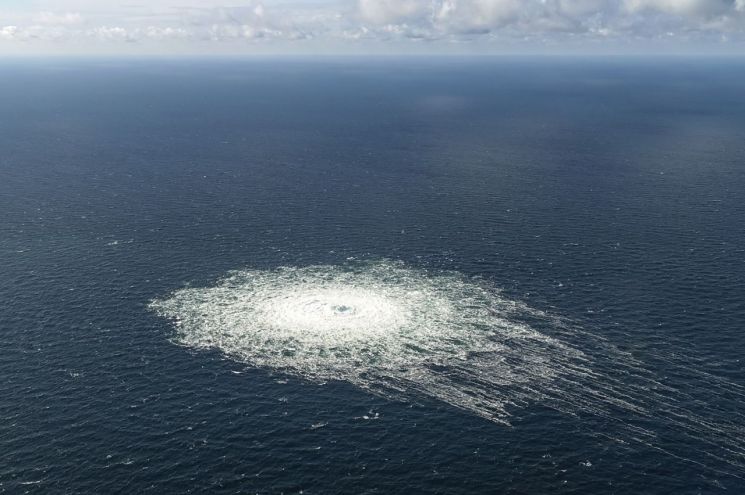
[Asia Economy Reporter Jeong Hyunjin] The Baltic Sea subsea pipelines 'Nord Stream 1' and 'Nord Stream 2', connecting Russia and Germany, experienced consecutive gas leaks in three pipelines within a day, according to reports by The Guardian and others on the 27th (local time). Given the energy conflict between Russia and Europe amid the Ukraine war, both sides harbor suspicions and are considering the possibility of 'sabotage' (secret destruction operations).
According to reports, Nord Stream operator Nord Stream AG announced that damage was confirmed consecutively in three subsea pipelines of Nord Stream on the same day. Just prior to this, the Swedish Maritime Administration confirmed two leaks in Nord Stream 1. The day before, the Danish Maritime Authority reported a gas leak in Nord Stream 2 and prohibited vessel navigation in the surrounding waters.
The Swedish National Seismic Network stated that just before the gas leaks were discovered, two large energy releases were recorded in the area. They explained that it is difficult to find any cause other than an explosion for energy releases of this magnitude. The German Research Centre for Geosciences (GFZ) also reported that seismometers on the Danish island of Bornholm near the leak site recorded two shocks the previous day.
Nord Stream 1 consists of two pipelines, each with an annual supply capacity of 27.5 billion cubic meters, and has been supplying gas from Russia to Germany since 2011. Russia notified that it would suspend gas supply through Nord Stream 1 for three days starting from the 31st of last month for maintenance, but unexpectedly discovered a leak on the 2nd, a day before the maintenance was to be completed, and indefinitely suspended gas supply.
Following Nord Stream 1, Nord Stream 2, completed at the end of last year to supply additional gas to Germany, has not been operational this year due to Western sanctions following Russia's invasion of Ukraine.
Regarding this incident, Russia and the West are expressing suspicions targeting each other, stating it is unlikely to be a simple accident. Kremlin spokesman Dmitry Peskov said, "This is an issue related to the energy security of the entire continent. The situation is very concerning." When asked if the leak was due to sabotage, he replied, "At this moment, nothing can be ruled out."
On the other hand, the West suspects that Russia may have intentionally intervened in this leak, considering Russia's continued reduction of energy supplies to Europe in response to Western sanctions.
Danish Prime Minister Mette Frederiksen said that sabotage cannot be ruled out. She stated, "It is still too early to draw conclusions, but it is clearly an unusual situation," adding, "Given that there were three leaks, it is hard to believe they occurred accidentally." She further added, "This is not an accident but a deliberate act." The German government also stated that this incident could be the result of a 'targeted attack' and said that Russia's involvement "cannot be ruled out."
Mykhailo Podolyak, advisor to the President of Ukraine, condemned the incident on Twitter, calling it "a terrorist attack by Russia and an act of aggression against the European Union (EU)."
The Guardian, citing sources within the UK, reported that the possibility of the incident being caused by submarines or underwater vehicles is low, reasoning that the Baltic Sea, where the incident occurred, is relatively shallow compared to other seas, so if such means had been used, they would have been detected.
© The Asia Business Daily(www.asiae.co.kr). All rights reserved.

















