Choo Kyung-ho, Keynote Speech at the '2022 Small and Medium Business Leaders Forum'
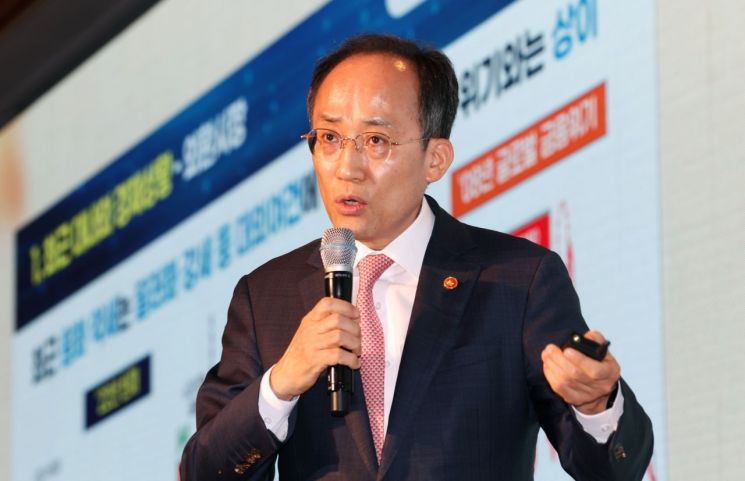 On the 27th, Deputy Prime Minister and Minister of Economy and Finance Choo Kyung-ho delivered a keynote speech on the topic of "Recent Economic Situation and Policy Directions" at the '2022 SME Leaders Forum' held at Lotte Hotel Jeju in Seogwipo, Jeju.
[Asia Economy Reporter Donghyun Choi] "The inflation trend is expected to peak in October this year."
On the 27th, Deputy Prime Minister and Minister of Economy and Finance Choo Kyung-ho said at the '2022 Small and Medium Enterprise Leaders Forum' held at Lotte Hotel Jeju in Seogwipo, Jeju, "Prices will gradually decline after October, but high inflation levels may persist for some time."
Deputy Prime Minister Choo cited the major causes of inflation as the global liquidity released during the COVID-19 period and the surge in raw material prices due to the Russia-Ukraine conflict. He explained the current economic situation, saying, "For the time being, the domestic consumer price inflation rate is expected to move around 6%. Currently, countries worldwide are sharply raising interest rates to curb inflation, which is increasing volatility in international financial markets, such as stock prices falling."
Regarding South Korea's cumulative trade deficit of $25.2 billion (approximately 35.85 trillion KRW) from January to August this year, Deputy Prime Minister Choo pointed to the increase in energy import costs as the biggest factor. However, he noted that South Korea's sovereign credit risk is significantly lower than during the 2008 global financial crisis, so there is no need for major concern. South Korea's Credit Default Swap (CDS) premium was 699 as of October 27, 2008, but it was 50 as of January this year. The CDS premium is a representative default risk indicator, referring to a financial derivative product that allows investors to recover principal if the issuing company or country defaults. A lower figure means lower insurance premiums to be paid.
Deputy Prime Minister Choo also said that the recent sharp rise in the won-dollar exchange rate in the foreign exchange market shows a pattern distinctly different from the past, and the possibility of a risk at the level of a financial crisis is low. He said, "During the 1997 foreign exchange crisis and the 2008 global financial crisis, the won surged excessively against the dollar, euro, and yen before moving sharply. However, now it shows a pattern similar to major global currencies." He added, "The recent won depreciation is due to external conditions such as the strength of the dollar. It is definitely different from past crises."
Deputy Prime Minister Choo promised to not take the situation lightly and to make every effort to stabilize prices and livelihoods, as well as manage financial and foreign exchange risks. He emphasized, "The government places the highest priority on stabilizing prices and livelihoods and is mobilizing all available means. Given the high uncertainty in financial and foreign exchange markets is likely to persist for a considerable period, we will not let our guard down and will do our best to stabilize the market."
© The Asia Business Daily(www.asiae.co.kr). All rights reserved.
![Clutching a Stolen Dior Bag, Saying "I Hate Being Poor but Real"... The Grotesque Con of a "Human Knockoff" [Slate]](https://cwcontent.asiae.co.kr/asiaresize/183/2026021902243444107_1771435474.jpg)
















