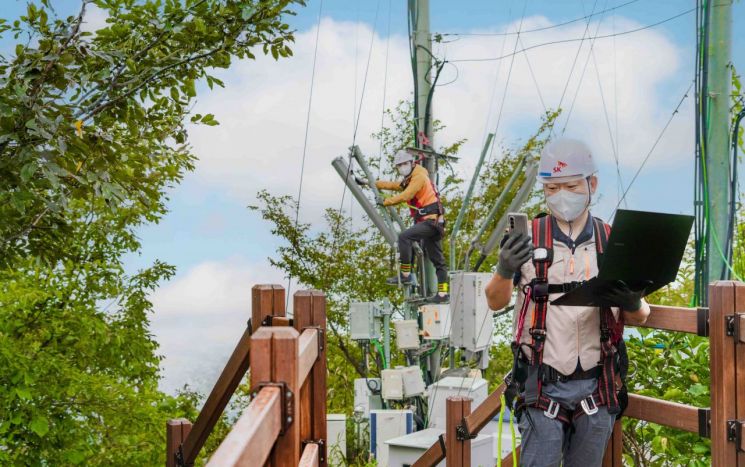
 Engineers from SK Onns, a subsidiary of SK Telecom, inspecting relay equipment installed in the mountainous area of Paju-si, Gyeonggi-do. Photo by SKT
[Asia Economy Reporter Oh Su-yeon] SK Telecom announced on the 27th that it will focus on fostering eco-friendly infrastructure technologies to reduce greenhouse gas emissions and achieve net zero (carbon emission zero).
SKT anticipates a sharp increase in base station equipment to utilize higher frequency bands to meet the faster data speeds demanded by the market in the future. Therefore, it believes that various efforts to offset the increased power consumption are necessary to open the era of net zero.
To this end, SKT plans to establish fundamental net zero execution measures such as ▲Single RAN ▲Artificial Intelligence (AI)-based network design ▲cooling and low-power design to directly reduce greenhouse gases.
Establishing Fundamental Net Zero Execution Measures... Efforts to Directly Reduce Greenhouse Gases
SKT is already practicing greenhouse gas reduction using various information and communication technologies (ICT) to achieve net zero by 2050. However, the current net zero implementation heavily relies on procurement through renewable energy certificates or renewable energy purchase agreements.
However, according to the 2050 Carbon Neutrality Committee’s ‘Carbon Neutrality Scenario,’ South Korea’s electricity demand is expected to increase more than threefold compared to 2018 by 2050. In the telecommunications sector, power consumption is steadily increasing as communication equipment operated during the advancement of 5G mobile communications and the evolution of 6G increases, making direct eco-friendly infrastructure technology urgently needed.
SKT has been reducing about 30,000 tons of greenhouse gases annually as of this year by utilizing Single RAN, a 3G·4G integrated equipment introduced worldwide for the first time in 2019, in its private network. It is also replacing outdated equipment and applying network design methods that consider energy efficiency in newly built areas.
Additionally, SKT closely analyzes data usage by region and adjusts equipment efficiently according to traffic. It operates base stations based on solar power generation facilities in about 160 buildings and exchanges, including the Boramae building in Seoul, to improve energy efficiency.
Along with this, SKT is also utilizing technologies such as AI-based intelligent analysis to manage network traffic load and reducing electricity use by cooling equipment with outside air inflow methods during the cold winter season when temperatures are low.
In addition to its efforts so far, SKT plans to newly apply advanced cooling solutions and low-power design solutions. The additional greenhouse gas reductions expected from these newly applied solutions are anticipated to reach up to 70,000 tons by 2030.
Collaboration with Telecom Operators, Equipment Manufacturers, and Public Institutions to Reduce Greenhouse Gas Emissions... Transition to Eco-Friendly Infrastructure
SKT is leading efforts to reduce power consumption of network equipment by collaborating with stakeholders responsible for domestic and international equipment manufacturing and construction, developing power efficiency rating indicators to reduce greenhouse gas emissions.
At the level of the three major telecom companies, about 200,000 shared infrastructure facilities are operated to prevent environmental destruction caused by redundant construction of structures necessary for telecommunications infrastructure. From the perspective of collaboration with local communities, network operation methods are being advanced to minimize intrusion into ecological protection zones designated by the Ministry of Environment and local governments.
SKT plans to publish the ‘Power Saving White Paper’ within the year to consolidate its know-how on carbon emission reduction activities and build consensus among mobile operators. It will also strengthen cooperation with public institutions by utilizing the Fire Department’s TV White Space (TVWS) network to prepare for large-scale wildfires, continuing ESG (Environmental, Social, and Governance) efforts using telecommunications infrastructure.
Kang Jong-ryeol, SKT ICT Infrastructure Officer (CSPO·Chief Safety and Health Officer), said, “Net zero, which all telecommunications operators worldwide face, is a challenging task that requires significant effort,” adding, “SKT will pool company-wide capabilities to concretize effective low-power solutions and apply them to business to achieve net zero.”
© The Asia Business Daily(www.asiae.co.kr). All rights reserved.

















