Won-Dollar Exchange Rate Surges to 1430 Won Intraday
Export Companies and Banks Benefit from Exchange Rate Rise
Export and Domestic Companies Must Establish for Economic Soundness
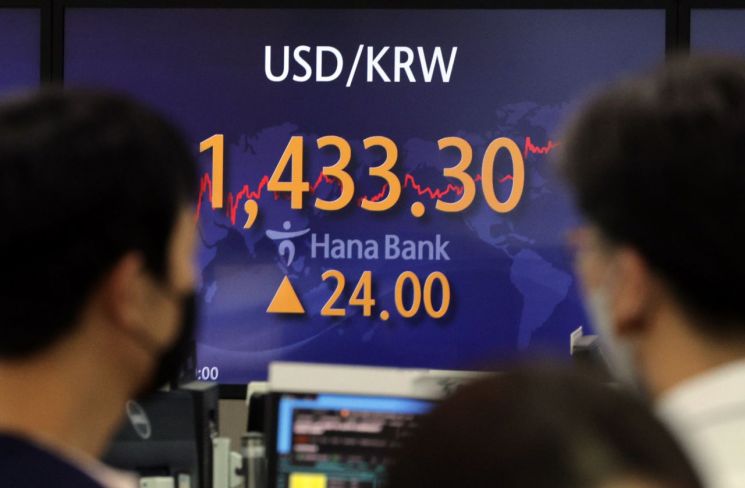 On the afternoon of the 26th, the won-dollar index is displayed on the electronic board in the dealing room of Hana Bank in Jung-gu, Seoul. [Image source=Yonhap News]
[Asia Economy Intern Reporter Lee Gyehwa] The KRW-USD exchange rate surpassed 1,430 won intraday for the first time in about 13 years and 6 months. Companies benefiting from the exchange rate increase, such as those seeing sales rise due to foreign exchange gains, are emerging. With expectations that the strong dollar trend will continue for the time being, these companies' profits are expected to persist.
On the 26th, the KRW-USD exchange rate in the Seoul foreign exchange market broke through 1,430 won intraday. This is 22.1 won higher than the previous day's closing price. The last time the exchange rate exceeded 1,430 won intraday was on March 17, 2009 (high of 1,436.0 won) during the financial crisis, about 13 years and 6 months ago. Considering it was in the 1,100 won range at the beginning of this year, it has surged about 30% in just 9 months.
Companies with a high export ratio are benefiting from the exchange rate increase. As the exchange rate rises, profits improve, offsetting losses caused by rising raw material prices. Samyang Foods, which has a large overseas sales ratio, is greatly benefiting from the exchange rate increase. According to the industry, due to the popularity of Buldak Bokkeum Myun, overseas sales are about 70% higher than domestic sales. In the first half of this year, domestic sales reached 141.3 billion won, and export sales amounted to 316.2 billion won.
Commercial banks are playing a role in foreign exchange hedging for small and medium-sized enterprises (SMEs) and mid-sized companies amid the rising exchange rate. Foreign exchange hedging, or hedge, is a method used to limit investment loss risks caused by changes in foreign currency exchange rates. According to data received by Lee Jang-seop, a member of the National Assembly's Industry, Trade, Energy, Small and Medium Business Committee from the Korea Trade Insurance Corporation, SMEs and mid-sized companies that subscribed to foreign exchange fluctuation insurance over the past five years (2018 to August 2022) returned 19.1 billion won in foreign exchange gains caused by the rising exchange rate to 12 commercial banks.
Foreign exchange fluctuation insurance is a product that eliminates foreign exchange gains or losses that may occur during the process of acquiring or paying foreign currency through exports and imports by fixing the foreign currency amount in Korean won in advance. For example, if Company A subscribes to foreign exchange fluctuation insurance at an exchange rate of 1,000 won per dollar, even if the exchange rate drops to 900 won when receiving export payments later, it compensates for the 100 won loss. Conversely, if the exchange rate rises by 100 won, the insurance recovers the 100 won increase from the bank.
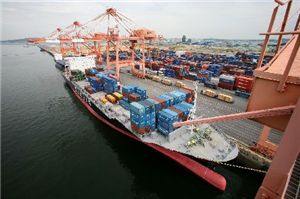 An increase in exchange rates is expected to improve the performance of shipping companies.
The shipping industry is considered a representative beneficiary sector of the exchange rate increase. Since shipping companies receive freight charges in dollars, a rise in the exchange rate leads to increased sales. According to Korea Credit Rating, the net export exposure of the shipping industry is 23.4%. Net export exposure is an indicator that measures the level at which net exports, calculated by subtracting imports from exports, are exposed to exchange rates. The higher the value, the greater the effect of increased won sales due to exchange rate rises.
There is a forecast that the U.S. high-intensity tightening policy will continue until next year. With ongoing U.S.-China tensions and the Russia-Ukraine war, money is flowing into the safe-haven dollar, maintaining the strong dollar trend. However, while companies benefiting from the strong dollar may receive advantages, experts point out that this is not a desirable phenomenon in the long term.
Professor Lee Min-jae of the Department of Global Business at Mokwon University emphasized, "While a strong dollar is an opportunity factor for export companies, for the soundness of the Korean economy, it is necessary for export and domestic companies to gradually achieve balance in the future."
© The Asia Business Daily(www.asiae.co.kr). All rights reserved.

















