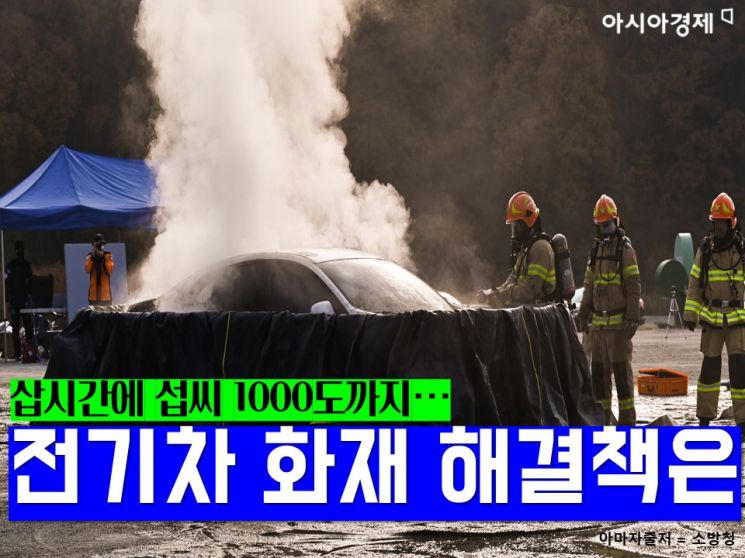
 Electric vehicles equipped with many components sensitive to high temperatures, such as batteries, are vulnerable to fire. / Photo by Song Hyundo, Asia Economy intern reporter
[Asia Economy Reporter Lim Juhyung, Intern Reporter Song Hyundo] While electric vehicles (EVs) are gaining popularity, there is also significant anxiety about vehicle fire accidents. It is known that once a fire breaks out in an EV, it is difficult to control the flames. We looked into the causes of EV fires and ways to respond.
On June 4th, an electric vehicle passing the West Busan Tollgate on the Busan Namhae Expressway crashed into a nearby tollgate shock absorber and caught fire. According to the police's analysis of closed-circuit television (CCTV), the entire vehicle was engulfed in flames within just three seconds after the collision.
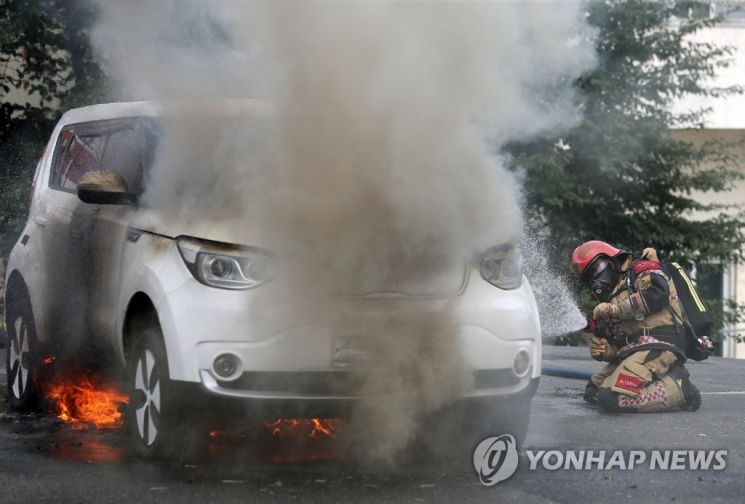 On the afternoon of the 16th, an experiment was conducted at the Gyeongbuk Fire Academy training ground in Andong-si, Gyeongbuk, to study suppression techniques for electric vehicle fires. / Photo by Yonhap News
According to the National Fire Agency, the number of EV fire cases increased nearly threefold from 7 in 2019 to 23 last year. Considering the cumulative growth rate of EVs, this number is likely to rise further. The number of registered EVs in South Korea was 135,000 in 2020, 231,000 in 2021, and 298,000 by the second quarter of 2022, showing an average annual growth rate of over 30%.
The reason EV fires particularly evoke fear among consumers lies in the fire-vulnerable structure of EVs. The battery, the main power source of an EV, begins to melt when its internal temperature exceeds 130 degrees Celsius, and thermal decomposition of the cathode material occurs above 240 degrees Celsius. Once thermal decomposition starts, the internal temperature rapidly rises to over 1,000 degrees Celsius; this phenomenon is called 'thermal runaway.' If thermal runaway progresses, there is a risk of secondary fires spreading throughout the vehicle.
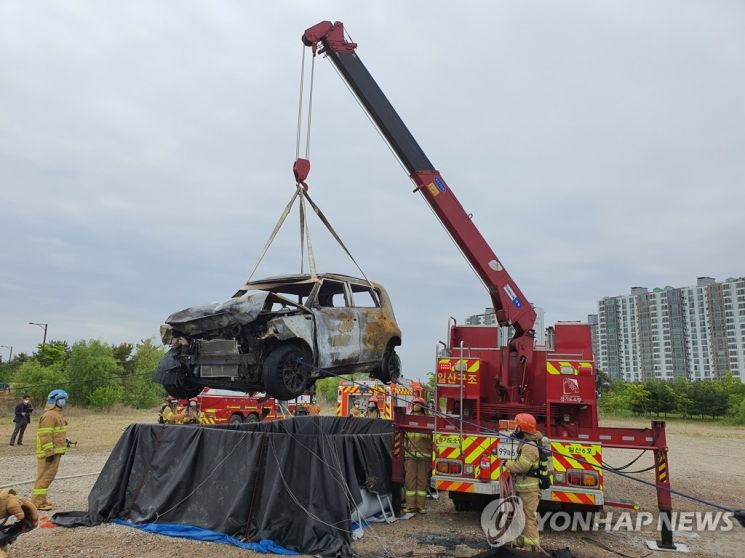 Last year, Ilsan Fire Station conducted an electric vehicle fire suppression experiment at the KINTEX parking lot in Ilsan, Goyang-si, Gyeonggi Province. The photo shows the method of extinguishing the fire using a portable water tank. / Photo by Ilsan Fire Station
The battery structure also makes fire suppression difficult during thermal runaway. EV batteries are usually installed under the vehicle and protected by a special case called a 'housing,' which makes it difficult for water to penetrate. The conventional water spray method used for fire suppression is less effective.
For this reason, firefighting authorities are seeking new suppression methods specialized for EV fires. The most promising solution is the use of a portable water tank. Unlike the water spray method that sprays water to extinguish flames, this method involves placing the vehicle in a portable water tank and injecting extinguishing water, allowing water to be sprayed directly into the battery gaps.
Another proposed solution is the suffocating fire suppression cover that prevents fire spread in the early stages. Developed in the Netherlands in 2014, it is a cloth made of specially coated fire-resistant fibers. When placed over a burning vehicle, it blocks oxygen inflow to extinguish the fire and also prevents the spread of toxic smoke and heat.
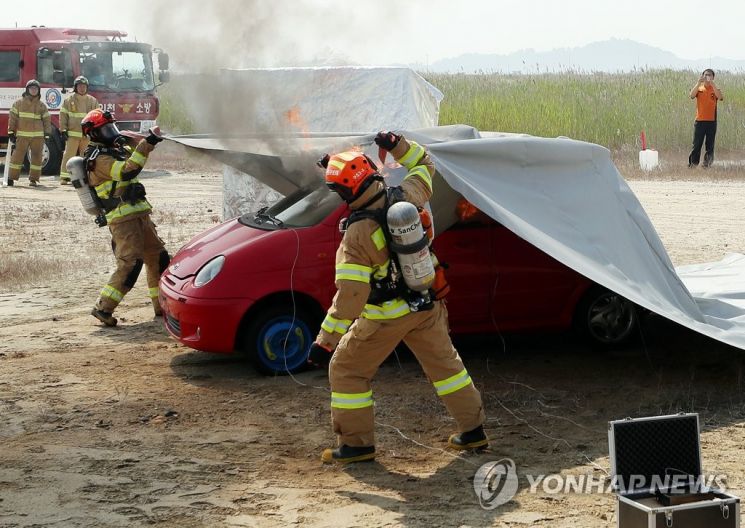
The National Fire Agency has shown efforts to prepare for EV fires, including demonstrations in June using waterproof sheets and portable water tanks for fire suppression. The Seoul Fire & Disaster Headquarters announced and distributed the 'Eco-friendly Vehicle Accident Response Guidelines' last year, encouraging fire accident responses that reflect the characteristics of EVs.
Experts emphasize that citizens' prompt and accurate reporting is also a key factor in reducing damage from EV fires. This allows firefighting authorities to choose the appropriate suppression method for the vehicle type. Researcher Na Yongwoon of the National Fire Research Institute explained, "EV fire suppression is a fierce race against time where a difference of 5 to 10 minutes can change the situation, so securing the golden time is crucial. Therefore, when reporting a vehicle fire, it is essential to inform that the vehicle involved is an electric vehicle."
© The Asia Business Daily(www.asiae.co.kr). All rights reserved.
![Clutching a Stolen Dior Bag, Saying "I Hate Being Poor but Real"... The Grotesque Con of a "Human Knockoff" [Slate]](https://cwcontent.asiae.co.kr/asiaresize/183/2026021902243444107_1771435474.jpg)


















