Hanwha Group Secures Management Rights of Daewoo Shipbuilding through 2 Trillion KRW Capital Increase
Final Acquirer Confirmed via Competitive Bidding Process Using Stalking Horse Method
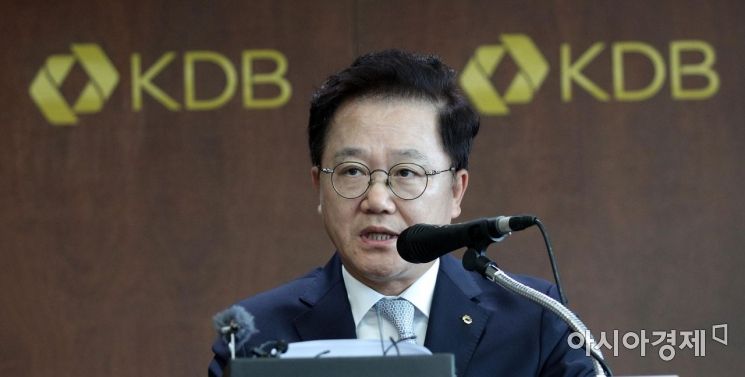 Kang Seok-hoon, Chairman of the Korea Development Bank, is speaking at an emergency press conference regarding current issues at Daewoo Shipbuilding, held on the 26th at the Korea Development Bank headquarters in Yeouido, Seoul. Photo by Kim Hyun-min kimhyun81@
[Asia Economy Reporter Song Hwajeong] Daewoo Shipbuilding & Marine Engineering (DSME) is set to join the Hanwha Group. The sale process is expected to be completed as early as the first half of next year.
Kang Seok-hoon, Chairman of KDB Industrial Bank, held an emergency press conference on the afternoon of the 6th at the Yeouido headquarters in Yeongdeungpo-gu, Seoul, announcing that as part of the strategic investment attraction procedure for DSME's normalization, Hanwha Group and DSME have signed a conditional investment agreement (MOU) including a third-party allotment capital increase plan worth approximately 2 trillion KRW.
Chairman Kang stated, "Under the system where the Industrial Bank is the major shareholder, there are limitations to fundamentally improving DSME's competitiveness, including research and development (R&D). To avoid repeating the mistake of missing the sale timing and incurring greater losses, since my appointment, I have been consulting with various stakeholders to expedite the sale of DSME." He added, "Management consulting results showed that given the current competitiveness level and market environment, DSME's possibility of self-driven normalization is low. We judged that finding a capable private owner is the fundamental solution to improve DSME's structure and strengthen its mid-to-long-term competitiveness." He continued, "While improving sale conditions through management efficiency, we kept all options open, including full sale and split sale, and after searching for buyers with a high understanding of the business and financial backing, Hanwha Group expressed its intention to acquire."
Hanwha Secures 49.3% Stake and Management Rights in DSME through 2 Trillion KRW Third-Party Allotment Capital Increase
The Industrial Bank approached all possible large domestic conglomerates for the sale of DSME. Chairman Kang said, "We approached most of the major conglomerates operating businesses in Korea," adding, "Among them, Hanwha Group showed acquisition interest and confirmed their intention."
According to the agreement, Hanwha Group will conduct a third-party allotment capital increase worth about 2 trillion KRW targeting DSME, securing a 49.3% stake and management rights. Hanwha affiliates participating include Hanwha Aerospace (1 trillion KRW), Hanwha Systems (500 billion KRW), Hanwha Impact Partners (400 billion KRW), and Hanwha Energy (100 billion KRW). Additionally, the Industrial Bank, which will become the second-largest shareholder with 28.2%, will prepare support measures for DSME's management normalization together with the creditor group. The Industrial Bank, along with the Export-Import Bank of Korea (KEXIM), will maintain various financial supports such as loans, refund guarantees (RG), letters of credit (LC), and credit lines for five years from the transaction closing date, and will also amend KEXIM's perpetual bond conditions. Chairman Kang explained, "Hanwha Group will inject 2 trillion KRW of new funds to supplement expected liquidity, and it is anticipated that some time will be required until normalization. During this process, the Industrial Bank's continued support will enhance DSME's sustainability and increase the likelihood of recovering the bank's loans and stock value, so we decided to extend support for five more years."
Competitive Bidding via Stalking Horse Method... Hanwha Holds Investment Priority Rights
DSME will also conduct a competitive bidding process using the 'Stalking Horse' method after signing the MOU with Hanwha Group to provide opportunities for investors offering more favorable conditions. The Stalking Horse method refers to a conditional acquisition contract between a restructuring company and a prospective buyer based on public bidding. The final investor will be decided depending on the bidding conditions of subsequent participants and whether Hanwha Group exercises its priority rights. Accordingly, the Industrial Bank will announce the competitive bidding on the 27th, receive letters of intent for about three weeks until the 17th of next month, conduct due diligence for up to six weeks, select the final investor, and sign the main contract (new share subscription agreement). Hanwha Group can exercise investment priority rights as the preferred negotiation partner at this stage. The selected final investor will complete the transaction by conducting the capital increase after obtaining domestic and international approvals related to corporate mergers and acquisitions and defense industry regulations. Overseas companies are not allowed to participate in the bidding alone. Also, considering the previous failure of Hyundai Heavy Industries' acquisition, Hyundai Heavy Industries and Samsung Heavy Industries, which may cause issues in corporate mergers, will be excluded from the bidding. Chairman Kang explained, "It is difficult for overseas companies to acquire DSME as the main entity. DSME's LNG business includes many national innovative technologies, and the defense sector also contains many national technologies, so bidders led by overseas companies will not be qualified."
Chairman Kang expects no major issues in overseas merger reviews if Hanwha becomes the final acquirer. Since 2019, the Industrial Bank has pursued a merger and acquisition (M&A) between Hyundai Heavy Industries Group and DSME, but it failed due to the European Union (EU) competition authority's disapproval of the merger. Kang said, "We expect general corporate merger reviews by overseas competition authorities in about ten countries. Unlike Hyundai Heavy Industries, which operates in the same shipbuilding industry, Hanwha has no shipbuilding-related portfolio, so corporate merger issues will be relatively minor."
Regarding controversy over a low-price sale, he said, "Hanwha is currently the preferred negotiation partner, and if a company offering better terms appears, we may contract with that company. While DSME was under the Industrial Bank's control, its corporate value continuously declined, suffering losses of 1.7 trillion KRW last year and 600 billion KRW in the first half of this year, making the situation very difficult. We believe that finding a private owner capable of bold R&D investment and management efficiency to normalize the company will minimize public losses."
On recovering funds invested in DSME, Chairman Kang said, "The Industrial Bank has injected about 4.1 trillion KRW of new funds into DSME, and the estimated loss so far is about 3.5 trillion KRW. Of this, 1.6 trillion KRW was set aside as loan loss provisions, and about 1.8 trillion KRW is stock impairment." He added, "If DSME moves from a watchlist loan to a normal loan classification, most of the 1.6 trillion KRW in provisions will be reversed as income. If DSME becomes a competitive company through private acquisition, and its stock price, currently around 20,000 KRW, rises to the Industrial Bank's purchase price level, a significant portion of the invested amount can be recovered."
© The Asia Business Daily(www.asiae.co.kr). All rights reserved.
![Clutching a Stolen Dior Bag, Saying "I Hate Being Poor but Real"... The Grotesque Con of a "Human Knockoff" [Slate]](https://cwcontent.asiae.co.kr/asiaresize/183/2026021902243444107_1771435474.jpg)
















