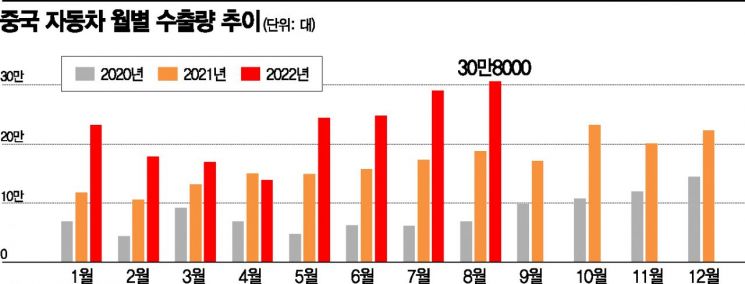
[Asia Economy Beijing=Special Correspondent Kim Hyunjung] China is increasing its automobile exports by prominently promoting new energy vehicles such as electric cars. Last month, exports exceeded 300,000 units for the first time, significantly surpassing South Korea's export volume of 168,155 units during the same period.
According to the China Association of Automobile Manufacturers (CAAM) on the 25th, China's automobile exports last month recorded 308,000 units, a sharp increase of 64.7% compared to the same month last year. With exports surpassing 300,000 units for the first time, China's monthly automobile exports have set new records for four consecutive months since May.
Looking at last month's figures alone, China's export volume nearly doubled that of South Korea (1,618,100 units). Based on cumulative exports from January to August, China sold 1,817,000 units overseas, while South Korea exported 1,463,800 units. Despite a decline in demand due to the global economic slowdown, both countries succeeded in export rebounds due to the base effect from last year's sluggish performance, but the gap in rebound magnitude appears to be widening.
Local Chinese media attribute the export boom to the strong performance of state-owned enterprises and the increase in exports of new energy vehicles (pure electric vehicles, plug-in hybrids, and hydrogen vehicles). From January to August this year, Shanghai Automotive Industry Corporation (SAIC), China's largest state-owned automobile company, exported a total of 579,900 units, a 56.67% surge compared to the previous year. In particular, 101,000 units were sold in August alone, with an increase rate of 65.7%.
Similarly, Chery Automobile, also a Chinese state-owned company, recorded cumulative exports of 250,000 units by August this year, a 51.1% increase compared to the previous year. This accounts for one-third of its total sales volume.
The performance of new energy vehicles is also remarkable. According to CAAM, China's new energy vehicle exports have been increasing monthly since the beginning of this year. The cumulative export volume up to August was 341,000 units, a 97.4% surge compared to the previous year. The contribution rate to total automobile exports reached 26.7%.
Recently, local economic media China Economic Net reported that 10,000 pure electric vehicles from Shanghai Automotive, launched targeting the global market, were exported to Europe. A representative from China's Ministry of Industry and Information Technology told the newspaper, "The export of 10,000 vehicles to Europe represents a new breakthrough for our automobile industry and new energy development," adding, "In particular, automobile exports have entered a rapid development phase."
China Economic Net explained, "Unlike conventional fuel vehicles, new energy vehicles are mainly exported to advanced countries such as Europe and the United States," noting that "85.6% of the total is sold to advanced countries." It emphasized, "We will no longer follow the past path of being known as 'cheap cars' overseas."
According to the China Association of Automobile Manufacturers, the average unit price of new energy vehicles sold in Europe last year was about $30,000 (approximately 42.6 million KRW). The media also introduced a recent McKinsey report that evaluated China's electric vehicles as having a clear advantage with futuristic design and rich networking features. The report also cited lower prices compared to European automobile manufacturers' products with similar performance as an advantage.
CAAM forecasts that automobile exports will exceed 2.4 million units this year. Considering the sales volume so far, this is rather a conservative target. Fu Bingfeng, Secretary-General of the association, stated, "Negative factors such as changes in international situations, slowing global economic recovery, global inflationary pressures, rising battery raw material prices, and the spread of COVID-19 are still occurring," emphasizing, "The industry must pay attention and devise effective measures in a timely manner."
China Economic Net also pointed out limitations, stating, "Overseas investment for establishing new automobile factories is much less compared to multinational automobile manufacturers," and "The independence of supply chains and brand influence are still under development."
© The Asia Business Daily(www.asiae.co.kr). All rights reserved.

















