<Illegal Acts Everyone Does, Tattoo②>
On Trial for Violating the 'Special Act on the Control of Health Crimes'
Constitutional Court Ruled Twice This Year That "Tattooing Constitutes Medical Practice"
Kim Doyun, Head of Tattoo Union Chapter, Says "Judges Are Outdated"
"The National Assembly Must Solve the Problem"
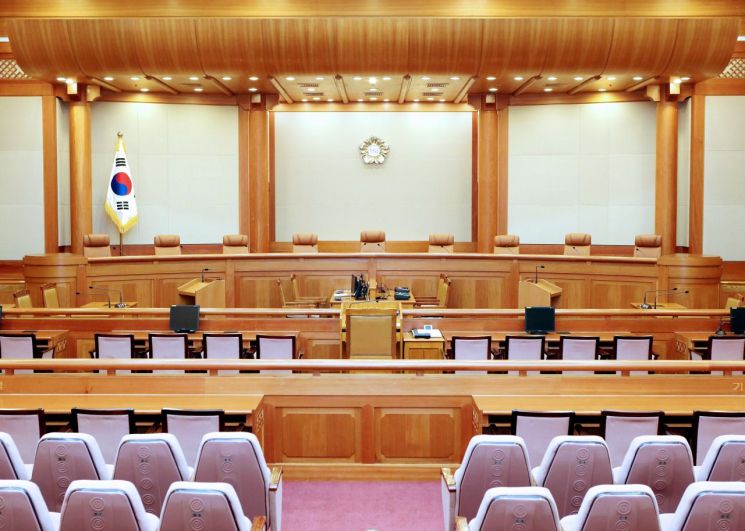
[Asia Economy Reporter Gong Byung-sun] Last July, the Constitutional Court once again upheld the Supreme Court's ruling that "tattooing constitutes a medical practice" based on Article 27, Paragraph 1 of the Medical Service Act. Kim Do-yoon, head of the Tattoo Union branch who filed the constitutional complaint, was left in despair again. He was fined in the first trial last December for performing tattoos. If this continues, he will become a convicted criminal. Kim said, "The second trial scheduled for October will determine whether my tattooing was illegal," adding, "Due to the Constitutional Court's lack of cultural understanding, I am at risk of becoming a convicted criminal."
This year, the Constitutional Court has ruled twice that "tattooing constitutes a medical practice." Both times, the court agreed that it is a medical act, relying on the logic from about 25 years ago that the method of puncturing the skin with needles and inserting pigment is dangerous. On April 25, 1996, the Constitutional Court judged that tattooing procedures could pose risks to the life, body, or health hygiene of the recipient.
However, tattooists have complained that they maintain hygiene in their own ways. In 2020, the Tattoo Union and Green Hospital collaborated to establish guidelines called "Tattooist Infection Control." Tattooists reported that some tattooists with medical licenses are unaware of these guidelines, resulting in cases where the recipient's skin becomes infected. Paradoxically, recipients often seek out famous tattooists who do not have medical licenses but have been verified by many people.
Furthermore, the Constitutional Court argued that creating a system such as tattoo certification would incur significant social and economic costs. Lawyer Kwak Ye-ram, who participated in the constitutional complaint with Kim in July, said, "The constitutional justices did not only address the issues raised in the constitutional complaint, such as freedom of occupational choice, but also introduced reasoning considering social and economic costs," adding, "I feel regret that they brought in different reasoning to make their judgment."
Tattooists Facing Imprisonment Due to Tattooing
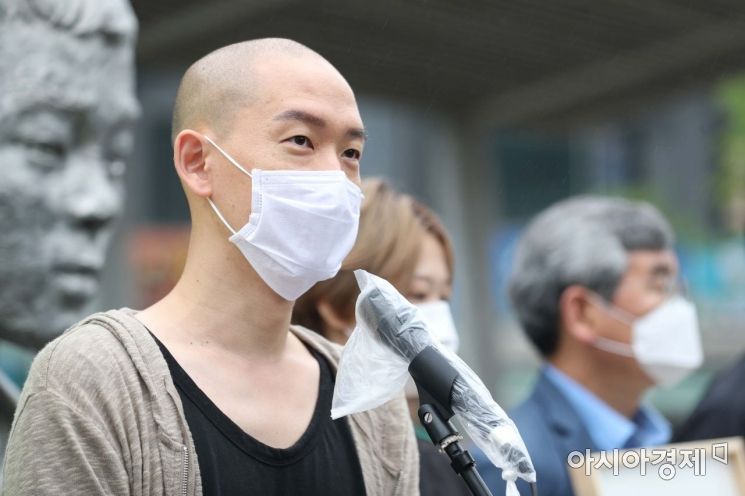 On the 29th, at the 12th Jeon Tae-il 50th Anniversary Campaign held at Jeon Tae-il Bridge in Jongno-gu, Seoul, Kim Do-yoon, head of the Tattoo Union branch, is urging the general professionalization of tattoo artists. Photo by Moon Ho-nam munonam@
Meanwhile, at least eight tattooists are at risk of imprisonment. According to the Tattoo Union, eight tattooists affiliated with the organization are currently either serving prison sentences or undergoing trials in the first or second instance for violations of the "Special Act on the Control of Health Crimes." They had hoped for a new ruling from the Constitutional Court but were disappointed twice this year. Considering tattooists not affiliated with the union, it is estimated that even more tattooists have been imprisoned or face imprisonment on the same charges. In December last year, Mr. A, who performed tattoos without a medical license, was sentenced to one year in prison and fined 1 million won for performing tattoos for profit over ten months.
Kim strongly criticized the Constitutional Court's ruling. He pointed out that no country except South Korea treats tattooing as illegal, yet the constitutional justices still view tattooing as an act done by gangsters. Kim said, "Even Japan, which provided the legal logic for the Korean judiciary until now, legalized tattooing in 2020," adding, "The justices' judgment stems from an outdated mindset."
Nevertheless, some tattooists expressed hope that the Constitutional Court might make a new ruling soon. Both rulings this year were split 5 to 4, showing significant dissenting opinions. In March and July, Constitutional Justices Lee Seok-tae, Lee Young-jin, Kim Ki-young, and Lee Mi-sun stated, "Tattooing is not a therapeutic act and should be distinguished from unlicensed medical practice," and "Due to social perception changes and increased demand for tattoos, it is necessary to judge from a new perspective." Lawyer Kwak said, "If we reverse the argument about social and economic costs, it means that the tattoo market is an area where various social problems are occurring," adding, "It can also be interpreted that the Constitutional Court is suggesting that the National Assembly should resolve this issue."
© The Asia Business Daily(www.asiae.co.kr). All rights reserved.


















