Fed's Three Consecutive Giant Steps
Will the Bank of Korea Also Take a Big Step?
Current Mortgage Loan Interest Rates Near 7% Ceiling... 8% Expected by Year-End
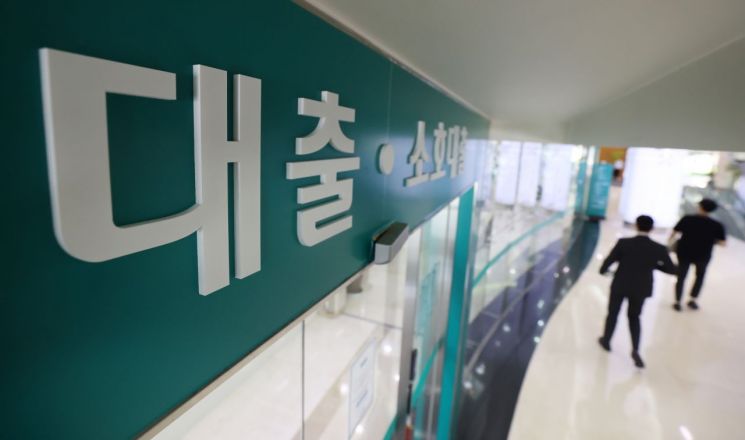 As the U.S. Federal Reserve (Fed) has implemented three consecutive giant steps, the Bank of Korea is increasingly likely to respond with a big step (a 0.50 percentage point increase), pushing the upper limit of variable interest rates close to 7%. The photo is not related to the specific content of the article. [Image source=Yonhap News]
[Asia Economy Reporter Yoon Seul-gi] As the United States has implemented three consecutive 'Giant Steps' (raising the benchmark interest rate by 0.75 percentage points), pressure for interest rate hikes in South Korea is increasing, causing mortgage loan interest rates at major commercial banks to surge. With the current upper limit of interest rates approaching 7%, and forecasts suggesting that the maximum rate could exceed 8% annually by the end of this year, the burden on vulnerable borrowers is expected to grow.
According to the financial sector on the 26th, the mixed (fixed) mortgage loan interest rates at KB Kookmin, NongHyup, Shinhan, Hana, and Woori Banks stand at 4.73% to 6.945% annually as of this date. Compared to July 17 (4.100% to 6.218%), the upper limit rose by 0.727 percentage points (p), and the lower limit increased by 0.63 p.
This is a consequence of the U.S. Federal Reserve (Fed) implementing three consecutive Giant Steps. On the 22nd, the Federal Open Market Committee (FOMC) decided to raise the benchmark interest rate by 0.75 p. The Fed is expected to take another Giant Step and a 'Big Step' (0.50 p increase) at the remaining FOMC meetings in November and December, respectively.
The possibility of a Big Step (0.50 p increase) by the Bank of Korea is also growing. On the 22nd, Bank of Korea Governor Lee Chang-yong hinted at the possibility of taking a Big Step instead of the previously planned 0.25 p increase at the Monetary Policy Board meeting on the 12th of next month, stating that "many preconditions have changed."
Alongside the tightening policies in the U.S. and South Korea, bond yields, which are one of the benchmark rates for loan interest rates, are also soaring. The rise in bond yields is reflected in the COFIX (Cost of Funds Index), affecting variable-rate products as well.
With additional interest rate hikes expected from major countries by the end of this year, there are forecasts that loan interest rates could exceed 8% by year-end. This would be the highest level in about 14 years since the 2008 global financial crisis.
If interest rates rise too quickly, the repayment burden on borrowers will increase, affecting not only the "Yeonggeuljok" (people who borrow to the limit) but also vulnerable borrowers who will face higher interest expenses. According to the 'September 2022 Financial Stability Report' released by the Bank of Korea on the 22nd, raising the benchmark interest rate by 0.5 p at once would increase the average annual interest burden per household by 502,000 KRW.
The rising loan delinquency rate is also a concern. According to the 'Status of Domestic Banks' Won-denominated Loan Delinquency Rates' released by the Financial Supervisory Service, as of the end of July, the delinquency rate for won-denominated loans at domestic banks (based on principal and interest overdue by one month or more) was 0.22%, up 0.02 p from the end of the previous month (0.20%).
The household loan delinquency rate (0.19%) increased by 0.01 p from the end of the previous month (0.17%), and the mortgage loan delinquency rate (0.11%) rose by 0.01 p from the end of the previous month (0.10%). The delinquency rate for household loans excluding mortgage loans (such as unsecured loans) was 0.37%, up 0.03 p from the end of the previous month (0.34%).
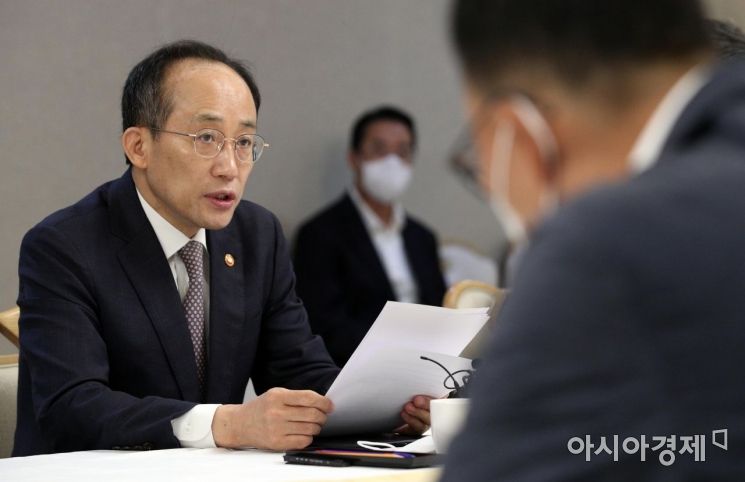 Deputy Prime Minister and Minister of Economy and Finance Choo Kyung-ho is presiding over the full meeting of the Public Institution Management Committee held at the Government Seoul Office in Jongno-gu, Seoul, on the 23rd. Photo by Kim Hyun-min kimhyun81@
The government has expressed serious concerns about household debt and urged caution regarding interest rate hikes. On the 25th, Deputy Prime Minister and Minister of Economy and Finance Choo Kyung-ho stated on KBS's 'Sunday Diagnosis' that "there are voices calling for interest rate hikes to control inflation and stabilize the exchange rate, but there are also concerns about the increasing burden on the economy and borrowers," adding, "There is a serious dilemma in how to balance these two issues."
He continued, "If the interest rate gap with the U.S. widens too much, it could cause instability in the foreign exchange and financial markets. However, aggressively following the U.S. would worsen domestic economic issues and household debt problems, causing many borrowers to struggle with interest burdens. South Korea's household debt is among the highest in the world, and the rate of debt increase is six times that of the Organisation for Economic Co-operation and Development (OECD)," he pointed out.
However, he emphasized that the speed and level of interest rate hikes are the central bank's exclusive authority. He said, "The speed and level of interest rate hikes are the central bank's exclusive prerogative, and I believe they will carefully solve the complex equation involving exchange rates, domestic and foreign interest rate differentials, household debt, and the economy."
© The Asia Business Daily(www.asiae.co.kr). All rights reserved.


















