UNESCO Global Geopark Evaluators Conduct On-Site Inspection of 20 Representative Geological Sites in Busan from 26 to 30
Final Certification Decision to Be Made in April Next Year Following UNESCO Global Geopark Council Review This December
[Asia Economy Yeongnam Reporting Headquarters Reporter Dongguk Lee] The Busan Metropolitan City announced that an on-site inspection for UNESCO Global Geopark certification will be conducted over five days from September 26 to 30.
UNESCO Global Geoparks are one of the three major protection systems designated by UNESCO, along with World Natural Heritage and Biosphere Reserves.
The purpose is to conserve areas with geomorphological and geological heritage as well as ecological, historical, and cultural values, while utilizing them for research and education. It also aims to promote sustainable regional development by operating geotourism, which is tourism that leverages natural landforms and geological heritage.
Currently, 177 geoparks operate across 46 countries worldwide.
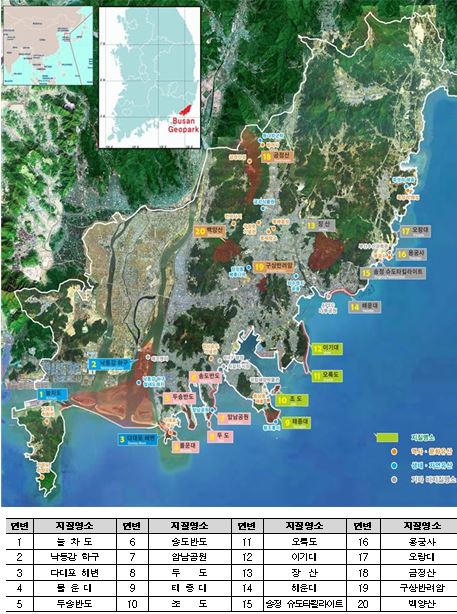
This follows Busan’s submission of an application for UNESCO certification last September to be recognized as a UNESCO Global Geopark, including 20 representative geological sites located in the 1 River, 3 Mountains, and 7 Major Regions, which also include sites certified as national geoparks.
The 20 nominated UNESCO Global Geopark sites are Nulchado Island, Nakdong River Estuary, Dadaepo Beach, Molundae, Dusong Peninsula, Dudo Island, Amnam Park, Songdo Peninsula, Taejongdae, Jodo Island, Oryukdo Islands, Igidae, Haeundae, Songjeong, Pseudotachylite, Yonggungsa Temple, Orangdae, Jangsan Mountain, Geumjeongsan Mountain, Baekyangsan Mountain, and Gusaeng Banryeoam.
For the on-site inspection, the UNESCO Global Geopark Council will visit Busan to directly verify and investigate the geological value and management status of the 20 representative geological sites.
The on-site inspection panel includes Ibrahim Komoo (Malaysia), Vice Chair of the Asia Pacific Geoparks Network (APGN), and Woloszyn Jagoda (Poland).
During the five-day inspection, the panel will conduct academic evaluations of geological sites such as the Nakdong River Estuary, Songdo Peninsula, Taejongdae, Oryukdo Islands, Igidae, Haeundae, and Geumjeongsan Mountain. They will also visit partner companies (Geo Partners), Geo Village, and related organizations to assess the positive impacts on the local economy and cultural heritage, as well as the overall capacity and potential for future heritage management.
After the on-site inspection, the results will be reviewed by the UNESCO Global Geopark Council in December this year, and the final certification decision will be made at the UNESCO Executive Board meeting held at UNESCO headquarters in France in April next year.
Since being certified as a national geopark in 2013 for 12 major geological sites including the Nakdong River Estuary, Taejongdae, Igidae, Geumjeongsan Mountain, and Gusaeng Banryeoam, the city has trained and deployed 23 geological park guides to operate geological park interpretation programs for elementary, middle, and high school students as well as the general public.
Busan has actively operated and promoted the geopark by collaborating with businesses within the geopark such as the Songdo Marine Cable Car and Geumjeongsanseong Makgeolli, making various efforts toward UNESCO Global Geopark certification.
In South Korea, Jeju, Cheongsong, Mudeungsan Mountain, and Hantangang River have been certified as UNESCO Global Geoparks.
If Busan succeeds in obtaining the Global Geopark certification this time, it will not only be a good example of a UNESCO Global Geopark within a metropolitan city but is also expected to create a synergistic effect with the International Geological Congress (IGC 2024) to be held in Busan in 2024.
The city aims to widely promote the appeal of an urban geopark with excellent accessibility using Busan’s urban infrastructure as a ‘15-minute city’ global hub, along with its natural scenery, geological heritage, and trails, establishing it as a world-renowned destination.
Busan has already been selected as the host city for the 2024 International Geological Congress (IGC 2024), held every four years. The IGC is the largest international academic event in the field of geology, with about 6,000 participants including geological experts, government officials, and NGO representatives from over 120 countries.
Lee Geun-hee, Director of the Environmental Policy Office of Busan City, said, “We will do our best to prepare for the inspection so that Busan’s outstanding natural scenery and geological sites can be continuously discovered and become a successful model of a metropolitan global geopark.” He added, “We ask for the citizens’ great interest and support for the UNESCO Global Geopark certification so that Busan, where nature, history, and culture harmonize, can be reborn as a new tourist attraction.”
© The Asia Business Daily(www.asiae.co.kr). All rights reserved.
![Clutching a Stolen Dior Bag, Saying "I Hate Being Poor but Real"... The Grotesque Con of a "Human Knockoff" [Slate]](https://cwcontent.asiae.co.kr/asiaresize/183/2026021902243444107_1771435474.jpg)











