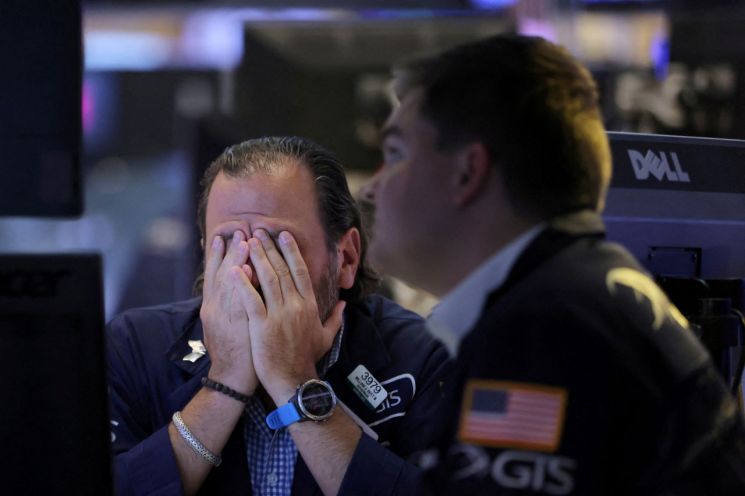
[Asia Economy New York=Special Correspondent Joselgina] As recession fears triggered by the U.S. Federal Reserve (Fed) grow, Wall Street is gripped by fears that the New York stock market, which has already fallen double digits this year, could decline further. With Federal Reserve Bank presidents expected to deliver a series of hawkish remarks this week, major investment banks including Goldman Sachs have lowered their year-end forecasts for the S&P 500 index.
◆"It will fall further" - Why is pessimism sweeping the market?
Due to the impact of interest rate hikes, a strong dollar, and a sharp rise in Treasury yields, the New York stock market closed lower last week and entered the final week of September trading on Monday the 26th (local time). Economic media CNBC reported, "The New York stock market is preparing to test its lows in the last week of September."
This pessimism in the stock market stems from the judgment that global economic uncertainty has increased further due to simultaneous interest rate hikes by major countries following the Fed’s clear message that it is willing to endure pain to curb soaring inflation. The recent sharp rise in Treasury yields has also been pointed out as a factor that increases downward pressure on the stock market. The S&P 500 index, a representative of the New York stock market, has already entered a bear market this year, down about 23% from its peak due to the Fed’s aggressive tightening.
Bank of America (BoA) forecasted that the large-cap-focused S&P 500 index could fall to around 3022 by the end of this year, which is more than 18% lower than the closing price on the 23rd (3693.23). Michael Hartnett, BoA’s Chief Investment Strategist, analyzed, "The Fed’s tightening is pushing bond yields higher, which could cause the stock market to fall further." According to BoA, their proprietary index has already fallen to its lowest level, and outflows from equity and bond funds continue.
Goldman Sachs also lowered its year-end forecast for the S&P 500 index from 4300 to around 3600, a 16% cut. Goldman Sachs stated, "Most investors believe a hard landing is inevitable," and "there are no signs of inflation easing in the short term." They also estimated that as interest rates rise to 4.50-4.75% by February next year, the S&P 500 index could drop to 3150 due to decreased corporate earnings. Earlier, UBS also lowered its year-end forecast for the S&P 500 index from 4150 to 4000.
Sam Stovall, Chief Investment Strategist at CFRA, mentioned that during bear markets before recessions since World War II, the S&P 500 index fell an average of 35%, and predicted, "If the June low is broken, the S&P 500 could plunge to around 3200, a 33% drop from the peak." This corresponds to a price-to-earnings ratio of about 14.9 times for the S&P 500. He also explained that investors might have to wait until the first quarter of 2023 to see the final bottom.
Market volatility has also increased again. The Chicago Board Options Exchange (CBOE) Volatility Index (VIX), known as Wall Street’s "fear index," surpassed the 32 level intraday for the first time since June. BMO Wealth Management pointed out, "The uncomfortable decline in the stock market this year does not seem likely to end soon," adding, "The reality is that until inflation eases significantly, the stock market will continue to be overshadowed by large clouds over the coming weeks and months."
Bloomberg reported, "The 'hawkish' Fed shattered investors’ hopes and plunged the stock market into a doom spiral last week," adding, "This has sparked traders’ fears of even greater additional losses."
◆'Buy the dip' strategy failing... "Worst in 91 years"
Given this situation, the 'buy the dip' strategy, which brought success to many investors worldwide after the 2008 global financial crisis, is barely working this year.
The Wall Street Journal (WSJ) reported that as the New York stock market has often declined further without rebounds after sharp drops, individual investors who have engaged in such buying are not seeing gains but only increasing pain.
According to Dow Jones Market Data, the S&P 500 index this year fell an additional average of 1.2% the week following a day when it dropped more than 1%. The additional decline after sharp drops in the S&P 500 index is the largest in 91 years since 1931.
WSJ stated, "Rebounds are rare and the downward trend continues, making the buy-the-dip strategy more painful," but added, "Nevertheless, many individual investors still hope for long-term gains and continue to pursue the buy-the-dip strategy."
◆Hawkish remarks expected... Continued rate hikes by major countries
This week, key inflation indicators watched by the Fed, such as the U.S. August core PCE index and the University of Michigan consumer sentiment index, will be released. The core PCE inflation rate, which had shown a mild downward trend recently, is expected to rebound from 4.6% last month to around 4.8% this time. This could further heighten inflation concerns. The final U.S. Q2 GDP figure will also be released on the 29th.
Numerous public remarks by Fed officials are also scheduled. In addition to Fed Chair Jerome Powell attending the Banque de France conference, Vice Chair Lael Brainard, New York Fed President John Williams, Cleveland Fed President Loretta Mester, Chicago Fed President Charles Evans, Atlanta Fed President Raphael Bostic, and St. Louis Fed President James Bullard will also speak.
At this event, remarks on inflation concerns, the magnitude of rate hikes in November and December, next year’s path, and economic growth forecasts are expected to be delivered, which will likely increase stock market volatility further.
President Bostic appeared on CBS and, when asked about the possibility of a soft landing for the U.S. economy, said, "It will be difficult. It won’t be easy." He reaffirmed the tightening policy, stating, "The Fed will do everything it can to avoid deep pain." However, he added, "I believe the economy has the ability to accept our measures (tightening) and slow down relatively orderly."
Monetary policy meetings are also scheduled in India, Mexico, and Thailand. Following last week’s simultaneous rate decisions by the Fed and about ten other central banks, these countries are also likely to raise rates.
Additionally, the strong dollar trend is expected to continue. The soaring value of the dollar due to Fed tightening is also cited as a major threat to the global economy. As differences in monetary policy stances with countries like Japan and China become more pronounced, weakness in the yen and yuan against the dollar is intensifying. This not only fuels global economic concerns but also inevitably leads to reduced overseas earnings for major companies due to the strong dollar.
© The Asia Business Daily(www.asiae.co.kr). All rights reserved.