Over 1,000 'Honeybee Stops' to Be Installed in London City Center
Bus Stop Roofs Turned into Gardens to Serve as Insect Habitats
"Preventing Honeybee Population Decline and Helping During Summer Heatwaves"
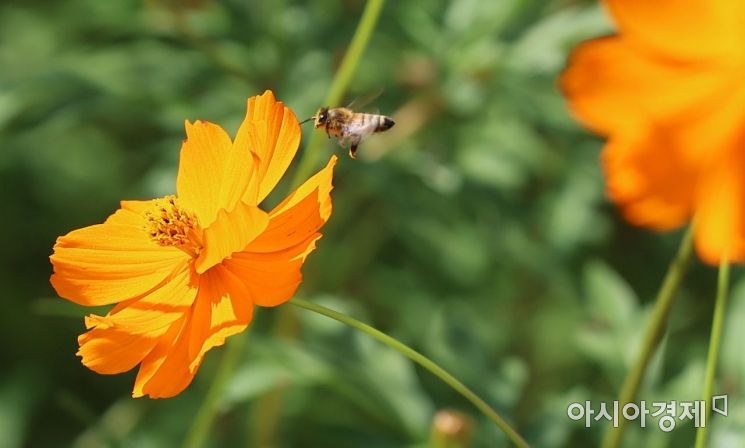 On the 25th, a honeybee is diligently collecting nectar from the fully bloomed yellow cosmos at Olympic Park in Songpa-gu, Seoul. Photo by Dongju Yoon doso7@
[Asia Economy Reporter Hwang Sumi] There appears to be a growing movement across Europe to install gardens for honeybees at bus stops. It is said that this can help prevent the rapid decline in honeybee populations and also cool down the hot temperatures at bus stops during the summer.
According to The Guardian on the 25th, Clear Channel, a multinational outdoor advertising company, plans to create more than 1,000 honeybee gardens across the UK.
This involves planting vegetation on the roofs of existing bus stops to create a single garden. These gardens first appeared in Utrecht, Netherlands, in 2018 and have recently spread throughout Europe, Canada, and Australia.
The company plans to install gardens on bus stops that have exceeded their average lifespan of 20 years and require replacement. Since water accumulation in the garden soil adds significant weight, a sturdier roof replacement is necessary. The roofs are mainly planted with native plants such as wild poppies and thyme that grow in the local area.
These bus stops are expected to help protect insects like honeybees and butterflies and maintain their populations. In the Netherlands, where such bus stops have already been introduced in urban areas, a study released last year showed that the decades-long decline in bee populations has stabilized.
They also have the effect of cooling down the extreme heat at bus stops during summer. The gardens absorb runoff rainwater and help prevent the urban heat island effect, where urban areas have higher temperatures than suburban areas. Garden maintenance is not very burdensome; according to The Guardian, aside from weeding about twice a year, little upkeep is needed.
A company representative emphasized, "Introducing these bus stops properly requires a lot of time, effort, and planning," but added that the small gardens created in the city will allow us to feel much more.
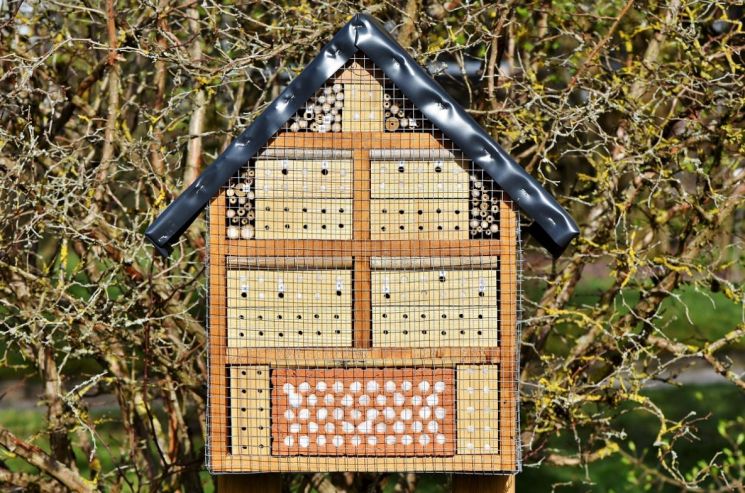
Meanwhile, according to the United Nations Food and Agriculture Organization, 71 out of the world's top 100 crops bear fruit thanks to honeybees. From crops on our tables to livestock feed, production relies on the help of honeybees. Since so many living things depend on honeybees, they are essential to ecosystem circulation.
However, the decline in honeybee populations is alarming. Since the 2010s, about 40% of honeybees have rapidly decreased worldwide, including in the US and Europe. According to the Ministry of Agriculture, Food and Rural Affairs in April, approximately 7.8 billion managed honeybees died in South Korea during last winter alone. This means 17.2% of the 2.2 million beehives nationwide disappeared.
© The Asia Business Daily(www.asiae.co.kr). All rights reserved.
![Clutching a Stolen Dior Bag, Saying "I Hate Being Poor but Real"... The Grotesque Con of a "Human Knockoff" [Slate]](https://cwcontent.asiae.co.kr/asiaresize/183/2026021902243444107_1771435474.jpg)

















